You know you're getting old when thirty years doesn't seem like such a long time anymore. Two things last week reminded me of Chicago in the late 70s and early 80s. Cleaning my desk at work, I came across a set of slides that I shot in the Loop while I was still in school, around 1978. Then the other day we watched at my son's request, the movie
The Blues Brothers which was shot in Chicago and its environs in 1979.
 |
| State Street in 1978 looking not entirely different than it does today as opposed to... |
 |
| ...this view two blocks to the north. None of it survives, least of all the red AMC Gremlin |
It's funny how you can look at pictures of the place you live from many years ago and be surprised at how much is still around, then look at other pictures from not so long ago, and be amazed at how much has changed. You're surprised at the things that have changed right under your nose while at the same time you're amazed that the world you inhabit isn't significantly different from the world that existed before you.
That said, a lot has indeed changed in the last thirty years.
When the movie
The Blues Brothers was released in June of 1980:
- The Cold War was very much alive and Apartheid was still the law of the land in South Africa.
- The words Chernobyl and AIDS meant nothing to most of the world.
- Jimmy Carter was the President of the United States and American hostages were being held at the American Embassy in Tehran.
And in Chicago:
- Jane Byrne was mayor.
- Long time Chicago institutions that were still around included Stop & Shop, the Berghoff, Maxwell Street, the original Bozo, and Marshall Fields.
- Chicago would not have a main branch of its public library for another ten years.
- Icons that had not yet made their way to Chicago included The State of Illinois Building (aka the Thompson Center), Oprah Winfrey, The Smurfit/Stone Building and Michael Jordan.
- Chicago was still the second most populous city in the United States.
 |
| Publicity still for the film The Blues Brothers (photographer unknown) |
By most accounts, Chicago, despite the current economic downturn, is in better shape today than it was thirty years ago. Like most comparable cities across the country, it experienced a decrease in population between the 1950s and the 1990s. In 1980 many Chicago neighborhoods were in decline while few were on the upswing. During the decade of the 1980s, Chicago would lose tens of thousands of jobs, mostly related to the steel and automobile industries. It was just a bad time for American cities, and probably the nadir for this one.
Things got so bad in the Loop that they decided to rip apart the thoroughfare that was once the heart of the city, and turn it into a gulp, mall. "It seemed like a good idea at the time..." was the mantra among people who attended the ground breaking ceremony which marked the demise of the State Street Mall in 1996.
As bad as things were in 1980, there were still vestiges of the old city that would soon vanish forever.
 |
| Times Square in miniature, Randolph Street c. 1977 |
There's a shot in the
Blues Brothers that follows the title characters as they drive west on Randolph Street. You see what was once the most vibrant street in Chicago, lit up like a little Times Square. There's the old Trailways Bus terminal with its enormous neon and incandescent sign (I wonder what ever happened to it), next door to Davidson's Bakery, a place we often frequented after our visits to Fields across the street. Then there's the old Walgreens that was replaced by, you guessed it, a new Walgreens. On the other side of State Street was a building covered with neon including the unforgettable Magikist (Kiss of Beauty) signs, miniature versions of the ones that graced the expressways until about 20 years ago. Also visible was a scrolling message sign that once displayed news headlines. Beyond that was the great theater district, the Oriental, the United Artists, the Woods, and the Bismark, along with a variety of restaurants, shops and night clubs, and the Greyhound Bus Station to boot, all lit up for one of the last times, if only for the cameras.
I saw
The Blues Brothers back when it was first released. My most distinct memories are the amazing performances from musical legends, all but one of them gone: Cab Calloway, Aretha Franklin, James Brown, Ray Charles, Pinetop Perkins, Big Walter Horton, and John Lee Hooker, as well as many great session musicians, including the recently departed bassist Donald "Duck" Dunn. Dunn has one of the most memorable lines in the very quotable movie:
We had a band powerful enough to turn goat piss into gasoline.
With the exception of Chaka Kahn who has a cameo appearance as a member of the choir in "Reverend" James Brown's church, few of the musicians in the movie have close ties to Chicago. It hardly matters, those musical bits alone are worth the price of admission. The rest of the movie is an endless string of slapstick; car chases, a nun armed with a yardstick, and several scenes where a character played by Carrie Fisher tries unsuccessfully to destroy the title characters in comic book fashion by progressively more drastic means that would make Wile E. Coyote proud.
When I saw the film for the first time I was also impressed to see a feature movie shot in Chicago. During the reign of Mayor Richard J. Daley who died in 1976, very few studio movies were shot here as supposedly the mayor was afraid Hollywood would portray his city negatively. That all changed under the Byrne administration which promoted film making in the city with a vengeance. Dan Aykroyd who wrote the screenplay (along with the director John Landis), and who played Elwood Blues, stated many years later that the movie was made to be a tribute to Chicago. It certainly was. Perhaps no major studio movie before or since has shown more of this city, from its rough and tumble rust belt industrial landscape, to its tony suburbs, and everything in between. The only thing missing are the familiar shots of the Michigan Avenue skyline. There is no question that the City of Chicago is one of the stars of the film.
 |
| Washington Station of the State Street Subway showing old signage and retired 6000 series cars |
Looking at
The Blues Brothers today is like looking into a time machine. In addition to the shot of an unrecognizable Randolph Street, there are also shots under the L on Van Buren Street where Elwood Blues lived in a tiny room in a flop house, that is before it was blown up by Carrie Fisher. Elwood's room was on the same level as the L tracks, and the old 6000 series CTA cars rumbled by one after the other, a few feet from the window, as Elwood's brother "Joliet" Jake, played by John Belushi, tried to get some sleep. "How often does that train go by?" Jake asks. "So often that you won't even notice it."
 |
The Dill Pickle on Van Buren before it was blown up by
Carrie Fisher, then removed forever to make way for a small park
across from the Harold Washington Library |
The storefronts on the street included a real diner called the Dill Pickle Pub (also blown up in the movie), several colorful, if less than "respectable" bars, a pawnshop that I believe was invented for the movie, and what was once the best hardware store in the city, Stebbins, which was across the street and not visible in the film. All that is gone now, replaced by respectability in the form of bland contemporary office buildings, a small park, and the Harold Washington Public Library. But back in 1980, Van Buren Street looked much the same as it had for decades, that is to say, right out of a Berenice Abbot photograph of New York in the thirties. Today, most of that character is lost.
At no single point in Chicago's history has the essence and character of the city been lost more than during the wholesale destruction of Maxwell Street on the near south side. One of Chicago's most storied neighborhoods, Maxwell Street was the historical port of entry for many groups of immigrants, most notably Jews from Eastern Europe in the early 20th Century and later, African Americans from the Mississippi Delta. The open air market that developed throughout the area was a fixture of the city until the late nineties when the entire district was taken over by the University of Illinois at Chicago, who after many years of trying, completely leveled the place, save for a few distinctive facades of commercial buildings on Halsted Street.
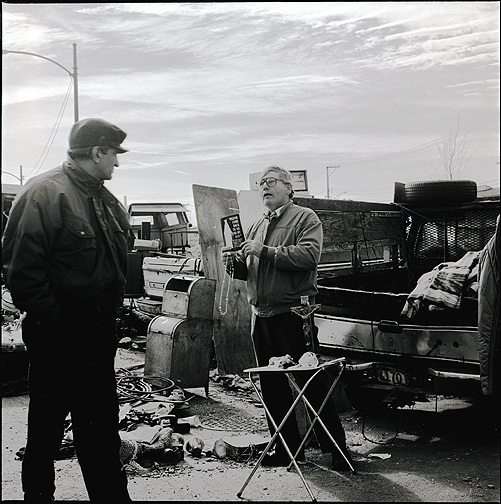 |
| Street preacher, Maxwell Street, 1993 |
Here's a short piece I wrote about Maxwell Street several years ago, and
here is a link to a site with photographs I made in 1993, not very long before it would all be gone. As you can see, there's nothing in the piece or the photographs that's at all sentimental about the place. It was not pretty, comfortable, or nice; it could be brutal at times, especially on days other than Sunday when the market was open. You wouldn't want to bring a girl there on your first date. Nor would you want to bring your mother, at least not my mother.
Yet it was an integral part of the fabric of the city, and even though a sanitized version of the market still exists just a few blocks to the east, Chicago lost a part of its soul when UIC took over the old neighborhood. John Landis captured part of that spirit in
The Blues Brothers in the scene where Blues giants John Lee Hooker, Big Walter Horton and Pinetop Perkins perform Hooker's "Boom Boom" on the street in front of the real Nate's Deli, which in the movie is a joint called simply "Soul Food Diner", and owned by the character played by Aretha Franklin. Of all the scenes in this fantasy movie, this one was the most true to life.
There are of course many recognizable landmarks in the movie that still exist such as the Chicago Skyway and moveable bridges over the Calumet River on the far southeast side of the city in the neighborhood of Eastside, (visible in the publicity photo above), the South Shore Country Club in the community of the same name, and the former Shoenhofen Brewery in Pilsen by Richard E. Schmidt, Chicago's most beautiful industrial building. It's to the film makers' credit that they chose to use these often overlooked buildings and structures.
During the climatic car chase at the end of the movie, you get to see much of the skyline and the Loop. It's striking if you know the city today, how many familiar buildings are missing as they hadn't yet been built. Still new buildings in 1980, the Sears Tower, the AON (Standard Oil Building as it was known then), the First National (now Chase) Bank Building and the John Hancock Building stand out as lone giants among buildings less than half their height.
As Jake and Elwood approach their ultimate destination, the County Building, they drive through Daley Plaza right in front of the Picasso. That view is exactly the same as it was thirty years ago. But directly across Dearborn Street to the east, stood an entire square block of buildings (known as Block 37), that was foolishly destroyed in the late eighties to make way for a project that never developed. Two remarkable buildings were lost in that act of vandalism, the 17 story
Unity Building built in 1892, and one of the handful of extant buildings in the Loop built just after the Chicago Fire, the McCarthy Block. There were many other notable buildings on that block including an early Louis Sullivan work, The Springer Building, the United Artists and Roosevelt Theaters, and 16 W. Washington, the skyscraper whose ground floor and basement were the home of the above mentioned epicurean delight, Stop & Shop.
 |
| The late, great Stop & Shop |
Block 37 would stand empty, a vacant lot in the middle of the heart of the city for more than ten years. It didn't go completely unused as in the summertime it was the site of children's arts camps and in the winter, an ice skating rink. Embarrassing to the city as the vacant lot was, the building that ultimately replaced it, a mixed use piece of insignificant junk, is much worse.
Here in a nutshell is a timeline of the infamous Block 37 boondoggle, which you will soon find out if you read the link, continues to play out to this day.
 |
Some of the long lost ambience of Block 37. Notice the shopping bag the woman is carrying.
Long time Chicagoans will recognize it as coming from the chain of supermarkets, Hillman's,
which had a store a few feet away, in the basement next door to Stop & Shop. |
Barely visible in the movie, just to the north of the County Building, stood the last home of the famous Sherman House Hotel. The hotel, one of Chicago's premier hotels for 100 years, closed its doors for good in the seventies but the building stood vacant until 1983 when it was leveled to make way for the State of Illinois office building, now known as The James R. Thompson Center.
As I mentioned above, much of the Chicago that I knew as a boy was still around in 1980, but it would not be for long. Thinking back to my life back then as a new adult with the whole world opening up before me, sometimes it seems like just yesterday.
The pictures prove otherwise.
CODA
Seeing The Blues Brothers for the first time in over thirty years, I figured out what bugged me the most about the film in the first place. Being a stickler for continuity, something that always annoyed me about films made in places I knew was when locations didn't make sense, for instance when a character walks down a particular street, turns a corner, and is in a completely different part of town. Today older and wiser, as well as having since made films and videos on a very small scale, I understand the logic behind such trickery.
 |
| One of the establishments lost when Van Buren Street went respectable. |
The Blues Brothers is filled with continuity issues which I now find to be amusing rather than annoying. In some cases the film makers seem to have exploited rather than disguised them. There are way too many worth pointing out, but the real doosey happens during that final car chase. After Jake and Elwood successfully evade what seems to be the entire Illinois State Police and Chicago Police Department put together, they are pursued by a small group of Nazis driving a red Ford Pinto and a station wagon. The chase takes them through the streets of the West Loop and onto the expressway, which is entirely plausible. But there's something strange about the expressway, it doesn't look familiar. It took me a few seconds to figure it out thirty years ago, but seeing the highway directional sign that said "Chicago" gave away without a doubt that they weren't in Chicago anymore. No, the boys didn't turn onto Chicago's famous Spaghetti Bowl interchange as you'd expect, but were for a brief time on the equally convoluted highway interchange just outside of Downtown Milwaukee! I understand why they used that particular stretch of road, there was construction going on up there at the time, featuring a ramp that abruptly ended into thin air. Given the nature of the chase scenes in the film, I'm sure this was too good to be true for the film makers who utilized it by having the Bluesmobile screeching to a halt just in the nick of time before going over the edge. The Nazis, unfortunately for them, were not so lucky and went over the edge.
The film makers could have easily gotten the shot without revealing its location. But they didn't. Clear as day in the background is Milwaukee's tallest building, the First Wisconsin Center (now the U.S. Bank Center).
 |
Pre-mall State Street with the famous Magikist Lips sign
and the State Lake Theater in the background. |
Now they could have just been sloppy, figuring no one would notice, or they could have simply not cared. My guess is they did it for comedic effect or as an inside joke. The next shot shows the Pinto in free fall, back in Chicago with the Hancock Building in the background. The car is at least 500 feet in the air, while the expressway ramp they flew off of couldn't have been more than 20 feet off the ground. The car lands cartoon style in the middle of a street creating a gaping hole, can't tell you exactly where but to me it looks more like Milwaukee than Chicago. More than likely however it was shot at the studio in Hollywood.
Oh, one last thing if you see the movie
The Blues Brothers. Jake and Elwood's mentor Curtis, played by the great Cab Calloway, is forced to delay the crowd before their big performance, while the boys have to sneak into the theater, evading cops, and the rest of the folks who are after them. He asks the Blues Brothers Band if they know (what else?)
Minnie the Moocher. As they break into the opening notes of the song, Cab is magically transformed from his black suit, fedora, and sun glasses, into his trademark white tie and white tails, while the band and the stage are likewise transformed into something that would fit right in with the Cotton Club c.1930. Check out the faces of the band as they back up the Hi-di-ho man. You can tell they are not acting, they're having the time of their lives.
Good times.


 ,
,