Showing posts with label Photography. Show all posts

Sunday, May 19, 2024

Time Stays, We Go

I just finished working on a remarkable set of photographs. They are the group of 48 portraits known collectively as The Brown Sisters, technically the work of Nicholas Nixon. I use that qualification because it would be remiss not to mention that all like all portrait photography, this group perhaps more then most, is the collaborative work of the photographer and his subject, in this case the photographer's wife Bibi Brown Nixon, and her three sisters, Heather, Mimi and Laurie.  

The photographs, one per year of the four women together, without break, span the years 1975 through 2022. 

I have heard it said it was the sisters who decided in 2022 to bring an end to the series, as they did not want the project to conclude with the death of one of them. 

Therefore, the collection of photographs currently displayed on the walls of The Art Institute of Chicago, is the complete, definitive set.  

Matting and framing these pictures inspired me to contemplate the inevitable; that is, all of us lucky enough to have been given the chance to live through many decades, have also been given the opportunity to grow old. 

It shouldn't come as a surprise that like many people, I feel a little ambivalent about that.

In an interview, Nick Nixon observed that we are all aware of the passage of time, at least from a philosophical standpoint. However, in the day-to-day course of living our lives, we haven't a clue.

I might add, that is until we see a recent photograph of ourselves.

It was a little jarring to see these pictures all together for the first time as the Brown sisters are my contemporaries, the three oldest and I were born in the same decade. I fall in age between Laurie, the third sister, and Mimi, the youngest who was born in 1960. 

I first became aware of this project when I was a student of photography back in the late seventies. The first two photographs were published in a book that accompanied an exhibition at the Museum of Modern Art in New York called Mirrors and Windows: American Photography Since 1960. The book was written, and the show assembled in 1978 by the influential curator of photography, John Szarkowski. It was one of the first books on photography I bought.

Szarkowski, as much a taste maker as anyone in the history of the medium, championed among others, street photographers such as Robert Frank, Garry Winogrand, Lee Friedlander, and William Eggleston, all of whose work displayed a cool, dispassionate view of the world. I'm leaving out perhaps the most famous of the group, Diane Arbus, who was an outlier among them in that respect as her work was anything but cold and dispassionate. Incidentally one of her pictures graces the cover of Szarkowski's book.

There is a certain coolness to those early iterations of The Brown Sisters as well. which makes them fit in with much of the spirit of Mirrors and Windows. Not your typical family photographs, in the first five pictures of the series, Nixon stood the sisters in a row in front of his 8 x 10" view camera much as if they were in a police lineup, sporting expressions to match. 

That changed abruptly in the 1980 entry where the eldest sister Bibi, has both arms wrapped around Laurie to her left. In turn, Laurie, who up to this point appeared to be the most aloof of the four, places her left hand tenderly around the forearm of her older sister. In this portrait, for the first time Nixon moves his camera in on his subjects so they fill the entire frame. Instead of lining up equidistant from the lens, the sisters overlap one another, each at a slightly different distance from the camera. All four gaze into the lens intently as they had not before, and even a trace of a smile can be seen on each of their faces. In this, perhaps the most intimate portrait of the entire series, it seems the sisters have finally become one with the project.

With work like this I think it's best not to know too much of the backstory, allowing the photographs to speak for themselves. What I will say is that Nixon would make about ten exposures every session and allow the sisters to decide which image would represent the group. I also know the sisters allowed the photographer one major concession, that is to keep the order in which they appear in the photographs consistent throughout the series. 

So, from left to right we have Heather, Mimi, Bibi and finally Laurie. The only time that formula was broken was the 2020 entry, the year of the Pandemic, when it wasn't possible for the four to get together in one place. Instead, each sister's image is taken off the computer screen and arranged in a grid, Zoom style, on the photo negative used to make the prints.

While imposing the order of the subjects seems contrived, it works as keeping simple things like that consistent, makes everything else all the more apparent.

Whether they be family photo albums or published photos of celebrities, we've all seen photographs taken over a period of years that document people growing older. It took me a while to figure out what separates this series from other photographic records of aging. 

Then it came to me.

Generally speaking, photographs that span a person's life are made with a variety of equipment common at the time, lighting, printing materials, and most important, the photographers themselves. On top of that, fashions change usually making it easy to date a picture by what the subject is wearing, their hairstyle, and even their pose, styles of which vary over the years. 

Consequently, old photographs by their nature tend to look old on their own, so when we typically see a picture of someone made say, fifty years ago, by nature we expect them to appear different than they do today.

None of that is true here.

In the Brown Sisters series, besides the consistent positioning of his subjects, Nixon uses the same camera, film stock, processing, and printing technique throughout the project. As the prints are made to archival standards unlike prints we typically see in a photo album, the nearly fifty-year old vintage prints in this series show no signs of deterioration such as stains or fading; they look no different than the ones made practically yesterday.

Despite a few fashion accessories such as the appearance of an alligator logo stiched onto a polo shirt, or a flip phone holster that scream a particular decade, there are few hints that place these photographs in any specific time.

The only thing that dates them are the sisters.

Which makes the aging of Heather, Mimi, Bebe and Laurie all the more stunning.

If this project were only about aging, we'd look at it for a few moments, say how interesting, then move on. What makes this work so compelling and memorable is that it is the story of the dynamics of one family, of the bonds that holds its members together, of more general themes such as love, kinship and forgiveness, and in the end, of the medium of photography itself, its possibilities and its drawbacks.

It takes an extraordinary group of people to pull off a project like this. The fact that all four sisters showed up together to participate in this project every year for nearly fifty years is nothing short of remarkable.

What's the big deal, you may ask, they're family after all. 

My point exactly.

Nixon claims that being an only child attracted him to the idea of exploring the relationships of a large family. I can relate having been raised as an only child, (I hadn't met my half-sister Eva until I was an adult.)

As such I've been particularly interested in the dynamics of big families and can honestly say that for of the vast majority of large families I've known intimately, including those of two wives and my own extended family, the mere act of gathering every sibling together in the same place, every year for forty-eight consecutive years, would by itself have been a non-starter. Even more remarkable is subjecting each family member to being photographed together in a photographic format that requires a good deal of patience, and is less than forgiving, especially to those of us beyond a certain age.

All it would take would be one individual, driven by some conflict, either petty or otherwise saying "no, not this year", to grind the whole thing to a halt.

One other piece of backstory I'll share is that in 2018, Nixon abruptly retired from his long-held post as professor at the Massachusetts College of Art and Design after allegations surfaced of inappropriate behavior with his students, thereby "violating Title IX, the federal law that prohibits discrimination on the basis of gender." I'll let you fill in the sordid details yourself.

One can imagine that if anything would have put an end to the project, perhaps even the Nixons' marriage, that might have been it. Nonetheless, the group of five got together to create four more entries after that episode.

As I mentioned above, the project really took off after that 1980 photograph when the four sisters appear to have taken over the reins of the project. From that point on, the poses vary, the women relate to one another differently, and the expressions change from photograph to photograph.  

It's tempting to attribute personalities to each of the sisters, even though we know them only superficially through their portraits. For me, through their facial expressions and body language, Heather appears the most vulnerable of the four while Laurie seems the most independent. Bibi the eldest seems to be the most loving and caring, as one might expect. Mimi the youngest, is the hardest to pin down as her appearance changes the most throughout the series. In the first few pictures she was still an adolescent and looked the part. In one photograph she sports a punk haircut, in another she is pregnant, the only obvious appearance of fertility in the entire series. But as the youngest, she does seem to be the object of the most attention from the other three. 

Of course I could be dead wrong in those assumptions. Part of that is a result of the imposition of the consistent order in which the sisters appear in each photograph. The two middle sisters in age are placed at either end of the group resulting in their inability to be in physical contact with each another. This makes them appear to be the most distant twosome of the group. In the middle, the alpha and the omega of the sisters, Bibi and Mimi by contrast are in close enough proximity to everyone else, to appear more connected to the entire group.

The story told in the pictures isn't complete as no story in photographs can ever be complete. As such The Brown Sisters displays the limitations of the medium of photography as much as the wonder of it.

They say that beauty is only skin deep. If that's true, so is aging. Naturally that applies only in a superficial sense. Non-superficial inner beauty is difficult (but not impossible) to capture in a photograph. In much the same way, a person may physically look old, but their spirit may be as young as that of a teenager. That can come across in photographs as it does here, especially in the case of Bibi, the eldest sister, as demonstrated by the constant gleam in her eye, not to mention perpetually keeping her hair long and flowing, well into her seventies.

What also can be easily conveyed in pictures is the feelings these women have for one another. Unless they are trained actors, which I have no reason to believe they are, the love they share for each other has been apparent in the pictures I'd say from the 1980 iteration until the last picture in the series from 2022.

As I said at the top, this is a remarkable, and I'll add here, life affirming body of work.

The Brown Sisters by Nicholas Nixon and Heather, Mimi, Bebe and Laurie Brown, will be on view at the Art Institute of Chicago until August, 2024.

Wednesday, June 30, 2021

Mad Dogs and Englishmen

Light to a photographer is what paint is to a painter, or a block of clay, wood or marble are to a sculptor. That's why you hear photographers and film makers waxing eloquently about particular types of light as other artists do about the raw materials of their craft. One of the most desirable types of light for many photographers is the natural light that occurs during "The Golden Hour", that is to say, the hour(s) just after dawn and before dusk.  
The long, seductive shadows
of golden hour light

It is at those times when the light from the sun, low in the sky, casts long, dramatic shadows. Filtered through more of the earth's atmosphere than at any other time of day, the quality of the light is relatively low in contrast and provides a warm cast which is especially flattering for portraits. But really everything looks beautiful in golden hour light which is why it's not surprising that many photographers make their images exclusively early in the morning and/or late in the afternoon.

The antithesis of the golden hour is the light found on a cloudless day at noon, particularly around the Summer Solstice when the sun is at its highest point in the sky. From the high angle the sun's light passes through the minimum amount of atmosphere, resulting in high contrast, bluish light. That trifecta of qualities can be a deadly combination. It's unforgiving light that in the wrong hands, can make anything look terrible. 

Which is why to paraphrase Noel Coward, unlike mad dogs and Englishmen, most photographers seldom go out in the midday sun.

But the truth is, while certain types of light are not appropriate for certain situations, there is no such thing as bad light.

I first discovered the magic of high noon summertime light about thirty years ago during a partial solar eclipse. In order to safely observe the rare celestial event, I came prepared with a simple device consisting of a shoe box with a tiny hole poked into one of its sides. This simplest of cameras commonly known as a pinhole camera, works on exactly the same principle as other cameras, just without the fuss of a lens.

In a nutshell, here's how it works:

The very act of seeing and image making are based upon a very simple principle, the fact that bright objects reflect more light than dark objects. Now imagine deconstructing the scene in front of a camera into a grid of tiny squares, each square reflecting a different value of light (and color). Light reflects in all directions from our squares, but as the pinhole is so small, only a tiny portion of light reflected from any one of our image squares will find its way into our pinhole aperture, Once it passes though the aperture, that ray of light then follows a straight line until it hits the back of our shoe box camera, resulting in a tiny speck of light. The more light reflected by our square, the brighter the light speck.

As the light reflected off each image square hits our aperture at a slightly different angle, the light entering into the camera will deposit itself on a different part of the camera back, Now take the light from all those little squares, each one carrying with it the reflectance value of its source and depositing itself faithfully within its unique set of coordinates upon a new grid of points of light on the camera back and VOILA(!), we have projected upon the back of our box camera, a two dimensional image representing the scene in front of the camera.

Now unless we were able to climb into our shoe box camera and close off all outside light except the light entering through the pinhole, it's very difficult to view the image of  most subjects with the naked eye as the pinhole only permits a small amount of light to pass through. Unless that is, the subject happens to be a very bright object, such as the sun.

The problem with the shoe box/pinhole/eclipse viewer is that you have to hold it very precisely and very still in order for the image of the sun to be easily visible on the back of the viewer. Not to mention that you look silly holding a shoe box over your head. 

In no time I chucked my homemade device because I discovered that nature provided a much more efficient pinhole eclipse viewer, the leaves of trees.

We've all seen the shadows of leaves cast by the sun. When leaves are dispersed and enough light passes between them, their shadows are distinct. However when a tree is densely packed with broad leaves such as those found on maple trees, only a small amount of direct sunlight if any passes though, and these tiny holes that allow light to pass work exactly as pinhole apertures. So rather than shadows cast on the ground, what we see in the photograph on the right are live images of the disc of the sun, one for each "pinhole" opening in the leaves. 

During normal times these discs of light on the ground may be mistaken for shadows, but during a solar eclipse, the image of the sun being blocked by the moon is unmistakable, as rather than a disk what we see are crescents of light, the shape of which determined by the amount of sun covered by the moon. In the extremely rare event of a total eclipse, the crescent for a brief moment becomes the familiar ring of light that is the sun's corona we've all seen in photographs of eclipses but few (myself included) have ever seen in person.

It was a discovery for me that day as while I understood the concept of the pinhole, I never thought of it in that particular context. As I was in a public park at the time, I shared my "discovery" with passersby who cared to notice. 

A few years ago during another solar eclipse, once again around noon in the same park and the same time of year, I tried to repeat the experience. Alas, it was a hazy day and while the sun was still visible through the thin cloud cover and still possible to view the eclipse by other means, the stark contrast between the sun and the rest of the sky wasn't enough to produce the pinhole effect through the trees. 

So the recipe for the leaf pinhole effect is a cloudless sky to provide sufficient contrast to be able to see the image, and the sun being high in the sky to produce nearly circular (rather than elongated) images of the sun. In other words, the dreaded summer solstice noon light.

A few weeks ago while walking home from the grocery store, again around noon, near the summer solstice, I became enchanted by these images of the sun as pictured in the second photograph, dancing around the sidewalk due to the wind blowing about the leaves and their "pinhole" apertures.

Since then I haven't stopped looking down, observing and photographing the wonderful array of images produced by nature upon the human made canvas of the sidewalk, during what I once considered the worst light of the day.

And as of a few weeks ago, I've joined ranks with the mad dogs and Englishmen out in the midday sun.


Monday, November 30, 2020

Something Discovered While Looking Up Something Else

Once upon a time there was a fixture in U.S. downtowns usually found near theaters and other high traffic pedestrian areas. They were folks, most always men, who snapped photographs of passersby, then handed them an envelope with a number that corresponded to the negative that was just shot. That was normally the extent of the contact between the photographers and their subjects, in my experience anyway, few if any words were ever exchanged. The hope was that a certain number of subjects would stick money into the envelope, throw it in the mail, then a few weeks later receive a print of the photograph that was taken.

As a child I was the subject of dozens of these photographs made both in Chicago and Milwaukee, but my parents, grandparents, or whichever adult I was with at the time, never took the time to send back the envelope.

It was understandable at the time because many people feel uncomfortable about photographs of themselves, especially caught unawares as most of these subjects were. But it was a shame as well because years after they are made, these photographs, many of which are discovered after spending decades inside a shoebox, become precious artifacts, historic records of people and places often long gone.

I know this to be a fact because at the wake of a dear friend's beloved aunt, one of the photographs displayed was of the two of them walking together hand-in-hand on Chicago's Randolph Street, made perhaps forty years earlier when my friend was about five years old. The woman obviously loved her nephew so much that she not only took the time to send in the money for the keepsake, but also managed to preserve it for the rest of her life.  

The other day as I was searching the web collecting tidbits for my previous post, I came across this post which features photographs taken along Wisconsin Avenue in Downtown Milwaukee, some of them made by these "street photographers" such as this one: 


On its own it's a compelling image of a young couple out on the town. From their attire and hairstyles, one can date the photograph fairly accurately. Someone familiar with the city in that particular time could pinpoint the exact location where it was made.

The young man has a determined look on his face, to me his body language suggests he's in a hurry, maybe they were late for a show. The woman on the other hand looks like she hasn't a care in the world, taking in the sights of what must have been a lovely evening. Or maybe not, not knowing these people we can ascribe all sorts of meaning to this photograph which is one of the joys (and dangers) of the medium of photography. 

But in this case we do have a story. From the blog post, here's Shirley Ann Huberty's account of the photograph of her parents: 
My mom and dad in 1946 taken in Downtown Milwaukee on Wisconsin Ave. In those years they had street photographers that would snap pictures of people walking. After taking the picture they would hand you a piece of paper where you could order the picture. I love this picture of them! My mom was 21 years old here!
Shirley's sister Bonnie adds this:
The picture is of our parents Robert L. Watson and Jeanne S. Stephan. They married in September 1947 and went on to have three daughters, ... five grandchildren and six great-grandchildren. Mom passed away just before Christmas at 95 years. She lived alone in their home after my dad passed in 2008.

In a typical studio photographic portrait, subjects and photographers usually do their utmost to create a flattering "respectable" image, one in which the subject feels best represents him or herself, one in which they'd like to be thought of or remembered. These are the images usually chosen to represent people in yearbooks, annual reports, and in many other sorts of publications, yes including obituaries. In that sense they are not unlike the death masks that used to be made of prominent people.

By contrast, these random street portraits capture the subjects living their lives. They may not always be flattering like this one is, but there is never the artifice of a posed portrait, they are always real, at least real insofar as depicting a split second of a person's life.  

In this photograph lovingly preserved by their family, Robert and Jeanne are alive, forever in their twenties, a young couple in love with most of their lives still in front of them. 

Which only confirms something I've realized for a good long time, photography is truly magic.

Wednesday, November 30, 2016

Photographs of the Month

November 5, Rosehill Cemetery
November 6, Touhy Avenue, Rogers Park

November 10, Pritzker Pavilion

November 17, South Garden, Art Institute of Chicago

November 21, Federal Center

November 15, Potawatomi Park

November 19, Modern Wing, Art Institute of Chicago

November 19, Peoples Gas Building

November 19, Arch from former Stock Exchange Building, Art Institute of Chicago

November 20, South Wabash Avenue

November 20, Auditorium Building, Roosevelt University

November 20, Rooftops, South Wabash Avenue

November 20, South Wabash Avenue

November 20, Union Station

Thursday, March 31, 2016

Photographs of the Month


Not to complain but the two operative words for this month were sick and tired. I caught a tenacious cold three weeks ago which is still hanging around and work deadlines have had their way with me all month. But I still managed to crank out my picture of the day and then some, however less than I would have hoped. As a result of my general malaise, I didn't stray far off my beaten path, but I think it was Aaron Siskind who told his students that if you can't take a good picture in your own backyard, you're not much of a photographer. You be the judge: 

I made some of my best pictures this year between 5 and 6 in the morning while taking my son to his early morning batting practice. I titled this one, "good fences make good neighbors":

March 2, West Ridge

Never able to resist a nice foggy day, on this particular one, the sun broke through the clouds while the fog did its thing. What more could a photographer ask from the photo gods:

March 14, Symphony Center, Santa Fe Building and Metropolitan Tower in fog.

On a brief respite from work, I made this picture of a man emerging from the wall of the Art Institute:

March 17, The Art Institute of Chicago, Michigan Avenue entrance..

I find it hard to photograph when the light doesn't move me. After leaving work on this day completely uninspired, I threw all caution to the wind and got on the train hoping something good would happen. The best light for me is the most challenging, when the sun and clouds are fighting for dominance. Sometimes it's like walking a tightrope, especially when you have only a second or two to get your picture. This one came pretty close to that magic moment but didn't quite get there. Still it's pretty hard to miss from this vantage point:

March 18, Chicago River at Wells Street

One of my favorite stops in the Loop is the Harold Washington Library stop on Van Buren between State Street and Dearborn. The platform is surrounded by nothing but classic Chicago School buildings, this one is the Old Colony Building:

March 22, CTA State and Van Buren Stop, Old Colony Building.

After a long winter, one of the sure signs of spring is the sun's rays shining down the east-west streets of the Loop, here illuminating the entrance of Louis Sullivan's Carson Pirie Scott Building, or if you prefer, the Schlesinger and Mayer Store, or perhaps the insipid Sullivan Center. Whatever you choose to call it, for my money it is hands down, Chicago's greatest building:

March 29, Carson Pirie Scott Building, State Street.

I was enamored of the light when I turned around on the train and snapped this picture. The church in the background is St. Ita, the exquisite High Gothic church designed by Henry Schlacks who also designed the endangered St. Adalbert in Pilsen:

March 29, Brwn Mawr "L" stop.

Trying to take every advantage of my commute, even while standing on the subway, I took this panorama of riders completely engrossed in their devices. So was I needless to say. As soon as I took the picture, I grabbed the empty seat and joined the chorus line :
March 30, Red Line Subway, somewhere under State Street
Happy spring!

Sunday, January 31, 2016

Photographs of the Month

My new year's resolution late last December was to kick-start my photography career which has been all but dormant since my son was born fifteen years ago this Wednesday. So far so good, I've even worked in the darkroom for the fist time in oh, about five years. On New Years Day I resolved to take one picture a day and post it on my Instagram account. The point of that exercise is to instill the discipline of thinking photographically every day and then the hard part, to act upon it. I must say having a smartphone has helped tremendously since I have no excuse not to take at least one picture a day as I always have a camera with me. Again, so far so good.

Now its the end of month one of the new year and I've made another resolution, to post some of my favorite pictures of each month here on the last day of the month. Furthermore they will not be the same images that appeared on my Instagram account, although they may, as is the case with a couple of these images, be alternate shots of the daily images.

Yes I am making up the rules as I go but what the heck, it's my resolution so I can do with it as I please. Let's see how it goes.

Here's my entry for January:

January 1
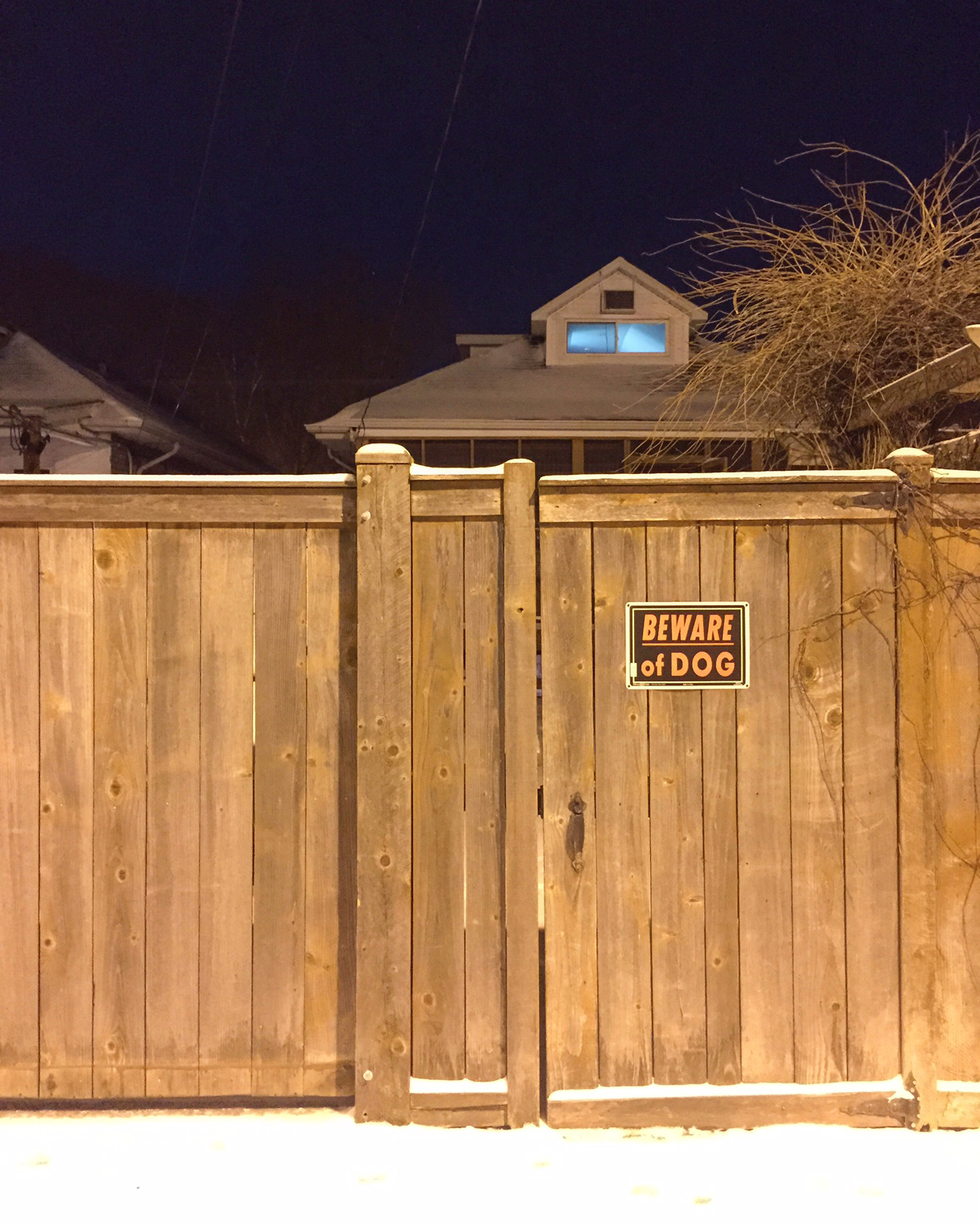
The first day of the year had me out and about testing my new camera. It was a pretty cold day so I stuck close to home and took this picture of a typical Chicago bungalow with a very atypical fence.


January 2
Again testing out the camera, this time in Maggie Daley Park. As with all digital cameras these days, this one is capable of shooting very high quality video. Here's a still image of the Chicago skyline made during a test of the camera's video capabilities.


January 5
Combining urban architecture and the industrial landscape that supports it, I've been a sucker for images of the city such as this one since God knows when. Expect to see more of them.


January 16
Except for the plastic horse and some of the businesses, everything in this picture has been around for a very long time, I just never quite saw it this way until the other day.


January 29
A snapshot I made this time as a passenger in the car. After I saw it, I wanted to crop the photo to straighten it out, which killed all the tension in the picture . This is the un-cropped version.


January 29
A construction site I visited twice this month,I was especially drawn to the white tarps billowing in the wind contrasted against the blue, or in this care, medium gray sky. And finally...


January 30
Lake Michigan looking very tranquil yesterday.

Finally one last resolution, well at least one more thing on my to-do list, was to clean up the web links section in the right column of the page as several of the blogs I've linked to have ceased to update. Some of the those I've decided to keep as their archives alone are notable, including "blogsolomon | Confessions of a Renaissance Hack" written by my late friend Jeremy Pollack. That link will remain on this site as long as this site remains.

Cheers.

Friday, March 6, 2015

My iPhone and I during the evening commute...

So I've had my iPhone for about two months and haven't quite gotten to the point where I feel lost without it, but I'm getting there. There are still a few things I'm fumbling around with, I still haven't mastered the art of typing on the device, especially on a moving train, as being able to write this blog during my daily commute was one of the justifications for getting this thing in the first place.

Another justification was being able to have a camera with me at all times without having to carry around my rather cumbersome gear. Again, taking pictures with my phone at a moment's notice, isn't second nature to me just yet.

But the other night on the way home during a spectacular "sky event" as a good friend would call it, I got inspired...


I posted this image on Facebook and got about 50 likes in a day, I'm guessing it was the sunset. A friend asked if I used any digital manipulation or if I published the image straight from the camera file. I responded merely that the image corresponded more or less to the way I saw the scene at the time, which was in fact, true. Having been a serious photographer since high school, a very long time ago, I know that photographs seldom look the way you see the image in your mind's eye when you take the picture. There are lots of reasons for this but the most obvious one is that a camera and the recording medium, whether it be film or an electronic sensor, do not "see" an image the way our eyes and brain do. Photographers since the advent of the medium over 175 years ago, have understood this and have worked very hard to make their final images look just the way they think they ought to look.

Yet another surreptitious smartphone photograph of
people using smartphones on the train.
In the case of the picture above, there is a great difference between the amount of light coming from the sky and the amount of light reflected by the woman's coat or the tracks. Photographers call this the dynamic range. Photographic media can record a far more limited dynamic range than we can see. When we take a picture, if the range between brightest part of the image and the darkest is too great, compromises have to be made. If we want to preserve detail in the shadow areas, then we have to be willing to lose some detail in the highlights which will be rendered as solid white. Likewise; if we want to preserve details in the highlights, such as the vivid colors in the sky, we have to acccept that the shadow areas will be rendered solid black, unless of course we do something about it.

Back in the day when we shot black and white negatives, we could control the exposure and the development of the film to maximize its potential of producing a suitable print.  Ansel Adams took this technique to its logical extreme when he developed what he called the "Zone System." Then when we made a print in the darkroom, we had the ability to selectively control the amount of dark and light by means of what we call burning (adding more exposure) or dodging, (subtracting exposure), to specific areas of the print. Burning and dodging a print is an art form unto itself; watching the hand gestures of a skilled photographic printer dodging and burning in the darkroom is a truly sight to behold, akin to watching a potter on a wheel or a woodworker on a lathe.

Moonrise, Rogers Park
Alas, as a result of modern technology, this is becoming a lost art as most of the post-production of the photographic images we see today is done on a computer. If prints are made, they are produced on a machine. Today we can digitally control images to a degree that we could only dream about in the old days.

We like to think of photography as a medium that accurately represents reality but the fact is, photographs represent reality no more than paintings or any other kind of visual representation, as the act of framing and recording any three dimensional image onto a two dimensional surface, whether it be film, paper, canvas, or a computer monitor, is by its very nature, artificial.

Moonrise  RP2
Ever since the advent of the revolutionary digital photo editing software Photoshop in 1988. many people have viewed any kind of image manipulation as artificial, and therefore, cheating. Some folks for example, go to the extreme of claiming that the photographs they publish on the social media site Instagram, were made without the benefit of one of that app's many image-altering filters. Somehow they feel this is more pure and honest. But the truth is that every photograph made since the very beginning of the medium has in one way or other been manipulated.

Do photographs lie? Of course they do. Every one of them, to some extent.

All digital technology has done is make the process simpler and more accessible to the general public.

Today, there are apps for smartphones that make it painfully easy to do what once took a skill developed after years of practice in the darkroom to accomplish.

So there's the long winded answer to my friend's question if I used Instagram filters and other digital manipulation techniques on these photographs from the other day. Here's the sort version:

You're damn right I did.

Casa Bonita and Venus (the planet)

Sunday, September 21, 2014

The Ken Burns Effect

A recent posting on Facebook of A Trip Down Market Street, this mesmerizing film of a cable car ride down San Francisco's main drag, brought to mind a couple of things:


If this looks familiar, you've probably seen bits of it used as a device in documentary films that deal with a particular time and place: America at the turn of the last century. Coincidentally, this week PBS has been broadcasting the latest Ken Burns film based upon the lives of Theodore, Franklin and Eleanor Roosevelt. Sure enough, in The Roosevelts: An Intimate History, one of the thousands of clips from hundreds of films Burns uses is a clip from this movie which was actually shot during Teddy Roosevelt's administration. In fact if you look carefully, you can see the clip over and over again as it is used in a promo for the show and one of its sponsors. I'm quite certain that I've seen portions of this film over the years, used in other works of Burns and his contemporaries.

I suspect most people don't immediately recognize the city depicted in the film. As such it could represent virtually any big American city at the turn of the twentieth century, which is why using clips from it is so attractive to contemporary filmmakers. But there is a story behind this particular film that makes it in its own right much more interesting than the documentary films who exploit it simply to establish a time and place.

The film  was produced by four brothers, Harry, Herbert, Earle and Joe, collectively known as the Miles Brothers. It was shot entirely in one take, not a small accomplishment given that the cameraman, Harry Miles, had to hand crank the film traveling through his camera at a consistent rate for the entire thirteen minute cable car ride. Another not so small feat is the fact that the cable car does not come to a complete stop in the entire film. The film is beautifully choreographed as obstacles including folks standing on the tracks playing "chicken", not moving away until the last possible second, and daredevil motorists darting in between oncoming cars can't stop our cable car as it moves inexorably toward its destination, the San Francisco Ferry Building at the intersection of Market and the Embarcadero, the heart of the city.

One of the many interesting aspects of the film is the way it shows the traffic pattern of a major artery in an American city before the time when vehicles powered by the internal combustion engine reigned supreme. The cable car, itself powered by a mechanism gripping onto an underground cable moving at a constant rate of speed, had to compete with electric powered street cars, horse drawn vehicles of all types, pedestrians, bicyclists, and automobiles. When I first saw the movie in its entirety this week, I was surprised by the amount of cars, given that the number of automobiles in the entire United States in the first decade of the twentieth century was less than ten thousand. Turns out I was not off base, according to the 60 Minutes piece you'll find below, the Miles brothers employed local motorists to appear in the film, (in some cases more than once), so the depiction of Market Street traffic c.1906 is a little deceptive.

As you may notice, there are no traffic lights, they wouldn't come around until a decade later. I guess it's debatable whether they could have used them in 1906 as vehicles with different capabilities of speed and maneuverability are forced to compete for right of way while only tacitly adhering to accepted rules of the road. Yet here everybody seems to get along just fine as the top practical speed of the "horseless carriages" on the road at the time was probably not much more than that of a carriage-less horse.

The most remarkable thing about this film is not apparent from a casual viewing. It was originally assumed that A Trip Down Market Street was filmed in October of 1905. Film historian David Kiehn would become obsessed with the movie shot in his home town and by taking note of many visual clues and doing some historical research which is documented in the 60 Minutes piece, determined conclusively that the film was shot in late March or early April of 1906, only a week or two before the catastrophic earthquake that took place on April 18th of that year. In all around 3,000 lives were lost in that earthquake and the ensuing fire, roughly the same number who perished in New York City, Arlington, VA and Shankesville, PA as a result of the terrorist attacks of September 11, 2001,

It's very likely that in a week or two, some of the people who appeared in the film would be dead and half of them would lose their homes. Most of the buildings would be gone. One exception is the Terminal Building visible throughout the entire movie, the ultimate destination of the cable car. The building survived the earthquake and today is still the focal point of Market Street. To all who care about such things, that building not only lives as a memorial to the 1906 tragedy, but also to the 1989 Loma Prieta earthquake which took the lives of dozens motorists who were crushed when the double deck highway they were driving upon collapsed. A similar freeway which once stood immediately in front of the Terminal Building was significantly damaged during that earthquake and shortly thereafter was demolished.

But the building also survived that earthquake intact; it and the film stand today as testaments to a great city and the indefatigable human spirit.


If there is such a thing as an American documentary filmmaker with a household name, it would be Ken Burns. So popular is his work, many people consider his movies to be the final word on the topics he covers. His films which air on PBS, are devoted to American subjects such as the Brooklyn Bridge, Jazz, Baseball, Prohibition, the Civil War, and now of course, the Roosevelts. No matter what subject, Burns's formulaic style does not vary from film to film. In each work, an authoritative voice-over narration moves along the story line supplemented by readings of quotes from correspondence, speeches or text supplied by notable actors, and comments from experts in the field. To set the mood, a soundtrack of period music plays incessantly in the background from beginning to end.

The bulk of Burns's imagery consists of archive film footage and still photographs. Setting a tone, they serve the same purpose as the soundtrack. What little original footage he supplies are images of un-populated historical sites usually shot romantically at dusk, and the "talking heads" of the experts, speaking reverently about the subject at hand. Never content to allow his visual material to speak for itself, Burns cuts up films (such as A Trip Down Market Street), to suit his needs. In a similar fashion, he seldom shows us a still photograph in its entirety, rather  he selectively crops images then animates them by panning or zooming in and out, usually for dramatic effect.  Burns in no way invented the idea of panning across still images, but he has used and abused the technique so often that Apple Corporation has included what they call the "Ken Burns Effect"  in their video editing software.  The Burns Effect is so successful that it has become the default setting when users choose to include still photographs into their videos. In other words, if you want to show a still image in your video without any pans or zooms in Apple software, you have to turn off the Ken Burns effect. Given his reputation as "the people's historian", I can't think of a more suitable metaphor.

Despite being widely admired, Ken Burns has his detractors. His work has a well deserved reputation for being less than rigorous with the facts. Never content to leave any loose ends, many feel his films package their subjects in neat and tidy bundles, avoiding the inevitable lingering doubts and messy questions that real historians deal with on a daily basis. And then there's that inescapable, plug-in style of his which treats every subject exactly the same.

But my biggest gripe with Ken Burns is the way he appropriates the work of others, without giving the authors due credit. You won't have a hard time finding the names of the "talent" who provide the voiceover narration and readings, nor will you have a problem learning who wrote and produced the films. You certainly won't have a problem spotting Ken Burns's name all over his product. But if you're interested in who provided Burns with the visual theme (or as the fancy people call it, the mise en scène) of his films, that is to say the photographers and filmmakers who are responsible for about 90 percent of what you actually see in a Ken Burns film, not to mention the musicians who provided the soundtrack, forget about it. Burns only pays lip service, and that's a generous term, to the archives where the work was found, but never to the creators of the work itself.

Which in my opinion is inexcusable.

To rectify that if only a bit, as promised, here from a 60 Minutes piece broadcast in 2010, is the story of a work of art that Ken Burns has used and abused time and again. A work that in my opinion, far from being merely a brief clip used to establish a particular time and place, is more ground breaking, powerful, and enlightening than any of the films that the so called "most respected historian in America" has given us to date:


Sunday, September 14, 2014

Getting into the act

Just when you thought the Vivian Maier saga couldn't get any wackier, a Virginia lawyer jumped into the fray and has begun legal action that might put at least a temporary halt to the production and sale of prints made from the late Chicago photographer's vast archive of negatives left behind after her death in 2009. As you may recall, several lots of items in lockers containing the life's work of Vivian Maier went up for auction after Miss Maier no longer could afford to pay the storage fees. Her work ended up in the hands of complete strangers including a former real estate agent by the name of John Maloof. Maloof like most of the world, was unaware of Maier when he purchased a large portion of her possessions in 2007. After deep-sixing his haul for a couple of years, Maloof returned to it in 2009 when he Googled the name Vivian Maier and discovered that she had died only a few weeks earlier. Soon he began scanning the negatives in his possession and posted the images on a blog titled: "Vivian Maier - Her Undiscovered Work."

I stumbled across his blog not long after Maloof first put it up as my post from 2009 testifies. Like so many others, I was blown away by the pictures that Maloof uncovered. Spanning five decades, Miss Maier's work, a combination very well seen street photographs. and compelling self-portraits, quickly became the talk of the art world. In 2011 the Chicago Cultural Center mounted a show called "Finding Vivian Maier: Chicago Street Photographer."

My own Vivian Maier bubble was burst by that show. Maier's talent and commitment certainly came through but it had to compete with the show's obsessive fascination with her profession as nanny and her eccentric personality. Along with the photographs on the wall, were cases displaying Miss Maier's belongings: in addition to the expected photographic gear were items of clothing, hats, shoes, and other personal items, which to me anyway had very little to do with her work.  Almost as troubling were the photographs on the wall, the vast majority of them were posthumous prints made in a style that bore little resemblance to the handful of vintage prints on display made by the photographer in the fifties.

This last part is important as I mentioned in my earlier post on Miss Maier, because vintage prints are the key to how an artist sees her work, while posthumous prints, in this case made from negatives some of which which Maier never laid eyes upon, represent the sensibilities of others.

Clearly I thought, the Vivian Maier we were seeing in the exhibition was as much the creation of a legend as it was an honest exploration into the work of a talented artist. That legend has grown exponentially in the subsequent years and Miss Maier has achieved in the words of cultural historian Pamela Bannos, the status of a "cult figure."

Alternate versions of Vivian Maier's life have emerged depending on whose collection you look at.

One might think that the folks who bought all the photographer's earthly possessions, the keepers of the Maier legacy if you will, would pool their resources in order to form a clearer picture of Miss Maier's life. Unfortunately that has not been the case. Each collector seems to hold on to his own piece of turf and we are left with a fragmented picture of a complicated person's life.

As you may expect, there is an economic force driving the Viaian Maier industry. Modern prints are being made in limited editions from Miss Maier's negatives and selling in the two to four thousand dollar range per print. Vintage prints are going for ten thousand dollars and up. With several thousand vintage prints and over one hundred thousand negatives in the hands of collectors in a very favorable market, you can imagine there is some very good money to be made.

I made the point in my previous post that there is nothing illegal about this. Miss Maier had no will and made no provisions for her possessions including her art work. The collectors bought Vivian Maier's work fair and square, yet there is something unsettling about the fact that while Miss Maier was living her last years in destitution, having a roof over her head only through the generosity of some of the children she took care of as a nanny many years earlier, complete strangers were buying up her life's work and upon her death set into motion the process of making a fortune off of it.

Enter from stage left, a knight in shining armor, the true defender of  Vivian Meier's legacy, in his eyes at least, a commercial photographer turned lawyer practicing in Orange, Virginia named David C. Deal. Troubled by perfect strangers cashing in on Miss Maier, Mr. Deal took it upon himself to hire genealogists to track down possible Maier relatives in Europe. Now it so happens that in an attempt to remain entirely above board,  John Maloof found an heir, a first cousin once removed named Sylvain Jaussaud of France with whom Maloof worked out a monetary agreement in exchange for the rights to Miss Maier's work. Mr. Deal's genealogists found yet another cousin, a gentleman by the name of Francis Baille, a retired civil servant in the town of Gap, somewhere in northeastern France.  Deal has filed a petition in Cook County that M.Baille be declared Vivian Maier's heir. Letters have been sent to all the collectors who have profited from the reproduction of Maier's work informing them that those transactions may at some undisclosed time in the future, be subject to lawsuit.

According to this article in the New York Times, M. Baille refused to speak with the press, wisely preferring all comments to be made through his lawyer who said the following:
It’s an extraordinary situation. You can imagine what it’s like to get a telephone call about someone who died that he never knew, with this precious legacy. He is very, very surprised.
One can only imagine.

Mr. Deal claims that he is only interested in doing the right thing and would be perfectly happy to break even in the, pardon the pun, deal. I have no reason (wink wink nudge nudge) to doubt his sincerity.

What I don't understand is this: if David C. Deal is so appalled by the ethics of strangers profiting off Vivian Maier, how is it different if the rights to her work are turned over to another perfect stranger five thousand miles away who was never aware of her existence let alone her work, who just happens to be a distant relative?
,
Perhaps M. Baille actually has a keen appreciation of his distant first cousin once removed, and for her "precious legacy". Perhaps he sees something terribly unjust that people who had no idea she existed while she was alive, and most likely would not have given her the time of day if they had, are profiting from her work now that she's dead. Perhaps M. Baille will decide that to truly honor his late relative, her work, now that it has come to be known to the world, should be laid to rest beside its maker.

But I doubt it.

From his lawyer's statement, it appears that M. Baille knows he's sitting on top of a gold mine. It seems very likely that M. Baille would certainly like to tap into that gold mine, as it appears to be his legal right. If that's true, it would certainly be in his best interest to support the continued publishing of her work and the promotion of her legend. And who would be better partners in that endeavor than the people who created the market for her work and tapped into it in the first place?

So if you're one of those people who are concerned that Vivian Maier's works will become unavailable to the general public because of her new found heir and the legal actions surrounding him, I would say don't worry.

Thanks to Dave Deal, there will just be another hand or two reaching out for a piece of the action.

Monday, July 28, 2014

Correction

In the original version of my post on Vivian Maier I wrote this:
The complete story of how Vivian Maier's work went viral is more complicated than I care to go into but in a nutshell, (John) Maloof would eventually buy up much of Maier's earthly possessions, but not all of them. Two other collectors, Ron Slattery and Jeffrey Goldstein also purchased a good deal of Maier's work. Not surprisingly, a bit of a struggle has ensued in the debate of who is the true keeper of Miss Maier's legacy. Here is a link to the web site of the alternate universe of Vivian Maier's legacy keepers. 
Today I got a phone call from Ron Slattery who wanted to make it clear that he is not part of the business of posthumously printing Miss Maier's negatives; rather he has amassed a collection of thousands of Miss Maier's vintage prints, color slides, and negatives which he has not printed.

Mr. Slattery added that not only did Miss Maier make prints of her work later in her career than most people realize, but she also produced portfolios, some of which are also in his collection.

I was not aware of this, nor the amount of vintage Maier prints that existed when I wrote that piece.

Shame on me.

I'm sorry for any confusion I may have caused.

Sunday, July 27, 2014

A tree falls in the forest

If you haven't heard of Vivian Maier by now, you simply haven't been paying attention. She's everywhere; her work has appeared in books, web sites, magazine articles, films, and gallery exhibitions. Her life and work have been featured on TV, social media and on the radio, you name it; Vivian Maier is just about the hottest artist around these days.

In case you've been living under the proverbial rock, Maier was an amateur photographer/artist in the purest sense of the term. She incessantly took pictures everywhere she went, beginning in the fifties and continuing until circumstances forced her to give up her passion sometime in the eighties. Despite the considerable volume of work she produced, estimates range between 100 and 200 thousand images, she rarely showed anyone her pictures. Many of her images in fact were never even seen by Maier herself as she left behind thousands of rolls of unprocessed film when she died in 2009.

Tempting as it might be to label Miss Maier an outsider artist, her work falls well within the established tradition of documentary or street photography as it was practiced at the time she was active. If you didn't know any better, you might confuse particular Vivian Maier pictures with the work of well established artists such as Berenice Abbott, Louis Faurer, Lisette Model, Harry Callahan, Helen Levitt, Robert Frank, Diane Arbus, Yasuhiro Ishimoto, Larry Fink, and countless others.

The back-story of Vivian Maier is almost as interesting as her pictures. I say "almost" to avoid distracting from what we should at this late date be paying attention to in the first place, the work itself. Yet "the press" seems fixated on her seemingly eccentric lifestyle, her decision not to exhibit her work, and the chosen profession that sustained Miss Maier (as she preferred to be called) and her work for many years, that of nanny. They have gone so far has to dub her quite regrettably: "Mary Poppins with a Camera."

An industry has sprung up around Vivian Maier since her death in 2009, engaged in discussing, analyzing, debating, promoting, disseminating, deconstructing and reconstructing her life and work. To be sure in case you're wondering, more than a few dollars have exchanged hands in the process.

While I have great admiration for Vivian Maier's work, some of the work of the industry whose stated intent is the promotion of Miss Maier's legacy is troublesome to me.

I first became aware of Vivian Maier and her extraordinary work in 2009 after stumbling upon this blog put together by one of the guys who discovered her pictures only two years before. According to his"official" Vivian Maier web site, John Maloof was looking for images of the Chicago neighborhood of Portage Park for a book project when he came across a box of photographs and negatives of Miss Maier's. He bought the box at an estate auction but put it aside once he and a partner didn't find any relevant images among the thousands of pictures. Maloof's attention returned to the box in 2009.

Not having a clue who the creator of the images was, he Googled the name "Vivian Maier" and came up with the photographer's obituary. It turned out she had died only a few months before; he had in fact took possession of much of her life's work while she was still alive.

Maloof began to scan the negatives and soon put together the web site, then a Flicker site. That site which chronicles much of the Maier phenomenon from Maloof's perspective can be found here.

The complete story of how Vivian Maier's work went viral is more complicated than I care to go into but in a nutshell, Maloof would eventually buy up much of Maier's earthly possessions. While there is certainly nothing illegal about legitimately buying a dead photographer's archive, then creating a myth around her in order to sell her work at exorbitant prices, I do find the practice unseemly at best, unethical at worst.  Playing up the Mary Poppins angle in the mercurial art world, the owner(s) of the Vivian Maier brand jumped at every opportunity to promote their product every step of the way. In the name of sharing her work with the world, they would process thousands of rolls of her film, select hundreds of images, then make limited editions of prints from the negatives and sell them for upwards of $2,000 apiece. This is not an unreasonable price for a high quality photographic art print but a few things must be considered:

That Miss Maier was a talent is indisputable. She knew her way around a sophisticated camera, mastering the technical aspects of focus, depth of field, and exposure, using those things to her advantage to create images of the highest professional standards. Beyond that, she had a tremendous eye, a fantastic sense of composition, and the willingness to confront her subjects directly, usually total strangers with whom she had no trepidations about approaching at close range and snapping their pictures. The pictures of hers that have come to light in the past five years are compelling images, windows into a bygone world where ladies wore gloves and hats with veils, and gentlemen wore suits and ties while strolling about the city. She had a particular interest in the poor and downtrodden, homeless people back in the days when they were considered little more than useless bums. Perhaps her most compelling images are the self-portraits, images of herself reflected in a mirror or a shadow, sheepishly placed within the context urban milieu that she loved to explore. Cynics might say that anyone shooting that much film would be able to produce a couple hundred good photographs, but that is not so. Vivian Maier had a clear vision of what she wanted in her work; there is no hit or miss quality in her photographs, she knew exactly what she was doing.

But there is more to being a photographer than taking pictures. An essential part of the art of photography is knowing what to keep and what to set aside. While it's true that photojournalists often shoot roll upon roll of film, (or today, digital files), then send them off sight unseen to their publishers who select the images they wish to use, even they had to at some point in their careers, edit their work to show to prospective employers. Miss Maier did leave behind a number of prints of her work, so we know that at some point she did in fact select what to print and what to leave behind. Those prints are what we in the biz refer to as "vintage prints", that is to say, prints made either directly by the photographer or under her supervision within a set time (say five or ten years) after the creation of the negative. Maier's vintage prints have been sent off to commercial fine art galleries where they sell for on average between the high four and the low five digits.

A photographer's vintage prints are valuable for us in that they provide a clue into how the artist saw her work as a finished piece at the time it was made. Comparing a photographer's vintage prints to her negatives is somewhat akin to comparing a painter's finished paintings to her sketchbooks. In Maier's case, she left behind hundreds of thousands of sketchbooks, but relatively few finished works.

It is interesting that in the vintage works we have, Vivian Maier cropped her prints in the darkroom, choosing to cut out bits and pieces of the image she deemed unnecessary or distracting. To crop or not to crop is the discretion of the artist and is an essential part of the process. Sometime during the fifties and sixties, it became the standard procedure among many photographers to eschew cropping altogether as the full-framed, un-cropped print was seen as somehow more pure and honest.

The folks who are making posthumous prints from Maier's negatives, have chosen to print with the more contemporary, full frame style, something Maier apparently never did. It's not unreasonable to print her negatives this way, after all no one could possibly assume to know how Maier would have cropped her own individual prints. Of course, no one could possibly know which of her negatives Maier would have chosen to print either, not to mention the infinite choices a photographer has to determine the final look of a print. So the question inevitably arises with these posthumous prints, whose work are they, Maier's or the printers'? That is precisely why you won't find the posthumous prints in the collections of fine art museums, the hand of the creator is simply too ambiguous.

Another particularly irksome issue is the fact that the owners of Maier's archive are making limited editions of these posthumous prints. In traditional printmaking processes such as woodblock printing, etching, and lithography, the matrix from which a print is made, whether it be a block of wood, a plate or a stone, is degraded slightly every time a new print is cast. The numbers of an edition actually mean something in these processes as the later prints in the edition are inevitably of a lower quality than the earlier prints. Not so with a photographic negative which if processed correctly can withstand thousands of exposures to light during the printmaking process before showing the slightest sign of degradation. The only reason to make limited editions of photographs, is to artificially inflate the value of the prints by limiting their quantity. This is a standard, well accepted practice in the art world when it comes to living photographers who have the inherent right to determine how their work is to be distributed. It is a much more questionable practice in the case of a dead artist who has no say about her work. Playing this card seems to fly in the face of the expressed idea of sharing Vivian Maier's work with the world.

So what is exactly is Vivian Maier's place in the world? The Vivian Maier industry would have us believe that they have given the us, in the words of this article in The Independent (with perhaps just a touch of irony):
one of the greatest photographic collections of the 20th century...
The article goes on to say the discovery of her work:
– led to Maier belatedly coming to the world’s attention and garnering a posthumous reputation on a par with Henri Cartier-Bresson.
In other words, hers is the work of a heretofore hidden genius, an artist who ranks up there among the great photographers of her generation, a secretive mystery woman who led a double life, nanny by day, great artist by night.

Compelling stuff to be sure but my biggest question (without any irony) to the VM industry is this: Are you serving Vivian Maier and the art of photography, or are you serving yourselves?

Full disclosure here: several friends and acquaintances of mine are a part of the Vivian Maier industry. Without exception, these folks are passionate and care deeply about the medium of photography. I have no doubt whatsoever that they sincerely believe that Miss Maier's work truly deserves the attention it is getting.

Pamela Bannos who is a photographer, cultural historian and professor at Northwestern University, is working on her own book on Maier, trying to create a balanced, nuanced view of the artist. Obviously she too believes that Maier deserves the attention. But she brings to light some troubling aspects about the way Miss Maier the person has been treated by her living handlers. Speaking about John Maloof and his recent film: Finding Vivian Maier, part of which includes scenes featuring several of Maier's personal belongings laid out for display, Bannos says this:
The way he handled this very private woman’s belongings made me feel very uncomfortable. I think that he has successfully made Vivian Maier into a cult figure and fetishizing her objects follows this model...
I don’t think the movie is a documentary about Vivian Maier at all — it is a film about John Maloof and his quest to “find” Maier. He states early on that his interest is in getting her work into museums, and then spends the bulk of the film exploring her quirky and then troublesome personality.
And what about that "troublesome personality"- should it be of any concern to us? Bannos speculates that Maier probably did at one point try to exhibit her work, as most of the prints she made herself are from her earlier period when she lived in New York. One can only speculate but perhaps early rejection soured her on the process of showing her work, but not on making it. If that is true, Maier's story is not all that unusual. There are countless people who are driven above all other things to make art of one kind or other, and few of them gain any recognition for it. Fewer still are lucky enough to support themselves entirely by making art. Even very successful artists (in terms of sales) at times need to supplement their income through teaching or other means. Others get by any way they can; unless you're like Josef Koudelka and content to lead a vagabond, hand-to-mouth existence in order to create your work, you get a regular job.

Much has been made of Vivian Maier's job as a nanny. Would so much have been made about her vocation had she been a teacher or lawyer? One can only guess, but I think the appellation:  "Hillary Clinton with a camera" doesn't quite have the same ring.

Finally there's the question about her work: is it really as good as they say it is?  There is no definitive answer to that question. Beyond everything I stated above about her work, the process of creating art is one of give and take. I think it's obvious that Vivian Maier's work was not created in a vacuum, she had to have looked at a great many pictures made by her contemporaries as her work is clearly influenced by them. By not exhibiting her work for whatever reason, she wasn't afforded the opportunity to give back, therefore her work inspired or influenced no one. If an artist such as Beethoven for example, had written exactly the music he did, however kept it all to himself during his lifetime, only to have is discovered posthumously, would he have been as great an artist? I think that question is similar to the philosophical question:  "if a tree fell in the forest with no one there to hear it, would it make a sound?"

My answer to both questions would be no.

By definition, sound is "the reception of mechanical waves of pressure and displacement, through a medium such as air and water and their perception by the brain." In other words, sound is the experience of a physical event, not the event itself. Hence if no one, (an animal with the capacity to hear that is) is present to experience and perceive the event, there is no sound. Likewise, art goes beyond the creation of work. It is a process intricately tied the world around it, not to mention what came before and what will ultimately come later. Great as Beethoven's music was, without Beethoven the teacher, Beethoven the performer, Beethoven the conductor, and Beethoven the living man, there would not have been the interaction with other musicians to guide, influence, inspire, or even piss them off as he often did. Without the living Beethoven there to directly influence Schubert and other composers of his era, the music created after him would be have been much different.Without Beethoven's direct contact with his successors, he would not have been as great an artist.

As Vivian Maier did not exhibit her work during her lifetime and participate in the give and take that is a very important part of creating art, she never realized her full potential as an artist. This does not take away anything in the slightest from her work. It is what it is, very well crafted, well seen images, some very good, some remarkable, some astounding, of a world we have lost. Miss Maier is not however a Berenice Abbot or a Cartier-Bresson, nor does she deserve to be included in their company because unlike them, whether by choice or circumstance, she and her work did not participate in the flow of concepts and ideas that moved art and the medium along as theirs did.

Perhaps it's too bad for us that Vivian Maier never realized her full potential; we'll never know how art made today would have been different if she had. We'll also never know if it was too bad for Vivian Maier that she never received the accolades during her life that she's receiving now. My guess is that she lived her life exactly as she saw fit. But that's only a guess; only she knew the answer to those questions, and she took those answers with her to the grave.

Since we don't have any of these answers, the ultimate question is this: is it right to exhibit her work at all without her permission? We could argue both sides of the issue until the end of time.

My personal feeling is this: we're all the better for having seen her work.

In the end I think the answer to the difficult question of Vivian Maier was best expressed by a short comment I found this morning on a Facebook post advertising a Vivian Maier event featuring collectors, book publishers, and printers of Miss Mayer's work, followed by a book signing. The comment, written by a woman named Michiko Kong was this:
Hardly seems fair to have a signing when the photographs are taken by Vivian.