Showing posts sorted by relevance for query jackie robinson. Sort by date Show all posts

Friday, April 15, 2016

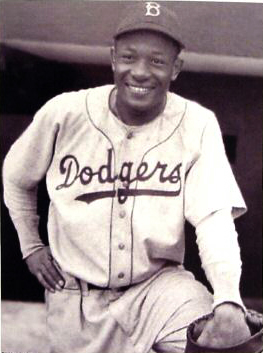
Jackie Robinson

There is a revealing moment that comes toward the end of the new PBS documentary on the life and times of Jackie Robinson. I'm not thinking of the clips of the magnificent ballplayer stealing home against Whitey Ford and the Yankees in game one of the 1955 World Series, or the noble civil rights leader marching with Martin Luther King. Nor am I thinking of the indignant man battling injustice directed at him and his people, or the successful businessperson, or the loving father in the arms of his family.

In 1966, Robinson worked as a special assistant for community affairs in New York during the administration of Governor Nelson Rockefeller. Given Robinson's achievements up to that point, not to mention his support of Rockefeller during the 1964 Republican presidential campaign, he probably could have had his pick of positions in that administration. The film clip I'm thinking of was shot at a community meeting where frustrated African American citizens were bringing concerns about issues plaguing their community to the table. In his capacity as the representative of the government, Robinson appeared shell-shocked at the barrage of criticisms brought before him. Clearly frustrated at not having the answers to these people's problems, he left the meeting by saying: "we'll get back to you."

Robinson the bureaucrat is hardly the image of St. Jack most of us are accustomed to seeing. However when you think about it, a lesser man in that situation might have just thrown up his hands and said: "Hey I'm Jackie Fucking Robinson, I broke baseball's color barrier. I don't need this shit."

Another clip shows Robinson humbly telling a woman that while his athletic accomplishments came easy to him, his new found career in service to others was hard, and it took lots of learning.

After his baseball career ended, Robinson could have retired to a comfortable life resting on his laurels, and settling down in his Stamford, Connecticut home with his wife Rachel and their three children. No none would have thought the lesser of him.

But as we all know by now, that was not Jackie Robinson. This quote of his closed part one of the documentary:
If I had a room jammed with trophies, awards and citations, and a child of mine came into that room and asked what I had done in defense of black people and decent whites fighting for freedom, and I had to tell that child that I had kept quiet, that I had been timid, I would have to mark myself a total failure at the whole business of living.
Having said that, Robinson could have taken an easier road toward being an advocate for his people. He could have followed the orthodox ideological path many of his contemporaries took. But his convictions prevented him from doing that too. He understood that life is complicated, and you can't simply find plug-in answers to difficult questions. Through all the heartaches and struggles the civil rights movement suffered in the sixties, Jackie Robinson still believed it was important to work within the system rather than against it. Rightly or wrongly, he didn't buy into the notion of changing the world by any means necessary.

For that he was excoriated by members of the black community, many of whom felt he was an old man out of touch with the times. Despite all he did for the cause of civil rights, he was labeled an Uncle Tom by some of his own people. I can only guess those words were infinitely more painful than all the invectives hurled at him by white players and fans during his baseball playing days put together.

Jackie Robinson's widow, Rachel Isum Robinson approached Ken Burns about a decade ago, asking him to follow up his nine part documentary called Baseball, which prominently featured her husband, with a new film that would exclusively feature him. Previous commitments prevented Burns from immediately acting upon her request, but he enlisted the help of his daughter Sarah Burns and her husband David McMahon to assist with the production of the Robinson film.

The film they made is a cohesive portrayal of the man and the struggles he faced during his lifetime. The filmmakers avoided the pitfalls of turning their work into hagiography, as so many portrayals of the Robinson have turned out, including the one in Ken Burns's Baseball. There was even a token effort to get into the heads of some of Robinson's fellow ballplayers who balked at the idea of playing with or against a black man. Unfortunately Dixie Walker, Enos Slaughter and the rest of the players who objected to Robinson's presence in the big leagues are no longer around to speak for themselves. That task was given to Robinson's teammate, pitcher Carl Erskine, who without condoning their behavior, explained their position as being Southerners brought up in a society that sincerely believed it was morally wrong for black and white people to mix. Even the late Red Barber, beloved to generations of NPR listeners for his weekly, homespun interviews with radio host Bob Edwards, admitted in archival footage from the original baseball documentary that he once believed having blacks playing ball with whites was wrong, and seriously considered quitting his job as the voice of the Dodgers over the signing of Jackie Robinson. It took Branch Rickey's tremendous power of persuasion to convince him to stick around.

Along with seeing Barber again, one of the joys of this Robinson film was seeing Buck O'Neil one more time. O'Neil, unquestionably the star of the original baseball series, was Robinson's teammate on the Kansas City Monarchs during the very brief time that Jackie played in the Negro Leagues. O'Neil gave interviews (not included here) where he described the position of white ballplayers at the time in practical terms. The black players he said, who would be coming into the league would be competing for the white players' jobs. Small wonder few major leaguers were thrilled at the prospect of several dozen new ballplayers competing for what few roster spots there already were.

Despite efforts to be as balanced as possible, Team Burns did seem to have an agenda in the making of this film, bending over backwards to make sure that white people didn't get too much of the credit for the integration of baseball.

In an interview published in an ESPN article titled: Jackie Robinson documentary kills myths of civil rights legend, Ken Burns said, referring to his original baseball documentary:
We sort of postulated that Branch Rickey reached down and touched Jackie, like Michelangelo,. He was supposed to be God, and Jackie was Jesus...(1) It wasn't just Branch Rickey alone in the wilderness. It was a black press that had been active for decades pushing it. It was a left-wing press.
Well it's not very likely that the black or left wing press held much sway with white America, let alone major league baseball back in the forties, so that last statement of Burns is over-reaching at best. For his part, Branch Rickey readily admitted that in addition to sincerely believing it was the right thing to do, much of his inspiration for bringing black players into the big leagues was money. This was never much of a secret so I find it a little surprising that folks like the author of the ESPN piece seemed surprised that "Branch Rickey wasn't Abraham Lincoln as a Major League Baseball executive." Of course anyone with a sense of history knows that Abraham Lincoln himself wasn't exactly Abraham Lincoln either.

The article and film suggest that Branch Rickey acted when he did in order to avoid repercussions from Mayor Fiorello Laguardia's threats of sanctions against the three New York teams if they did not integrate. What the article and film fail to point out are the incredible lengths Rickey went to keeping his plans of breaking  the color barrier secret until the time was right, including creating a smokescreen by planting a story that he was scouting black players in order to create a new Negro League. I think it is very clear that without Branch Rickey, his devotion to the cause, and his masterful manipulation of both the press and major league baseball, the integration of the game would not have happened for at least another five years if not more. It is disingenuous for Burns or anyone who knows anything about the subject to suggest otherwise.

The film touches upon the Dodgers' insistence that Robinson testify in 1949 before the House Un-American Activities Commission in regards to singer Paul Robeson's comment that black people would not fight in a war against the Soviet Union and Communism. Robinson was reluctant to testify but feared his job and the future of blacks in the big leagues were at stake, so he gave in. Many people in the black community were bitterly disappointed by Robinson's supposed betrayal of Robeson, himself a great hero to the movement.

But Robinson's statement, which he allegedly had Rickey's help composing, turned the tables on the commission, stating unequivocally that it was not the appeal of Communism that was turning blacks against this nation, but the continued treatment of an entire race as second class citizens. He added that the fact that Communists were exploiting race problems in the United States for their own benefit, did not mean the causes for those problems did not exist. Unfortunately the Burns film merely glosses over the substance of Robinson's comments before the committee, focusing on only a few trite words about being more concerned about his upcoming contract with the Dodgers than politics. You can find his complete statement to the committee here.

It wasn't his words in the end but the fact that he appeared at all before a committee bent on condemning Paul Robeson that soured his reputation with many in the black community. What should have been one of his finest moments, turned into a very bitter experience which he regretted in his later life.

Well made as it is, like all Ken Burns films, with the exception of personal anecdotes, this film doesn't contribute much original research or insight into its subject. The fact that so many people were surprised by what they learned from the film, simply means they never cracked open a book on the subject. Jackie Robinson is one of the most celebrated Americans of the twentieth century, and the vast amount of published material on him, testifies to that fact.

Many were surprised for example that Robinson supported Richard Nixon over John F. Kennedy in the 1960 presidential election. Robinson correctly surmised from talking to him that JFK was not informed, nor particularly cared about civil rights issues. He correctly believed that the choice of Lyndon Johnson as Kennedy's running mate was made to appease southern white voters. He also believed that the choice of Johnson would hurt black people. He turned out to be dead wrong on that one. He also turned out to be wrong about Nixon, and ended up once again being on the losing side when he endorsed Hubert Humphrey over Richard Nixon in 1968.

One issue that the film takes a different point of view from just about everyone else, concerns Dodger captain and shortstop Pee Wee Reese and his supposed public comforting of Robinson during his first visit with the Dodgers to an overtly hostile Cincinnati. Despite featuring the event in the original baseball series, Burns now claims the incident never happened. He is sure of this because "There is no image or write-up (of the incident) anywhere".

Well he's probably right. We'll never know for sure but Pee Wee Reese more than likely did not put his arm around Jackie Robinson's shoulder on May 13, 1947 in Cincinnati. Robinson remembers him doing it later, perhaps the following season. In the seminal book concerning the Robinson era Brooklyn Dodgers, The Boys of Summer, author Roger Kahn interviewed Robinson, Pee Wee Reese and several of their teammates. Reese talks about making similar gestures toward Robinson many times during their playing days with the Dodgers, but does not specifically mention Cincinnati or that particular game.

So at some point, in a show of solidarity, Reese put his arm around Robinson on the field. Given all the momentous events surrounding Jackie Robinson and the integration of baseball, why such a fuss over a trivial matter? (2)

According to Burns, we white folks like to hold on to "myths" like Reese putting his arm around Robinson in Cincinnati, or Branch Rickey being Abraham Lincoln, "because it gives white people skin in the game." Frankly I'm not quite sure what he means by that. I think most white people today understand that the exclusion of African American players in "organized baseball" (for lack of a better term), was a grave injustice that had to be addressed, not something given to blacks out of the kindness of the hearts of white folks. But in order for the major leagues to integrate, there had to be white people on board willing and able to make it happen. And yes, there were many white folks who did everything they could to not make it happen. But it was going to happen one way or other, regardless of those people.

In a parallel universe, there was a brilliant history of black baseball which produced some of the greatest players the game has ever seen. Without those players, we would not be talking about Jackie Robinson today; he stood upon their shoulders. Unfortunately, the minute Jackie Robinson broke into the big leagues, the Negro Leagues became irrelevant, and the livelihoods of thousands of folks whose lives were wrapped up in them, not just ballplayers, were lost. Despite that, I've never heard a report any of those players who were simply born at the wrong time, publicly gripe about Jackie Robinson's good fortune.

And then there was Jackie Robinson who devoted most of his life after his retirement from the game to the cause of civil rights, justice, and equality in this country. Ken Burns in his seemingly endless promotion of this film, presents Jackie Robinson as the "most important man in the history of baseball," That of course is an opinion to which he is entitled. As far as baseball is concerned, I consider Jackie Robinson the Neil Armstrong of the game. Both men were chosen to be the first at what they did, and both responded to the task in extraordinary fashion. But had it not been for those two individuals, someone else equally qualified would have been chosen, and more than likely would have done a magnificent job.

What sets Jackie Robinson apart, is his extraordinary life away from baseball. It takes a great man to humble himself  for a cause he believes is greater than himself. Robinson sacrificed everything, even the love and respect of his own people, because he believed in doing not what was popular, but what was right.

As the Neil Armstrong of the game, Jackie Robinson may not have been the most important person in the history of baseball, but I think it's safe to say that for his exemplary work both on and off the field, he is the most important baseball person in history.

Happy Jackie Robinson Day.


Notes:

(1) Not to nit pick, but the person in what I believe the painting Burns is referring to in his comment is Adam, not Jesus.

(2) If Burns were truly concerned about clearing up the falsehoods found in his earlier work, he should start by correcting the hatchet job he did on the characters of Ty Cobb and Charles Comiskey.

Monday, April 15, 2013

42

Before the March on Washington, before the integration of the University of Mississippi, before the Freedom Ride through the South, and the sit-in at a lunch counter in Greensboro, NC, before the Montgomery Bus Boycott, before Brown v. the Board of Education, and Executive Order 9981 which officially integrated public schools and the armed forces respectively -- before every great moment in the struggle for civil rights in the United States that anyone alive can remember, there was Jackie Robinson.

One does not usually hear Robinson's name spoken in the same breath with the likes of Thurgood Marshall, Medgar Evars, James Meredith, Rosa Parks, Malcolm X, Martin Luther King, and scores of other individuals who fought tirelessly and often gave up their freedom and even their lives for the cause of civil rights in this country. After all, Jackie Robinson was only a ballplayer and much of his legacy is wrapped around a game. But back in the day, baseball wasn't different from any other institution in the United States in regards to race, it was simply more public, and the integration of the game brought the issue of racial injustice in this country to the forefront. Because of that, Jackie Robinson's trailblazing career marks the beginning of the modern American civil rights movement.


Jackie Robinson
April 15th, is the anniversary of Robinson's debut with the Brooklyn Dodgers in 1947 which officially broke the Major Leagues' color barrier. It will be celebrated all over the big leagues as Jackie Robinson Day, the day where every Major League baseball player will wear on his back the number 42, a number that has officially been retired on every big league team, Jackie Robinson's number.

It is right and just that we celebrate Robinson this way. However, lost in all the attention we give to one man, are others who broke into the big leagues at the same time, who suffered exactly the same indignities and hardships, but got none of the accolades.

Most of the credit for integrating baseball has been given to Branch Rickey, the president and general manager of the Brooklyn Dodgers. Rickey understood the lucrative potential of attracting the untapped reservoir of the African American community to his ballpark and began his pursuit of a black player for his team in 1945. However Bill Veeck, the most innovative of baseball owners, proposed integrating baseball back in 1943. Veeck's proposal was rejected by then Commissioner of Major League Baseball, Judge Kenesaw Mountain Landis.

While Bill Veeck was serving in the Marine Corps in the South Pacific during WWII, (where he lost a leg), back home Landis died and was replaced by former Kentucky governor Happy Chandler. Chandler was amenable to the idea of integrating baseball and it was with his support that Rickey succeeded in putting Jackie Robinson in his opening day lineup for the Dodgers on April 15, 1947, making him the first black major leaguer in over fifty years. Once the door was opened, if just by a crack, Bill Veeck who by then owned the Cleveland Indians, like Rickey knew he had to proceed cautiously. Not only would he need a stellar player, but someone who combined intelligence with an even temperament, courage, and enormous strength of character. In other words he needed someone who like Robinson, not only understood the significance of the position he would be thrust into, but also had the intestinal fortitude to withstand the abuse that would inevitably come his way. If that player failed the test, the cause would be set back twenty years.

Larry Doby
Veeck found his man in Larry Doby. Doby spent his childhood in Montclaire, NJ. Growing up there he didn't experience the same kind of up-front bigotry that many of his fellow Negro League players did. That all would change while he served in the Navy during WWII. From basic training on Doby was "stunned and embarrassed" by being segregated from the white inductees, some of whom were friends he played ball with as a kid. It was unfortunately a lesson that would prepare him for his future life in the major leagues.

After the War, the former all-state athlete in multiple sports returned to his position at second base with the Newark Eagles of the Negro Leagues where he got Veeck's attention. Unlike Rickey who prepared Jackie Robinson (and the baseball world), for integrated baseball by playing Robinson in the minors for one year, Doby played in a double-header for the Newark Eagles on the Fourth of July of 1947, and the next day found himself in an Indians uniform in Chicago playing against the White Sox.

Another difference: Veeck bought Doby's contract from Effa Manley, the owner of the Eagles, in marked contrast to Branch Rickey who reasoned that since there was no reserve clause in the Negro Leagues, he had no obligation to compensate in any way the Kansas City Monarchs, Robinson's former team.

Even though he had been in the majors only three months, Jackie Robinson took it upon himself to mentor Doby, teaching him the ropes of coping in a world where both men would be stars on the field, yet treated like dirt everywhere else. Another mentor was Veeck whom Doby viewed as a second father. Where Robinson was forced to play with teammates who did not accept him for his race, Veeck traded the Indians players who refused to shake Doby's hand when he was introduced to them. Other than that, Doby suffered exactly the same indignities as Robinson. Despite being the second African American ballplayer in the majors, it must be remembered that playing in a different league, Doby just like Robinson, was the first player of color to appear in ballparks with fans that had never seen black and white ballplayers together on the same field. Just like Jackie Robinson, Doby was taunted on and off the field by fans and other players, he wasn't able to stay at the same hotels as his teammates, he received death threats. Yet Doby never received the credit nor the adulation that Robinson did, especially later in life.

Doby like Robinson knew his responsibility as a pioneer was to keep quiet despite the indignities. Unlike Robinson who after a few years was allowed to (and did) let loose a bit, Doby continued to keep all his frustrations to himself. As a result many of his teammates considered him aloof and sullen. One can only imagine what must have been going on inside of him.

Larry Doby had a very respectable major league career. In thirteen complete seasons in the majors, he complied a .283 batting average, hit 253 home runs, and 970 RBI. Twice he led the league in home runs and in one year, 1952, he led the league in runs scored, home runs, slugging percentage and yes, also strikeouts. Other notables for Doby: he became the first black player in the majors to win a World Series title as the Indians became world champs in 1948. In 1949, Doby joined Robinson, Roy Campanella and Don Newcombe (both players also from the Brooklyn Dodgers) as the first African American players chosen to play in a Major League All-Star Game. In 1978 Bill Veeck hired Doby to manage the Chicago White Sox, making him the second black manager to be hired, behind Frank Robinson. Doby was inducted into the Baseball Hall of Fame in 1998.

Home Run Brown
Doby and Robinson were not the only black players who broke into the major leagues in 1947. Hank Thompson and Willard "Home Run" Brown were both signed by the St. Louis Browns that year. Unlike the Dodgers and Indians, two very successful clubs in cities that supported at least tacitly the idea of blacks and whites playing baseball together, the Browns were a terrible team in a city that was shall we say less than progressive on the subject of race. Some of the players on St. Louis's other team, the Cardinals, tried to organize a walkout rather than play against the Dodgers and Jackie Robinson. Thompson and Brown were not signed, in the words of Brown's general manager Bill DeWitt: "because they are Negros, but because we hope they can put more power in a club that has been last in the American League club batting most of the season." Unfortunately neither the city nor the ball club were as colorblind, and neither accepted them. Toward the end of the season, both players spent most of their time on the bench. In a game against Detroit, Brown was sent up to pinch hit. He had sat for so long he didn't even have his own bat to use, so he borrowed one from the team's one slugger, Jeff Heath. Brown swung at a Hal Newhouser pitch and sent it deep into center field of old Sportsmans Park, hitting the fence some 428 feet away. Brown was one of the fastest men in baseball at the time and when the dust settled, he had circled the bases for an inside the park home run. It would be the first home run hit by a black player in the American League. For his efforts, Brown returned to the dugout and was greeted with silence by his teammates, no one even looked his way. Heath picked up his bat that Brown used and smashed it against the wall. Both Brown and Thompson were cut from the Browns at the end of the year.

Dan Bankhead
The first black pitcher in the Major Leagues was Dan Bankhead who became Jackie Robinson's teammate on the Dodgers. His debut was on August 26, 1947 where he hit a home run in his first at bat. It would however be his only big league home run, for as great a pitcher as he was in the Negro Leagues, he had less success in the majors. No one is entirely sure why but it has been speculated that having grown up in the deep south, he was terrified at the prospect of hitting a white batter with a pitch and the consequences it would bring upon himself and others. As anyone who knows baseball can tell you, it's impossible to be an effective pitcher while fearing to pitch inside to a batter. Years later, Bankhead's son recalled his father telling him that he once had a no-hitter going deep into the game. He then intentionally tossed up a lollipop to the batter who obliged him with a base hit. "It wasn't time yet for a black man to throw a no-hitter" he told his son. Like Home Run Brown, Dan Bankhead's Major League career was short lived.

The old Negro Leagues began to fold shortly after 1947. Still it took a long time for the Majors to fully integrate. In the fifties, for black players who were not of superstar caliber like Willie Mays, Ernie Banks or Henry Aaron, options were drying up. The Yankees would not sign a black player until Elston Howard joined the team in 1955. The Phillies and the Tigers would wait a couple more years. It would take twelve full years after Jackie Robinson played his first game in Brooklyn before every team in the Major Leagues signed their first African American player. That happened when the immortal Pumpsie Green joined the Red Sox in 1959. Talk about a slow train coming.

In regards to Larry Doby, the sports writer Scoop Jackson said the following about the tradition of  every big league ballplayer wearing Jackie Robinson's number 42 jersey on the anniversary of his breaking into the big leagues:
Second place finishers in America are suckers. And so are those who make the story of history less simple than it needs to be. This happens sometimes in America. Those who don't come first or don't do things a certain way get lost. They disappear. 
In an age of historical amnesia where fewer and fewer of us consider history important, an era where many ballplayers, including African American ones barely know about Jackie Robinson, what he did for the game and what he did for them, fewer still know the names Larry Doby, Home Run Brown, Dan Bankhead and countless others.

That's a damned shame.

Sunday, April 29, 2018

Dead Icons

April is the month where we recognize two significant events in the history of the American Civil Rights movement, one positive, the other devastating:

On April 15, 1947, Jackie Robinson made his first appearance with the Brooklyn Dodgers, marking the end of the enforced segregation in major league baseball.

On April 4, 1968, Martin Luther King was assassinated.

I noticed something interesting on both April 4th and April 15th this month. Not surprisingly, on those two days, many folks took to social media to honor the two American icons. Among those posts were comments that considering their source, seemed a trifle ironic.

On the morning of April 4th, President Trump tweeted the following:
Today we honor Dr. Martin Luther King, Jr. on the 50th anniversary of his assassination. Earlier this year I spoke about Dr. King’s legacy of justice and peace, and his impact on uniting Americans. Proclamation: 
Accompanying the tweet is a brief video of Trump espousing King's contributions to this country, summarizing the words of his official proclamation recognizing the anniversary of King's assassination as a day to "honor Dr. King's legacy" (whatever that means). In the words of the proclamation, Trump speaks of the injustice of racial inequality and division:
We must learn to live together as brothers and sisters lest we perish together as fools... As a united people, we must see Dr. King’s life mission through and denounce racism, inhumanity, and all those things that seek to divide us.
If not original, those words are all well and good, they're hard to argue with, yet they seem to run counter to just about everything Donald Trump has said and done as president. Say what you will about whether the man is a bigot or not, but it's no secret that a good number of his supporters are dyed-in-the-wool racists, and proud of it. It's also no secret that Donald Trump will bend over backwards to avoid offending that reliable, but less than admirable base.

Despite that, Trump has had numerous opportunities as president to bring this country together in terms of race, When the issue of removing Confederate monuments in the South came up, the president could have made a very reasonable argument that while he was not particularly in favor of removing monuments that have stood in place for over a century, he undertood the concerns African American people have about their communities memorializing the people who led the battle to enslave their ancestors. Trump then could and should have urged both sides to get together and compromise. Instead, he took a rigid stance against the removal of the statues while completely failing to even acknowledge the argument of the other side.

When Nazis. Klansmen and other white supremacist groups descended upon Charlottesville to protest the removal of one of those monuments, and incited the violence that led to the death of a young woman, the president could have done what any reasonable leader would have done and what the Governor of Virginia did do, denounce in no uncertain terms those hate groups, Instead Trump punted, insisting that "both sides" were wrong for what took place in Thomas Jefferson's home town.

Then just last week, a white mass murderer walked into a Nashville retaurant and killed four African American people, before being subdued by an un-armed man who saved countless lives. Despite going out of his way to publicly display sympathy for the victims of a truck attack in Toronto that happened the following day, the President of the United States remained silent about the tragic loss of four of his fellow countrymen, and the indesputable heroism of another.

One could argue these are sins of omission, in no way displaying any real intent to divide the country along racial lines or express any animous to African American people. To that I would bring up Trump's famous stance against African American football players who chose to kneel during the national anthem out of protest for numerous police killings of African American men in this country. Again, like the issue of the Confederate statues, Trump could have easily formed a nuanced response saying that while he didn't apporve of players not standing for the anthem, he understood their concerns and would work to help address the issue they were protesting against. Or he could have simply left the issue alone as at the time only a small handful of athletes participated in the protest and were it not for him, the issue would have been all but forgotten.
.
Instead, at a rally in Huntsville, Alabama in front of a bunch of hootin' and hollerin' supporters, Trump of his own free will chose to say this: "fire those sonsofbitches!"

All of that makes Donald Trump's words in praise of Dr. King. and his bemoaning of the division of this country, sound quite hollow.

Trump wasn't alone among Americans not particularly known for their concern about civil rights, to pay lip service to Martin Luther King and Jackie Robinson this month. I read numerous posts from folks who are openly hostile toward current day activist groups and leaders, particularly the Black lives Matter movement and the kneeling NFL players, who couldn't say enough good things about Robinson and Dr. King. When pressed about the seeming contradiction of prasing those two dead icons while condemning living people fighting exactly the same battles today, these folks insist that King and Robinson would not approve of today's crop of activists. One commentator, responding to the question what would  MLK think of the current president's zealous concern about protecting our borders at the expense of human rights, said this: "Dr. King fought for the rights of American citizens, not for those who were here illegally."

Interesting.

As for Jackie Robinson, I read countless posts speculating about how horrified Robinson, himself a WWII veteran, would feel about football players kneeling during the anthem. Well in fact, Robinson told us exactly how he'd feel in his autobiography:
There I was, the black grandson of a slave, the son of a black sharecropper, part of a historic occasion, a symbolic hero to my people. The air was sparkling. The sunlight was warm. The band struck up the national anthem. The flag billowed in the wind. It should have been a glorious moment for me as the stirring words of the national anthem poured from the stands. Perhaps, it was, but then again, perhaps, the anthem could be called the theme song for a drama called The Noble Experiment. Today, as I look back on that opening game of my first World Series, I must tell you that it was Mr. Rickey’s drama and that I was only a principal actor. As I write this twenty years later, I cannot stand and sing the anthem. I cannot salute the flag; I know that I am a black man in a white world.
I have a very strong feeling that if  Dr. King and Jackie Robinson were still alive, many of the people who wrote so eloquently about them this month would despise them today, much as they and their ancestors did when they were alive. One could say that it is the height of hypocrisy to praise dead icons while condemning the living who follow in their footsteps. Then again, one could say it is human nature that compels us to do so. After all, April is also the month that we recognize a momentous event in the life of another controversial figure who was despised in life and revered in death far more than King and Robinson combined.

Like King and Robinson, his followers today, make him in their own image so to speak, as an advocate for what they believe to be right, all the while forgetting his life was devoted to challenging their beliefs, and especially their self-righteousness. When Jesus of Nazareth told a wealthy young man who was interested in follwoing him to sell all his possessions and give the proceeds to the poor., the man walked away dejected. This led to the comment, "it's harder for a rich man to enter the Kingdom of Heaven than for a camel to pass through the eye of a needle." The funny thing is, you seldom hear well-off white, evangelical Christians relate that story, just as you won't find many liberal, pacifist, Beatitude reciting Christians relating this quote:
Do not suppose that I have come to bring peace to the earth. I did not come to bring peace, but a sword.
When Jesus turned over the tables of the merchants in the Temple in Jerusalem, even his own people truned against him. In much the same way, during their own lives. Jackie Robinson as I wrote here, and Martin Luther King, as I wrote here, were also rejected by members of their own community.

The fact is, trouble makers like Jesus, Jackie Robinson and Martin Luther King, are seldom appreciated in life when they constantly remind us of our own shortcomings.

Once they're killed off and can no longer threaten us, they become convenient symbols of our self righteousness and vanity. In the case of Martin Luther King, lavishing praise upon him without truly understanding what he stood for, is a convenient way of saying hey, I'm ok, I'm not a racist. It's the modern day equivalent of the statement: "some of my best friends are Negros."

Michael Harriot wrote this scathing article called "What to Say When 'WYPIPO' (White young people of influence, privledge and opportunity) Bring Up MLK." His contention is that we white folks:
have managed to whitewash (King's) legacy and transform him from a revolutionary willing to bleed and die for what he believed in, to a meek, milquetoast orator who fits their narrative of the sweet, submissive hero who begged them for a seat at the table.
The truth is, the real Martin Luther King was so radical in his beliefs and his actions, that by comparison, today's leaders of the civil rights movement look like Reagan Republicans. 

Unless we're willing to to stand up and support groups like Black Lives Matter, and take a knee during the anthem in protest of police violence, if we white folks really want to honor Dr. King's legacy, perhaps the best thing we can do is not mention his name at all.

Tuesday, February 27, 2018

Pioneers

While writing my last post, I came to a fork in the road. I chose to go down one path with the intention of coming back to the other path later in the post. That didn't happen. Here is the other path.

Devante SmithPelly, the Washington Capitals ice hockey player who was racially taunted by Chicago Blackhawks fans last week, follows a long line of professional athletes who have found themselves among a small handful of black players in their sport, and as a result. suffered indignities at the hands of fans and fellow players.

Much has been written about the abuses that Jackie Robinson endured after he became the first African American to play “organized" baseball since blacks were excluded from the game in the 1880s. His story and career, have become the stuff of legend. Less well known are the stories of the players who followed him into the majors, some of which I wrote about here. Even less known are the pioneers who became the first African American players in the other American professional sports leagues.

Kenny Washington
Like Major League Baseball, the National Football League originally featured black players until a "gentleman's agreement" was forged between owners to keep them out.  Kenny Washington, was a teammate of Jackie Robinson at UCLA on both that school's football and baseball teams. While there, Washington set several school rushing, passing, and defensive records (as players played both sides of the ball in those days), as well as being the first consensus All American from UCLA. He was considered by some to have been a superior baseball player to Robinson. So impressed by his abilities, George Halas, owner and head coach of the NFL Chicago Bears, tried to draft Washington after he graduated from UCLA in 1940, but was thwarted from doing so by the rest of the league. Washington languished in the semi-pro Pacific Coast Professional Football League from 1941 until 1945, playing most of his prime years in minor league football. When the Cleveland Rams moved to Los Angeles in 1946 and expressed interest in playing in the publicly owned LA Coliseum, overwhelming pressure from the municipality convinced the team to integrate, which they did, signing Washington on March 21 , 1946, exactly one year before Jackie Robinson became a member of the Brooklyn Dodgers.

Jackie Robinson famously endured both verbal and physical abuse from fans and his fellow players and so did Washington. But as a football player, one can only imagine that the physical abuse from players had to be far more savage. Unlike Robinson, Washington's career in the big leagues was short lived. With five knee surgeries behind him and already past his prime when he entered the league, Washington played three seasons in the NFL, putting up impressive, but not Hall of Fame stats, which is why he isn't enshrined in the sport's shrine of immortals in Canton, Ohio. Still, Kenny Washington's contribution to the game of professional is unquestionable and he is deserving of much greater recognition. There is a movement underway to include him in the Pro Football Hall of Fame, but given his record on the field in the league, that seems unlikely. It would be interesting to poll current players in the NFL, a league now dominated by black athletes, to see how many of them know the name Kenny Washington. My guess is that few of them do.

There isn't a long history of segregation in the National Basketball Association only because the league wasn't founded until 1949. Unlike this country's three other major professional sports, baseball, football and hockey, (sorry soccer fans), the origin of the game of basketball can be traced to a particular moment and to a single inventor.

Time now for a brief interlude...

In 1891, PE teacher James Naismith of the Springfield, Mass. YMCA was given the task of creating a new activity to distract his bored and rowdy track and field athletes during the cold New England winter months. His boss, the head of that particular Y, had a few requirements for the activity: it had to keep the athletes in shape, it could not not take up too much space, and it especially had to be "fair for all players and not be too rough."

The new activity would be a goal-oriented game like football and hockey. To make it fair and not too rough, Naismith placed the goals, originally peach baskets, high up above the players' heads so they would be unguardable. There also was no running with the ball, it was advanced by passing it from player to player. Goals were scored by players successfully soft-tossing the ball (originally a soccer ball) into the appropriate basket without it coming out. Upon a successful score, the janitor present at the game, had to walk up to the basket then climb a ladder to fetch the ball. Following that, a "jump ball" at center court would resume the action, if you could call it that, Contrary to what you might have expected, no, the new game was not called "watching paint dry", but Basket Ball. You may think that the greatest innovation in the game of basketball was the jump shot or the slam dunk, but I give that award to the guy who decided it would be a good idea to cut a hole in the bottom of the baskets.

Here is an interesting site devoted to the evolution of basketball.

Anyway, Naismith's game was a big hit, first on the YMCA circuit, then at schools and universities, before finally turning professional . It was played by folks of all races, and evolved as most things did back in those days, in the parallel universes of segregation. But unlike baseball where white teams played black teams only in exhibition games, officially sanctioned games and even championships were held between white and black basketball teams.

One of those all black teams was the Harlem Globetrotters which began as a legitimate barnstorming team, not the circus act they would later become, and not as the team's name implies, from New York City, but from Chicago. In 1948 the Globetrotters took on the all white Minneapolis Lakers (today's LA Lakers), and the man many considered to be the game's first superstar, 6'10" George Mikan. The game took place here in Chicago at the old Chicago Stadium. The Lakers had their way with the Globetrotters in the first half, but the combination of double-teaming Mikan, and a consistent fast-break offense in the second half brought the Trotters back. The lead went back and forth in the second half and with the game tied at 59 with 90 seconds left in regulation time, Marques Haynes eluded the Laker defense all by himself, dribbling the ball until there were two seconds left on the clock. At that point he passed the ball to Elmer Robinson for a perfect 30 foot set shot to win the game at the buzzer.

While it was only an exhibition game, the Globetrotters beating a team that greatly out-sized them put to rest for good the notion that black basketball players were inferior to whites. It had the same impact to African Americans as Jesse Owens winning the gold medal at the 1936 Olympics, Joe Louis beating Max Schmeling in the first round of their second fight in 1938, and of course, Jackie Robinson joining the Brooklyn Dodgers.

Chuck Cooper
In 1949, the year after the Globetrotters' victory over the Lakers, the Basketball Association of America, the league the Lakers belonged to, merged with its rival, the National Basketball League, to form the National Basketball Association. The NBA would remain all white for exactly one year.

Settling on on the true Jackie Robinson of the NBA is a little complicated as there were actually three of them. From the 1950-51 season overview in NBA.com's encyclopedia, we learn this:
The season marked the first appearance of black players in the league. Chuck Cooper became the first black player to be drafted when he was chosen by Boston; Nat "Sweetwater" Clifton became the first to sign an NBA contract when he signed with New York, and Earl Lloyd became the first to play in an NBA regular-season game because the schedule had his Washington team opening one day before the others.
To further muddy the waters, one of the NBA's predecessors, the NBL, became integrated for a short time in the early forties during World War. II.* Unfortunately during a game, a fight broke out between black and white players, marking the end of that noble experiment.

Bringing up the rear as far as professional American sports leagues are concerned, the National Hockey League finally broke its color barrier with Frederickton, New Brunswick's own, Willie O'Ree, who broke in with the Boston Bruins to replace an injured player on January 18, 1958 for  a game in Montreal. 

There was little fanfare for O'Ree's debut. Eleven years earlier, Jackie Robinson was carefully groomed for the role he was about to be thrust into by his mentor Branch Rickey. Not O'Ree. His coach with the Bruins,  Mike Schmidt, while acknowledging the milestone, and assuring O'Ree that his teammates were all on board, told him in typical understated hockeyspeak, to put that all behind him and "just go out there and play hockey."

Willie O'Ree
O'Ree played only two games with the Bruins in 1958 before going back down to the minors. He was called back up two seasons later and played 43 games with the club. Like the other Jackie Robinsons of their respective sports, O'Ree received more than his share of racist taunts from the fans and the opposing players."Players would take cheap shots at me, just to see if I would retaliate..." O'Ree said, "...They thought I didn’t belong there. When I got the chance, I’d run right back at them."

Jackie Robinson was told by Branch Rickey that under no circumstances was he to retaliate when another player went after him, so as not to set back the cause of integration. For better or worse, fighting is an integral part of the game of hockey, at least as it is played in North America, and O'Ree was given the green light to not turn the other cheek. The worst cheap shot taken at O'Ree was right here in Chicago when my onetime hero Eric Nesterenko of the Black Hawks (as the name of the team was spelled at the time) verbally taunted O'Ree then speared him with his stick to the face, knocking out two teeth. O'Ree's stick then managed to find Nesterenko's head, setting off a bench clearing brawl. It took fifteen stitches to sew up Nesterenko's bloody head. Being hockey I have no doubt that after their penalties, both players barely missed a shift. O'Ree, a very popular player among his teammates, didn't need to fight all his battles. When opposing players would taunt or take a run at him, they had to answer to the enforcers on his team, namely Fern Flaman and Leo Labine.

While the rules of hockey allow retaliation against fellow players, the fans are another story.  O'Ree said the treatment by opposing fans was worse in the American NHL cities than in Montreal or Toronto. It seems the worst city of all, sad to say, was Chicago. "Why don't you go down south where you belong and pick some cotton" was probably one of the tamer remarks hurled in his direction. He was pelted with garbage while serving time in the penalty box but he never fought back. He said: "If I’m going to leave the league, it’s because I don’t have the skills or the ability to play anymore. I’m not going to leave it ’cause some guy makes a threat or tries to get me off my game by making racial remarks towards me."

After that 1960-61 season, (the season the Black Hawks won the Stanley Cup), O'Ree was traded to the Montreal Canadiens. As that team was stacked with talent, O'Ree unfortunately never played another game on NHL ice, but he did continue to play professional hockey in the minors, finally hanging up the skates for good in 1979 at the ripe age of 44.

Unlike Kenny Washington who died in 1971. Willie O'Ree lived to see the day when the contributions of pioneer black professional athletes were rediscovered and finally appreciated. In recent years, O'Ree, who is still very much with us, has received countless honors and awards including the Lester Patrick Award for outstanding service to hockey in the United States, and the Order of Canada, that nation's highest civilian award. Since 1998, Willie O'Ree has served as the director of Youth Development for the NHL/USA Hockey Diversity Task Force. As you can imagine from his job title, the goal of the organization is to promote the game of ice hockey to new audiences, especially in minority communities, and to encourage the participation of these groups in youth hockey. One might look at the numbers of black players in the NHL today (averaging out to about one player per team) as evidence that the Task Force is barely sputtering along. That is until you realize that after O'Ree's days were done in the NHL, no black player stepped on NHL ice for another thirteen years.

Hockey has indeed come a long way since the days of O'Ree's youth when, as a teenage baseball player,  he got to meet Jackie Robinson at Ebbets Field. When O'Ree mentioned that his true love was hockey, Robinson of all people responded: "I didn't know black kids played hockey."

The unfortunate taunting incident that took place in the United Center a little over a week ago, and the public's strong reaction against it, is a good indication that like hockey, society has come a long way since these pioneers broke into their respective leagues, but still has a long way to go.


* Integration was something Major League Baseball could and should have done during a time when there was a player shortage due to World War II. While the poobahs still deemed it unacceptable for blacks to play professional baseball, the majors fielded a child, sixteen year old Joe Nuxtall, and a one armed outfielder, Pete Gray during the war. That proved to be the final slap in the face for supporters of the integration of the Major Leagues which finally took place on April 15, 1947.

Monday, March 24, 2014

Dream Team

BOSTON , March 19, 1936- Coming off his team's worst season ever and on the verge of bankruptcy, Emil Fuchs, the owner of the Boston Braves has come up with a brilliant plan to save his team. With nothing to lose, Fuchs has had a change of heart and asked Babe Ruth, who retired in mid-season last year after an un-productive three months, to re-join and manage the team. Ruth who has long expressed an interest in managing, gladly accepted the offer under the condition that he would have complete control over player personnel. Fuchs has obliged.

Babe Ruth
Ruth's first move sent shock waves through the major leagues as he single-handedly erased forty years of organized baseball tradition by breaking up the team and signing several Negro players to join the club. The starting nine of the new look Braves includes some of the luminaries of black baseball: first baseman Oscar Charleston, second baseman Sam Bankhead, third baseman Judy Johnson, outfielders Jimmy Crutchfield and Cool Papa Bell, and a battery consisting of catcher Josh Gibson and the incomparable pitcher, Satchel Paige. Joining Paige on the mound will be Ted "Double Duty" Radcliffe, and lefty Leroy Matlock.

As bench-minder, Babe Ruth plans to insert himself into the lineup on occasion as pinch hitter.


NEW YORK CITY, October 8, 1936- At Yankee Stadium today the unthinkable took place as the Boston Braves, a team who last year posted the third worst record in baseball history, took the World Series from the mighty New York Yankees, winning the Fall Classic in a decisive game seven. Led by the greatest Yank of all, rookie manager Babe Ruth, the Braves with their new cast of characters, mostly players from the Negro Leagues, took everything the Yankees were able to dish out and then some as they frustrated the Bronx Bombers almost every step along the way.

The old Bambino whose qualifications to be manager were once discounted in the baseball world, seemed to let the team manage itself as his players played old school, opportunistic ball, slap-hitting, bunting and running at will on the unsuspecting New York pitchers and infield. Indicative of the style of play that won the championship, the winning run came in the top of the seventh in game seven as the Braves' Cool Papa Bell, showing little signs of slowing down at 33, advanced from first to third on a Sam Bankhead bunt, then later scored the game's only run on a Lefty Gomez wild pitch. Satchel Paige, while giving up early hits to Bill Dickey, Lou Gehrig, George Selkirk, (Ruth's replacement in the outfield), and youngster Joe DiMaggio, shut down the Bronx Bombers in order in the final three innings, preserving a brilliant four hit shut out; final score, Braves 1, Yankees 0.

But it wasn't all running and pitching that won Boston the championship, these Braves have power to back up their speed on the base paths. Josh Gibson who at only 25, has already been compared to his famous manager on a number of occasions, hit a remarkable six home runs in the series. Veteran Oscar Charleston, who many believe is the real brains behind the team, hit four dingers and drove in twelve runs in the series. Even Bell, not usually known for his power, hit two round trippers, and recorded seven RBI.

For many, the highlight of the series came late in game six when Babe Ruth put himself in to pinch-hit. With nobody on base, the Yankees had the game well in hand leading by six runs when Ruth came up to bat against his former teammate Johnny Broaca. The bespectacled right-hander (perhaps out of compassion), floated a curve ball over the plate and as in days of old, the Sultan of Swat parked the ball into the upper deck of the right field stands. Not a soul was seated nor a dry eye in the house as the greatest ballplayer ever circled the bases of the house they say he built, perhaps for the last time.

But it was the future not the past that reigned supreme this year as Satchel Paige stole the show. He won all three of his starts, allowing only four runs, frustrating the Yankee hitters with his control of a fastball that has few if any peers in the game. While most of these Yanks including DiMaggio have faced Paige before in exhibition games, the high-kicking "Satchelfoot" seemed to save his best for this series. Showing typical confidence in his stuff, Paige brought to his game a new found seriousness, a sense of purpose born out of the desire to prove that he and his teammates indeed deserved to stand exactly where they were standing, on top of the world.

-

That account of the 1936 baseball season is of course, fiction. It was inspired by a recent New York Times article about Julia Ruth Stevens, the daughter of Babe Ruth. In the article, Mrs. Stevens claims that her father, who expressed a strong desire to manage a ball club, was overlooked not because of his lack of qualifications, but because he intended to hire black ballplayers.

Except for his well documented respect for some African American ballplayers, Mrs.Stevens's memories fly in the face of just about everything that has been written about Babe Ruth. The popular image of him is of a carousing, carefree, but lovable lout. The general impression was that he was not exactly the sharpest knife in the drawer; great as he was as a player, no one in the game took the idea of him managing a ball club seriously.

In the article, Mrs. Stevens claims that while her dad was quite the rake in the early days, he had settled down by the time his playing days were over, and was in fact, quite an intelligent, caring human being. One could discount Mrs. Stevens's remarks as a 97 year old’s sweet remembrances of her long departed old man; but maybe, just maybe, there might be something to it.

In 1936, the Babe's full year of retirement, hiring blacks to play ball was not a threat that would have gone unnoticed. Baseball famously had excluded African Americans as participants in the game since the 1890s, and that ban, which was not officially spelled out on paper, was as binding as a straight jacket. In 1936 that jacket was pulled as tight as ever and no one, not even someone with the clout of Babe Ruth could loosen it.

It would take eleven more years before Jackie Robinson became the first African American ball player in the major leagues in the twentieth century. In the intervening years, several events took place to make that possible:
  • World War II: African Americans in the armed forces fought valiantly to help establish democracy in Europe and the Pacific only to come home to a country where they were treated as second class individuals. That irony was not lost on many Americans, both black and white. 
  • The death of the Commissioner : Perhaps no man has ever been so aptly named as Judge Kenesaw Mountain (as in, he who will not be moved) Landis. Baseball Commissioner Landis's rule was law and that law extended to the so called "gentlemen's agreement" banning black players from the game. Any time the issue of the color line was brought before him, Landis would explicitly deny that there was any ban in place, then move on to the next issue, thereby tabling all propositions to integrate the game. When he died in 1944, his replacement Happy Chandler expressed his support of integrating the game. 
  • Joe Nuxhall and Pete Gray: Despite the fact that baseball lost many of its best players to the war effort, in 1942, President Roosevelt wrote the Green Light Letter, commanding that baseball go on in any way it could for the morale of the nation. The game went on with teams that were made up largely of men who were not eligible for military service. Joe Nuxhall was a 15 year old left handed pitcher who the Cincinnati Reds briefly put in their lineup, and Pete Gray was a one armed-outfielder who played one season for the St. Louis Browns. The fact that baseball owners would gleefully accept children and players missing limbs, but still not blacks, was truly a bitter pill to swallow. 
  • Politics: Government officials in Boston and New York City put pressure on their cities' teams to enact equal opportunity hiring programs, extending to players.The big league teams in those cities conducted tryouts for black players in 1945 with no results; they turned out to be shams, show trials at best. 
  • $$$: Despite all the changes mentioned above, the one issue that ultimately moved baseball to integrate was money. Attendance at Negro League games was booming by the mid-forties, especially at the East/West All Star game held annually at Comiskey Park in Chicago. That game alone drew over 50,000 every year. Owners couldn't help but notice.
The Houdini baseball needed to free itself from the straight-jacket of segregation turned out to be Branch Rickey. Egalitarianism may have played a role in his efforts to bring a black player to the Brooklyn Dodgers but Rickey, the team's president and general manager made no bones about the money that could be made with the potential of the black community's dollars spent at the ballpark. Rickey stopped at nothing to achieve his goal. The most important piece to the puzzle was to find the right player to break the barrier. He understood that any mistake could set the cause back ten years. Unlike others who publicly expressed their desire to integrate the game, Rickey kept quiet until the last possible moment. To that end, in order to alleviate suspicions while scouting black players for his team, Rickey announced plans to create a new, (and bogus) Negro League. Once Rickey found his man, he took pains to lecture the black community on how to behave in the stands when Jackie Robinson took the field. For their part, the black fans who attended Dodger games in every National League park in 1947, understood what was at stake and took those words to heart.

A brilliant account of the atmosphere at one of those ballparks, written by Mike Royko on the day Jackie Robinson died, can be found here (found among other articles by the great columnist).

I wrote a piece last year that bemoaned the fact that while Jackie Robinson is deservedly a national hero and icon, the people who immediately followed him into the big leagues are all but forgotten. Larry Doby, Hank Thompson, Willard Brown, and Dan Bankhead (Sam's brother) all played in the major leagues in 1947 but none of them are household names. The same can be said for the black ballplayers who preceded Robinson. The scenario at the top of this post was made up, but the teams were not. The players listed as members of the Boston Braves were actually members of a real team at the time. Some called it the greatest (non all-star) team ever assembled, others called it the best team money could buy. The Pittsburgh Crawfords were put together by a Steel City entrepreneur who worked on both sides of the law named Gus Greenlee. Taking advantage of the Great Depression, a power vacuum in the Negro Leagues, and the lack of any rules preventing him from doing so, Greenlee was able to rob other teams of their best players. He knew what he was doing; five of the Crawfords' starters are in the Baseball Hall of Fame, which is saying something as it is exponentially more difficult for a Negro League player to be honored by that institution than a major league player from the same era. Of those players, only Satchel Paige would ever play in the big leagues where at 42 he became the oldest "rookie" in baseball history.

How the 1936 Crawfords would have fared against the Yankees (who in 1936 were on the verge of yet another dynasty era), is anybody's guess. The comparison between black baseball and the major leagues is a difficult task because Negro League statistics are notoriously unreliable and even when stats were complete, competition was erratic. All the black teams barnstormed extensively each season and some of those games were against teams comprised of major leaguers. More often than not, the black teams won. Some point out that's not a fair comparison because the black players had more to prove than the whites. I'm not so sure I buy that argument. Like all professional athletes, the white players were competitors at the pinnacle of their profession; they hardly would have allowed themselves to be beaten, especially those players who couldn't stand the humiliation of losing to blacks. Ty Cobb who was often on the losing end of those games eventually refused to play against blacks for exactly that reason. So many big league teams lost to black teams in the twenties that Judge Landis barred major league teams from participating in games against black teams. (He did not prevent big leaguers from playing on non-sanctioned teams however).

Perhaps a more reasonable standard of judgement are the testimonies of countless baseball people, including some major league stars who like Babe Ruth, claimed the best black players were as good as the best white players and deserved to be in the majors. Another reasonable standard was the performance of the first black players who made it into the big leagues. Jackie Robinson won the National League Rookie of the Year Award in 1947, despite the fact that he was by most accounts, not the best player in the Negro Leagues when he became the chosen one. In the decade after Robinson was signed by the Dodgers, a trickle of black players made it into the big leagues, yet some of the most recognizable names of that era, Roy Campanella, Ernie Banks, Frank Robinson, Henry Aaron, Willie Mays, and of course, Jackie Robinson, were black players. In the fifties, Sam Jethroe, Joe Black, Jim Gilliam, Frank Robinson, and Willie McCovey, won Rookie of the Year honors. Roy Campanella, Willie Mays, Hank Aaron and Ernie Banks (two years in a row) all won the MVP award. Brooklyn pitcher Don Newcombe won both awards as well as the being the first winner of the Cy Young Award. According to the Win Shares system of evaluating ballplayers devised by Bill James, approximately twenty percent of the best players in the National League in the early fifties were black players, a percentage far in excess of their numbers in the league.

Given that, it's not much of a leap to realize that a good number of the best players playing the game before Jackie Robinson, were indeed Negro League players. Banning a high percentage of the best players available, the major leagues before 1947 did not truly represent the best baseball of the era. It's tantalizing to imagine what if his daughter is right, and Babe Ruth had been chosen to be the manager of a major league team, AND been allowed to include black players.

One thing's for sure: it would have been a hell of a team.

The 1935 Pittsburgh Crawfords
Top Row: L-R: Olan Taylor (1B), Judy Johnson (2B), Leroy Matlock (P), ?, Josh Gibson (C), Hood Witter (trainer).
Middle Row: L-R: 'Cool Papa' Bell (CF), Sam Bankhead (SS), Oscar Charleston (1B), Clarence 'Spoony' Palm (C), Jimmie Crutchfield (OF), Ernest 'Spoon' Carter (P), William Perkins (C/OF).
Bottom Row: L-R: Timothy Bond (SS/3B), Howard, Bertrum Hunter (P), Sam Streeter (P), Harry 'Tin Can' Kincannon (P), Duro Davis (P).

If only...


Monday, September 1, 2014

The game still matters

In a time when folks are declaring gloom and doom for the sport of baseball, this year's Little League World Series produced no fewer than two powerful, feel good stories that prove the game we still refer to as "The National Pastime" matters.

"Throw like a girl" has been the mantra of baseball fans across this country as one of the highlights of this year's Series was a flame throwing 5'4" 13 year old from Pennsylvania named Mo'ne Davis. Young Ms. Davis, only the 18th girl to participate in the Little League World Series became the first member of the female persuasion to pitch a shutout in the competition held annually in Williamsport, PA. That performance against South Nashville on Friday August 15 turned Mo'ne into a national celebrity.

It was hard not to root for Ms. Davis and her team the Taney Dragons from Center City, Philadelphia. The Dragons team, much like my son's travel baseball team, and decidedly unlike most of their competition in the LLWS is integrated; its players and coaches reflect the multi-cutural population of the city they represent. Also like my son's team, one of its best players happens to be a girl.

But I couldn't root for the Taney Dragons on August 21st because that day the team from Philadelphia faced the team from my home town, Chicago: Jackie Robinson West.

The team that is known affectionately around these parts simply by its initials JRW, is an all-star team, its members chosen from a league of the same name located on the south side of Chicago. Much has been made about this all African American team representing a part of town that lately has gotten more publicity for bad things rather than good. People have expressed amazement at their success given that in our time fewer and fewer African American players play in the Major Leagues and interest in the game in the black community is at an all time low.

But there's nothing at all amazing about the success of JRW. The league was established back in 1971 by Joseph H. Haley, an educator by profession. His league has become one of this city's most cherished institutions, thousands of Chicagoans from all walks of life including a few major leaguers have had the honor of calling themselves members of Jackie Robinson West. In the words of the Illinois General Assembly's official proclamation marking Mr. Haley's passing in 2005:
From a league with just five teams, Jackie Robinson West Little League has grown to more than 1,000 players on 36 teams; the league has instilled the values of good citizenship, perseverance, team effort, sportsmanship,and self-discipline in generations of young people; Mr. Haley wanted the children in his league to get a good education and taught them that school was more important than baseball.
On the evening of August 21st, the alderman of the ward where my son plays baseball, arranged for a viewing party to watch the game between JRW and the Taney Dragons, which would determine who would go on to the US finals. It was one of dozens of such parties around Chicago to support the team that represents not just the south side, but our entire city.

In that game Chicago would never look back after scoring four runs in the bottom of the first. Despite a late rush from Philly who down by one run, loaded the bases in the top of the last inning, the game ended 6-5, JRW.

The mostly white crowd at our event went wild when Philly harmlessly lined out to the Chicago second baseman to end the game.

It took a spectacular double play to win the next game against a strong, highly favored Nevada team who smoked both JRW and the Dragons in their first meetings. But in the end, JRW won that game too and became the US Little League Champions.

Unfortunately, JRW lost the World Championship to South Korea the following day but it hardly mattered. The city of Chicago threw them a huge party that culminated Downtown at the Pritzker Pavillion in Millennium Park. It was the kind of celebration normally held all too infrequently when one of this city's professional sports teams wins a championship. Sadly I missed the event as I was out of town.

Public figures and executives from both of Chicago's major league baseball teams were there to speak words of encouragement to the young players and to all young people of the city, black, brown and white, at least those who cared to listen. The message was simple: their most important job was to get a good education first, and good things most likely will follow.

In both victory and defeat, JRW has represented Chicago honorably. As a result, the team and the league have rightfully been embraced by the entire city.


Coming as it did on the heels of a well publicized national tragedy, some writers could not resist the temptation to frame the story of a Little League baseball team winning the national championship within the subtext of race in America. In a blog for The Nation, directly under a picture of the young members of the JRW team aboard a float being cheered on by throngs of white people during a parade in Williamsport, Dave Zirin wrote this:
... the events of this summer show with bracing clarity that there are huge swaths of this country that love black culture and hate black people.
The whole point of Zirin's piece was to compare the public's reaction to this year's Little League World Series, to that of the shooting of an unarmed black teenager Michael Brown, by a Ferguson, Missouri police officer. Zirin expresses his astonishment over JRW "beating the odds" as an all black team from the inner city where: "the gutting of the social safety net, the explosion of economic inequality and the hollowing out of our cities" has decimated "Little League programs, Boys & Girls Clubs and community centers: the very infrastructure baseball demands." These are the very conditions Zirin argues, that paved the way for incidents like the one in Ferguson.

In other words, blacks don't play baseball anymore, so the story goes, because society has taken away the apparatus for them to do so.

If anything, the events of this summer have proved (to anyone who didn't know it already) that theory to be nothing but hooey.

The point Zirin seems to miss is that successful Little League programs, like so many other successful institutions involving children, are not the result of any social safety net, but are the result of the one most important factor in determining the course of a young person's life: parents.

From an article written by Bob Cook in Forbes Magazine, published just before the start of this year's tournament:
What makes Jackie Robinson West succeed as a league is the same as what makes any league succeed, no matter the players’ race, ethnicity or income status. 
“It’s a combination of factors,” said (Joseph Haley's son who took over the league upon his father's death, Bill) Haley, a dispatcher for the Chicago Transit Authority. “Our league has a strong tradition. The coaches were once players. It’s taken hold in the community. You pull kids from a limited area, so there’s a sense of community to start out with. Being state champions (the league has won two Illinois championships in a row) is incidental to what we’re trying to do.”

The key, Haley said, is not the children. “It’s the adults. Baseball is a family game. It starts with just a dad playing catch with his kids. You’ve got a dad who hits pop flies on a Sunday. That’s where the connection comes in.
 
“That’s how it started for me.”
Those words ring true for anyone who has ever been involved with Little League baseball at any level.

In expressing his amazement over the success of the team from the Jackie Robinson West league, Dave Zirin (who happens to be white), seems to fall into the trap of mistakenly assuming that African American communities are places filled with nothing but hopelessness and despair, fueled by poverty and racism. Implicitly he's saying that it's hard for black folks to do anything on their own without help from above. As such, characterizing the success of JRW as "astonishing" and "against all odds" is parochial at best, patronizing at worst.

The success of the Dragons and JRW teams are tremendous accomplishments to be sure, but no different from those of any other Little League team who reaches those heights. What Zirin and other social commentators fail to take into account is that the stories of Mo'ne Davis, her Taney Dragons teammates, and the team from Jackie Robinson West are not simply triumphs of the human spirit, but like anything worthwhile in life, are the result of countless hours of dedication, hard work, and the pursuit of perfection from everybody involved: the players, the coaches, the community, and especially the parents.

That's a valuable lesson all of us need to learn.

Thank you Dragons and JRW for being such magnificent teachers.

Saturday, May 9, 2015

Race Bating

Commenting this week on the scandal du jour known as "Deflategate", Father Michael Phleger posted the following on his Facebook page:
Today ESPN reported that New England Patriots most probably deliberately DEFLATED the balls in the AFC Championship Game......If this is true then shouldn't the New England Patriots lose their title as was done to the Jackie Robinson West Team???? but, oh that's right the JRW team was all Black....silly me!!!!!!!! 
He was referring to investigations that have concluded that the National Football League champion New England Patriots tampered with balls used in the game leading up to the Super Bowl. At this writing, the NFL is contemplating punishments to both the team, and their quarterback Tom Brady, the alleged instigator of the transgression. Suspensions and fines most likely will be the result, not the stripping of their championship title, as was done to the Jackie Robinson West Little League team on account of rules violations.

I admire Father Pfleger, his ministry and his commitment to the predominantly African American community in which his parish, St. Sabina resides. I agree that the punishment to the JRW team was unnecessarily severe and bemoan the likelihood that the punishment to the Brady Bunch will probably be little more than a slap on the wrist. But I strongly object to Father Pfleger's defining the comparison of the two teams and their punishments around the issue of race.

First and foremost, the NFL and Little League Baseball are two unrelated governing bodies, the rulings of one have absolutely no relevance with the rulings of the other. Had LLB a history of letting off white teams for comparable rule violations, then Pfleger would have a point. However LLB already has a precedent of revoking the championships of teams who broke their rules. Had they given a lighter penalty to JRW, they most certainly would have been accused of favoritism toward an all black team.

Likewise, had a black quarterback, say Seattle's Russell Wilson, been accused of a similar offense as Brady's, and his team's Super Bowl championship from last year been revoked, the good Father would have been spot on. But neither the NFL, nor any other major American professional sports league to the best of my knowledge, has a precedent of revoking a championship for any reason.

If you look at the details of each case separately, I think it's clear that Father Pfleger's implication that race played into either decision is absurd. Last summer, the entire nation tuned in as two little league teams captured the public's imagination. The Taney Dragons of Philadelphia, featured Mo'ne Davis, a 5'4" girl with a 70 mph fastball. The other team was Jackie Robinson West, from the south side of Chicago. What was unusual about both teams as far as the Little League tournament was concerned, was that both came from big cities and were made up predominantly of African American players. The last part is particularly significant as organized baseball has witnessed a steady decline in the numbers of black players in its ranks for the past few decades. Nobody knows the exact reason for this but the attention paid to the two little league teams from Philadelphia and Chicago was seen as a shot in the arm for baseball in the African American community.

I don't have the numbers but I can't ever remember as much attention paid to the annual Little League Tournament held in Willimasport, PA. When the JRW team returned home to Chicago after capturing the American championship, they were hailed as conquering heroes, the celebration for them downtown was not unlike celebrations of Chicago's championship professional teams. Their championship was seen as a happy story which contrasted sharply with tales of violence and misery in much of Chicago's African American community.

With all the attention to youth baseball, all the good will generated, not to mention all the revenue gained from advertising and contributions brought through the efforts of the Jackie Robinson West team to the game, it's inconceivable to me that Little League Baseball would single out JRW for punishment because of their race. In fact, I'm not entirely convinced that the opposite was not true, that JRW may have been given special treatment by receiving every benefit of the doubt, as the allegations of the team's fielding players from outside their district had been well known for a long time. It turned out that during the tournament, LLB simply chose to look the other way. It was not until long after the championship was awarded, when irrefutable evidence surfaced that the allegations of rules violations were true, that LLB was forced to act. Although I strongly disagree with the revoking of JRW's championship, LLB's decision was entirely consistent with their actions of the past.

There have been a number of instances where national championships have been revoked for rules violations in amateur sports organizations such as the NCAA. As a professional league, the National Football League has different commitments than amateur leagues, namely contracts, stock holders, team owners, and the most important source of revenue, the fans who pay for it all. A disqualification of a team's championship would go a long way to disrupt the ungodly revenue stream that comes into the NFL and other professional sports leagues. No one in the industry wants that. Unlike Major League Baseball, the majority of NFL players are black. A very large number of its fans are black. A different set of standards for blacks and whites would definitely not be in the best interest of an industry for whom the only color that matters, is green.

Father Pfleger does have one point. I said I do not believe that the ultimate decisions of the NFL and LLB were racially motivated, but the public's opinion, at least judging by the comments to Pfleger's post, is certainly racially charged. Unfortunately, most of the hundreds of comments the post received, seem to follow along racial lines; most of the black commenters supported Father Pfleger's implications, while most of the whites attacked him, sometimes in the most vulgar of terms. It must be pointed out that Father Pfleger himself is white.

Again, I applaud much of the work Father Pfleger has done at St. Sabinas, but I strongly urge him to tone the race bating down. There are plenty of instances of bigotry and racism in our society that deserve to be attacked. Finding racism in places where it does not exist, and further dividing us along the color line, is in no one's best interest, except sad to say, Father Pfleger's and others who seem to thrive on the attention it generates.

Saturday, June 21, 2025

"The Faith of Fifty Million People"

The idea staggered me. I remembered, of course, that the World’s Series had been fixed in 1919, but if I had thought of it at all I would have thought of it as a thing that merely happened, the end of some inevitable chain. It never occurred to me that one man could start to play with the faith of fifty million people — with the single-mindedness of a burglar blowing a safe.

from The Great Gatsby - F. Scott Fitzgerald

The nice thing about writing a blog is that you have the freedom to write whatever you please because you don't have an editor looking over your shoulder. The bad part is you don't have an editor looking over your shoulder reigning in your compulsions and keeping you honest. I know my posts tend to come in on the long side and that's putting it mildly. Even so, I often have more material to cover than even I am willing to include in a single post. When that happens, I usually decide it's time for a break and continue with a part two, sometimes even a part three.

In my last post, the one about Shoeless Joe Jackson possibly getting into the Baseball Hall of Fame, I came to a natural end point and left it at that.

Yet, long as that post was, there was still more I wanted to cover on the subject, so I'll be doing that in this post.

There are a couple other reasons. First, it gives me the opportunity to cover one of my favorite subjects, baseball history. Some people assume that because I write about it so often, I must be a rabid baseball fan. The truth is I'm not. I would have a hard time coming up with a list of a dozen current Major League ball players off the top of my head, including those on my hometown teams. I leave that to my son. But I do love the history of the game which ties in, in some curious ways, to the history of this country, especially its urban history, which is what this blog is ostensibly about. At least that's what it says on the masthead.

Writing about baseball also helps me contemplate a topic that has little or nothing to do with the current state of the world, especially American politics, which I've written about ad nauseam for the past ten or so years.

After all, how many ways are there to spell shit show?

Ok now that's off my chest...

One of the things that keeps me interested in the story of the infamous 1919 Chicago White Sox, (eight members of whom including their star left fielder Joe Jackson, conspired to intentionally lose the World Series), is not so much the story itself, but the myths surrounding the story and how willing folks are to buy into them, and to what lengths they will go to defend them, over a century after the fact.

That's pretty much par for the course in the game as until fairly recently, baseball history was not considered a subject worthy of serious study. Its major chroniclers were sports writers, albeit some very good ones. The problem is, these writers may have been good story tellers, but they were lousy historians. Putting it another way, baseball traditionally had a lot of Homers, but few if any Thucydides. Consequently, much of baseball history is built upon a string of myths, (including its own creation myth) with a few facts thrown in for good measure. 

Here's a good article written by a real historian, in fact, the official historian of Major League Baseball, John Thorn. In his piece, Thorn cites an article from the Society of the Advancement of Baseball Research, which debunks many of the myths and misunderstandings surrounding the Black Sox Scandal.

However I do have a bone to pick, ok maybe just a nit, with an issue that Thorn brings up.

It's the idea that Babe Ruth "saved" baseball from the existential threat to the game brought on by the Black Sox Scandal. 

I bring that up because when I told my friend Rich about the last post I was about to write, he made the comment: "Babe Ruth saved baseball after the scandal didn't he?" Even though I've gone on record making that claim, I've had my doubts about the subject for a few years now with nothing to really back it up, so I just answered in the affirmative.

My current feeling is not to diminish Babe Ruth's impact on the game of baseball one bit. I agree with John Thorn and countless others that with his free swinging, all-or-nothing approach to hitting the baseball, there is no person who singlehandedly changed the modern game more than the Sultan of Swat. I commented in an earlier post about a list where Thorn ranked in order the 100 most important people in baseball history. As much of a cliché it may seem, you-know-who was number one. 

Jackie Robinson came in at number two. 

Many people would argue that it should be the other way around and I see their point. But my argument, take it or leave it, is that Jackie Robinson was the Neil Armstrong of baseball, that is to say his groundbreaking role as the first black player in modern Major League Baseball history, was the culmination of the efforts of many people, especially the scores of Negro League players who came before him and upon whose shoulders he stood. There is no doubt that he played the role into which he was cast brilliantly and for that he is well deserving of all the accolades. But if it hadn't been Jackie Robinson, like Neil Armstrong, the first man to walk on the moon, it would have been someone else. 

On the other hand, Babe Ruth changed baseball (some would argue not necessarily for the better*), all by himself.

But did his presence in the game on the heels of baseball's "original sin", its "loss of innocence" and all the other dubious, grandiloquent labels we've come to accept that describe the 1919 World Series Scandal, really save the game from ruin? 

I would argue no, for there is in fact little evidence that the scandal rocked the game to its core and that consequently, the game wasn't in any need of being saved.

Consider the quote at the top of this post from the novel The Great Gatsby. In it, Nick Carroway, the book's narrator is describing a lunchtime meeting where he joins Gatsby and one of his associates, Meyer Wolfsheim. Carroway describes his first impressions of Wolfsheim this way: 

A small, flat-nosed Jew raised his large head and regarded me with two fine growths of hair which luxuriated in either nostril. After a moment I discovered his tiny eyes in the half-darkness.

The trio lunch together and Fitzgerald, in Calloway's voice goes into detail contrasting the demeanor of  Wolfsheim with that of the two Gentiles, Gatsby and Carroway, in words that would never fly today, At one point Gatsby excuses himself leaving Carroway alone with Wolfsheim who directs Carroway's attention to his own cufflinks which turn out to be made of human molars. 

After lunch, Carroway asks Gatsby who this curious character Wolfsheim was, a dentist perhaps? 

"Meier Wolfsheim?" replies Gatsby. The narration continues:

"No, he’s a gambler.” Gatsby hesitated, then added coolly: “He’s the man who fixed the World’s Series back in 1919.”

Then comes the line quoted at the top of this post.

The character of Meyer Wolfsheim was a none too subtle reference to the real Arthur Rothstein, the New York gangster who played a role in the Black Sox Scandal.

If you can get past the anti-semetic subcontext, the line about playing with the faith of 50 million people is inspired. It was appropriated in addition to me, by Ken Burns as the title to his chapter on the decade of the nineteen teens in his Baseball TV series. 

The quote above is also inaccurate, as it is commonly accepted that no, the 1919 Series wasn't "fixed" by one man, rather that the players themselves came up with the idea.

But what really interests me about the quote is this line: "I remembered of course that the World Series had been fixed in 1919." As has been well noted, this year, 2025 marks the centennial of the publication of  The Great Gatsby. Which brings to mind that at the time of the book's release, the Black Sox Scandal had only been a few years old. The Great Gatsby actually is set in 1922, only one year after the trial and banishment of the eight players involved in the scandal. Yet Fitzgerald's use of the world "remembered" sounds as if Calloway was recalling an event that had happened in the distant past, perhaps a decade or even a generation before. If the event was grave enough to have challenged the faith of 50 million people (just less than one half the U.S. population at the time), AND had happened only one year before, one would think Fitzgerald might have used the term "I knew of course" rather than "I remembered..." 

One might argue that Fitzgerald was living in Paris at the time he was writing Gatsby so he would have been farther removed from the event than had he been stateside. But I have perhaps a more plausible explanation. 

Maybe the Black Sox Scandal wasn't as big a deal with baseball fans as we today assume it was. Could it be that Fitzgerald as well as Nelson Algren, James T. Farrell, Elliot Asinov and other writers who took it on as a subject, used the event as purely a literary device rather than an accurate depiction of history? After all, these authors were first and foremost great story tellers, not historians.

OK that's pure speculation, but there is some empirical evidence that backs up my claim that the 1919 Black Sox Scandal really didn't have an existential impact on the game, attendance at ballparks. 

The data comes from the site: BallparksofBaseball.com

Between 1910 and 1916, total yearly attendance for the 16 Major League teams, eight in each league, ranged between 4.5 and 6.5 million fans. On April 17, 1917, the United States entered World War I but despite that, MLB attendance remained within that range at 4.8 million that year. 

However, attendance took a drastic hit in 1918 as many players were either drafted and entered the service or as was the case of Joe Jackson and Lefty Williams, two of the banished 1919 White Sox players, chose to leave baseball to work for commercial enterprises with government contracts that were deemed "essential" to the war effort. There they spent most of their time playing exhibition baseball. With a good number of ball players off to war or somewhere else, attendance took a big hit, coming in at 2.8 million.

World War I ended in November of that year and MLB attendance bounded back in 1919, slightly topping the previous record of the decade at 6,532,439.

Word of the fixing of the Series didn't become public until just before the end of the 1920 season and that year saw a dramatic increase in attendance, up to 9,120,875. If you know your baseball history, you know that was the year that much to the chagrin of their fans, the Boston Red Sox sold Babe Ruth to the New York Yankees. Much of that jump in attendance is a result of New York City alone as attendance for Yankees home games more than doubled from 619,164 in 1919 to a staggering 1,289,422 in 1920. 

You may recall that Ruth started out as a pitcher. That all changed when he moved south to New York because, valuable as he was on the mound, his presence everyday in the lineup as a slugging outfielder was even more valuable. As an everyday presence in the lineup, Babe Ruth hit 54 home runs in 1920. He broke the previous record of 29, set by himself the previous year, on July 19, halfway into the season. By the way, the previous record of 27 homers in one year that Ruth broke in 1919, was set by Ned Williamson in 1884. 

Ruth's 54 home run record lasted all of one year. He hit 59 the following year and 60 in 1927, for arguably the best Major League team ever. 

That record stood until another Yankee, Roger Maris broke it in 1961. 

So yes indeed, Babe Ruth's becoming a Yankee had a profound impact on the popularity of baseball, becoming more profound every subsequent year in the decade of the twenties.

But it must be remembered that as a member of the American League, Babe Ruth only played against American League teams, half of the teams in Major League baseball. 

In 1920, the Yankees' National League stadium-mates the New York Giants** saw their 1920 attendance increase by over 200,000 from the previous year. More dramatic, over in Brooklyn, the National League Robins (today's LA Dodgers), attendance went from 360 thousand+ in 1919, to a little over 800 thousand in 1920. 

It wasn't just New York, attendance was up for every team in the majors in 1920, American and National League, except for Detroit for some reason, and for both Boston teams, the Red Sox, for obvious reasons, and their crosstown rivals the Braves. Maybe for them it was a matter of guilt by association. 

Of course Babe Ruth never played against National League teams during the regular season so it can safely be assumed that he had little impact on the attendance at National League parks, at least until later years when players all over the Majors adopted his style of hitting.

Anyway the 1919 Scandal surfaced and became public at the end of the 1920 season so one would expect that if it had a major impact on the game, it would have been reflected in the attendance at ballgames in 1921 and the subsequent years. Indeed, overall attendance did drop by about five percent in 1921. 

Much of that loss can be accounted for by the understandable drop in attendance of 35 percent for White Sox home games alone. Was it out of disgust with the scandal or simply the fact that the team, one of the best in baseball at the time, overnight lost three out of its four starting infielders, two of its three starting outfielders, and two of its starting pitchers?  The White Sox wouldn't become competitive again until the 1950s. And the Red Sox in 1921 continued to hemorrhage fans, about 30 percent of them from '20 to '21, clearly out of disgust with their owner Harry Frazee, who allegedly sold Babe Ruth to finance his theatrical ambitions.

As for the rest of the teams in baseball, 1921 was more or less break even, some teams gained fans, while others lost fans. The same was true in subsequent years but with overall attendance increasing gradually year by year.

Maybe you see something in those numbers that I don't, but to me they don't show any clear indication that baseball as a whole was in serious trouble after the Black Sox Scandal.

In fact, in the years after the 1919 affair, every team in baseball except the Red Sox, turned a profit. That includes the Chicago White Sox. 

Yes, much of that is due to Babe Ruth who for his part, invented and defined the role of baseball superstar, while the game he represented, gladly went along for the ride.

Because of that, the image of Ruth, the Redeemer in pinstripes, fits in nicely with the narrative of the betrayal of the faith of 50 million people brought on by baseball's "Original Sin".

But that's all likely as much a part of baseball mythology as is so much of the legacy of hands down the game's greatest player with one exception. Babe Ruth really was that. 

Yet the loss of innocence part is all hooey. Outside of a parent and child playing catch, baseball at its purest, there never has been anything remotely innocent about the game.

In fact, just like the kid outside the courthouse in Chicago during the trial of the Chicago eight allegedly saying to Shoeless Joe Jackson: "Say it ain't so Joe",***  one of the most important milestones every American youngster experiences, is having to learn that hard lesson. 

In that vein I'll close with a couple excerpts from one of my all-time favorite writings on baseball, the article Mike Royko wrote to honor Jackie Robinson, written on the day the great man died.

Royko was as good storyteller as there was, but this is as real as it gets:

All that Saturday, the wise men of the neighborhood, who sat in chairs on the sidewalk outside the tavern, had talked about what it would do to baseball.

I hung around and listened because baseball was about the most important thing in the world, and if anything was going to ruin it, I was worried.

Most of the things they said, I didn't understand, although it all sounded terrible. But could one man bring such ruin?

They said he could and would. And the next day he was going to be in Wrigley Field for the first time, on the same diamond as Hack, Nicholson, Cavarretta, Schmitz, Pafko, and all my other idols.

 I had to see Jackie Robinson, the man who was going to somehow wreck everything. So the next day, another kid and I started walking to the ballpark early.
...

I've forgotten most of the details of the game, other than that the Dodgers won and Robinson didn't get a hit or do anything special, although he was cheered on every swing and every routine play.
But two things happened I'll never forget. Robinson played first, and early in the game a Cub star hit a grounder and it was a close play.

Just before the Cub reached first, he swerved to his left. And as he got to the bag, he seemed to slam his foot down hard at Robinson's foot.

It was obvious to everyone that he was trying to run into him or spike him. Robinson took the throw and got clear at the last instant.

I was shocked. That Cub, a hometown boy, was my biggest hero. It was not only an unheroic stunt, but it seemed a rude thing to do in front of people who would cheer for a foul ball. I didn't understand why he had done it. It wasn't at all big league.

I didn't know that while the white fans were relatively polite, the Cubs and most other teams kept up a steady stream of racial abuse from the dugout. I thought that all they did down there was talk about how good Wheaties are.****


NOTES:

*They call it the "Deadball Era", when most of the drama of the game took place on the base paths rather than at home plate. It was the style of hitting and baserunning that created this, not the liveliness or lack thereof of the balls. Players could have hit home runs as Ty Cobb proved time and again, but they chose instead to make contact and keep the ball in play to get on base in any way they could, rather than swinging the bat as hard as possible trying to get the ball out of the park, thereby increasing the possibility of striking out, which Babe Ruth did a lot, for his time at least. But to the fans, the home run became the ultimate symbol of success in the game, and the hard-scrabble fight for every base type of play that Cobb and his contemporaries personified, went out of style. Some would say, to a certain degree anyway, it's coming back. I'm all for that. 

**For 10 years the Yankees shared the Polo Grounds with the National League Giants. The original Yankee Stadium, dubbed "The House that Ruth Built" opened in 1923.

***Yet another piece of dubious baseball lore.

****From Jackie's Debut a Unique Day, written by, Mike Royko and published in the Chicago Daily News, October 25, 1972. Do yourself a favor and read the whole piece because its real payoff, the second thing Royko mentions he'd never forget, comes at the very end. You can find it, along with a couple other articles by the great columnist here.