Showing posts with label Transportaion. Show all posts

Sunday, April 24, 2011

You don't see these everyday

Those were the words of the Metra train operator the other day as we headed into the downtown station which I still have a hard time calling Olgilvie Transportation Center. He was pointing out three passenger cars, freshly painted in old Union Pacific livery that were parked at the station. A few passengers including myself chose to disrupt the routine of our daily commute to check them out. One was a woman I'd say in her early forties, who was curious what the fuss was all about. The other, a man in his early sixties got it. Only he and I made the complete trek across the station and almost the entire length of the platform to take a look at these beauties.

"This is how I used to travel back when I was a kid" the man said.

"Me too" I replied, wistfully.

Monday, November 22, 2010

The right to whine

Gladly I don't fly much anymore. After my kids were born I haven't volunteered for many work trips, and after my mother moved back from Arizona we don't have to fly to visit family. A friend of my parents was a pilot for United Airlines. By pure coincidence, he retired on September 11th, 2001, the day in his words that: "it stopped being fun to fly."

And how.

The events of that terrible day changed the world forever, the world of aviation being one of the most obvious changes to most of us. The latest developments are x-ray scanning devices that provide airport security officers with images of contraband that could be smuggled onto airplanes, as well as unprecedented details of a passenger's anatomy. Travelers can opt out of the scan if they agree to an aggressively thorough physical search.

Needless to say countless travelers are appalled by such an intrusion of their personal space. Libertarian congressman Ron Paul has authored a bill that would prevent a government agency, namely the Transportation Security Administration, to engage in any kind of bodily contact that would be considered otherwise inappropriate and even illegal in this country. He contends that the TSA violates our basic liberties and is essentially doing nothing to increase safety in the air, and as such, should be eliminated. Government's responsibility says Paul should be to preserve our liberty and not necessarily our safety.

Interesting.

I must admit to having been a little appalled myself when I heard a report that the odds of getting cancer from one of these scans were about the same as being involved in a terrorist attack. Astronomical odds to be sure but it seemed that if it was an even tradeoff, what was the point?

Well the point, as Mohamed Atta and his homicidal companions proved with such deadly accuracy almost ten years ago is that an airplane in the wrong hands can, not only be deadly to those on board, but to countless other innocent women, men and children on the ground. So the TSA not only serves to protect the lives of air travelers, but all of us.

That point seems to be lost on Paul and countless of passengers who have been publicly balking at the increased security. Could there be an ulterior motive from a politician who is at odds with the current administration? I'll leave that up to you to figure out. Ideology aside, Ron Paul's assertion that the TSA is useless and should be abolished is ludicrous. Does anyone seriously believe that we should go back to the practices in place at airports before 9/11 where the airlines themselves were responsible for security? It's hard to imagine.

Someone made the point the other night on a radio program that with these draconian security measures in place, the terrorists have won. On the contrary, the host brilliantly pointed out, the terrorists are emboldened by all the whining done by Americans who feel their liberty is somehow compromised because they are inconvenienced. After all the terrorists, say what you will about their motives, are people who are willing to die for their cause. They can look at us with derision as a bunch of crybabies who can't look beyond our own selfish needs and who complain about a small sacrifice, one not only for our own benefit, but for the benefit of others.

More than three thousand people lost their lives in the attacks of 9/11. Hundreds of thousands of men and women volunteered to give up their liberty to go to war in Afghanistan and Iraq to protect our liberty and our safety. So far over 50,000 have been seriously injured and over 5,000 of them have died. *

Liberty is not free, it has a price, and thousands of our best have paid the supreme price in the past ten years. We owe it to them and to their loved ones to do our own small part.

If our part is submitting to an inconvenient and possibly embarrassing search when we fly, it's a small price to pay.

Besides, what good is our liberty if we're dead?


* not to mention nearly 100,000 people from Iraq and Afghanistan who have died in those two wars.

Monday, November 15, 2010

High speed to nowhere?

The following is a comment and a response to that comment that I found following this Milwaukee Journal Sentinel article about the governors-elect of three states, including Wisconsin, promising to reject hundreds of millions of federal dollars earmarked for the creation of High Speed Rail systems in their states. Here is comment one:

Florida's governor seems opposed to HSR as well. He's talking about "privatizing" a rail system there. He may be on to something. Let's privatize roads! Let the markets decide, you know, that Ron Johnson "creative destruction" thing. Let's put rail up against roads in a competitive, free-market scrum and let capitalism decide who lives and dies. But it's got to be a fair fight -- with no socialist subsidies either way.

And the response:

I love it. Since we have had roads and cars shoved down our throat for so so so long it is easy to forget that oil companies make billions because they do not pay for the roads that people use. Car companies also do not pay for the roads. It appears that when you get the federal government to subsidize something it forces the population to use something they might not otherwise use because they are already paying for it. The goal of transportation is to foster economic growth and profit indirectly not directly. Roads do not turn a profit.


These two folks bring up a fact that is so often neglected in the debate over public subsidies for transportation. Namely that few of us ever factor in what it costs to build and maintain the tremendous infrastructure necessary to enable us to drive our cars. We do calculate the steep cost of owning a car, payments, gas and insurance, because that comes directly out of our pockets. Yet it would be impossible to use those cars without the roads, highways and bridges that are built and maintained by the government at the local, state and federal levels. In the winter they are plowed, in the summer the potholes are filled. Government provides police and safety workers that help prevent us from killing each other and when accidents do happen, someone comes along to take care of the victims and someone else comes along to clean up the mess, all on the government's payroll. And after the roads and bridges have served their useful purpose, the government steps in and re-builds them. We take our roads and highways so much for granted that it is inconceivable that one day they will not be there for us.

If roads were privatized as the first commenter suggested, and it were up to us to pay directly out of our pockets every time we used them, and I'm not referring to the token amount we pay on tolls, gas taxes and license fees, I mean really pay for them without any government subsidies, we would not be having this conversation about whether or not we should encourage the development of high speed rail. It would be a done deal.

Of course passenger rail service today is subsidized as well, but not nearly to the extent that driving is. The cost of a rail ticket is comparable to an airline ticket (whose industry also benefits from government subsidies). Since the current system of public transportation in this country, both long and short distance, is for the most part, expensive, slow, and woefully inadequate for serving most people's needs, the vast majority of Americans, myself included, feel compelled to own a car. The choice between traveling long distance by rail or by car is unfortunately a rather simple one.

Governors-elect Scott Walker of Wisconsin, John Kasich of Ohio and Rick Scott of Florida, all Republicans fulfilling campaign promises, have taken action to stop the creation of High Speed Rail systems in their states by announcing that they will reject federal money that has already been set aside for their states. The argument of the politicians is that the money should go into repairing highway infrastructure rather then into some government "boondoggle" to build a train that "no one will use." It fit right into their "let's cut spending and lower taxes" song and dance, music to the ears of the constituents who voted for them, most of whom are probably married to their cars and would never conceive of taking a train in the first place.

"Let's just privatize passenger rail" is the mantra of those against government subsidies for High Speed Rail, knowing full well that it will not succeed as passenger rail has never succeeded in making money. True there once were the glory days of passenger rail, back when railroads were thriving businesses and traveling by rail was still glamorous. But even then a railroad was lucky if it could turn a marginal profit off of passengers. It was always transporting freight that made the railroads their money, passenger service existed almost entirely for advertising and public relations. The Interstate System of highways built under the Eisenhower administration marked the beginning of end for most of the railroads, as the trucking industry took over much of the long distance freight business and the automobile began to reign supreme as the cross country transport of choice for most Americans.

As the two commenters above pointed out, roads do not turn a profit either. But roads and highways are seen in this country as a necessity while passenger rail is seen as a nice thing to have but something we can live without. This is not so in other parts of the world.

Americans have witnessed in the first decade of the 21st Century that driving and air travel both have their downsides. We saw what happened after the tragedy of September 11, 2001 with the complete shut down of air travel in the U.S. for several days, and the economic blows the airlines took in the subsequent years. And while we have for many decades been the beneficiaries of cheap gas, we all know that the oil market is capricious, and that the days of inexpensive fuel, both in terms of cost at the gas pump and cost to the environment, are numbered. Alternative transportation systems benefit all of us, now and in the future. Without them, one day we may wake up to find that the once most mobile of nations has become paralyzed. Not only will HSR benefit the economy, but it will also play a critical role in national security. I believe that not supporting it is both short-sighted and foolish.

The future governors rightly claim that HSR will cost the states money in operating costs, perhaps in the low tens of millions per year, certainly not chump change. On the flip side there is this: once they reject the HUNDREDS of millions of dollars of federal money, it will be gone from them forever along with opportunities for new support industries, jobs and tax revenue. The money will be freed up and made available to other states to further along their own development of HSR. States such as Illinois are chomping at the bit to get it and the opportunities that it will provide.

Governors-elect, Walker, Kasich and Scott however are sticking to their guns, hell bent it seems to leave their states behind in the dust.

Friday, April 16, 2010

Union Station

The tour of my list of unfortunate architectural contributions to our city continues with this uninspiring box that sits above the concourse of Union Station in the West Loop. The tower in the photograph on the right is Gateway Center III and the squat black building on the left is the MidAmerica Commodity Exchange. Both are the work of the inescapable firm of Skidmore Owings and Merrill.

In a previous post I listed two criteria for truly awful buildings. This one meets both. Any building fronting the river sits on a prominent location and as such the architects have a responsibility to respond in kind with a building of at least some distinction. Can't see much in the cracker box tower. The Exchange Building at least has a trace of relevance, the estimable AIA Guide to Chicago describes it as "a supine version of the John Hancock Center."

And any building that replaces a beloved building faces the inevitable comparison to its predecessor that is more often then not, negative, often to the extreme.

I have a particular ax to grind with this one as I had a history with the original concourse building of the Union Station complex. When I was a small child, my grandparents would often take me Downtown on Sunday afternoons. One of our favorite haunts was Union Station which at the time consisted of two buildings. The headhouse still exists west of Canal Street. You can just barely see it in this photograph peeking over the addition on the left. The great waiting room was there as it still is, without a doubt one of the finest extant interiors in Chicago. East of Canal in a separate building was the concourse building.

As great as the waiting room is, the interior of the concourse was arguably better. This was the first experience of Chicago that travelers from all over the country had as they disembarked from trains that had names like the Hiawatha, the Broadway Limited and the California Zephyr. And what an experience it was. The roof as you can see from this postcard rendering, was held up by arched trusses that were supported by iron posts, inspired by the concourse of the late, great Pennsylvania Station in New York. Chandeliers suspended in mid air illuminated the great space when golden beams of sunlight didn't stream through the windows. When you got off your train and walked into that space, you knew you had arrived at someplace special.

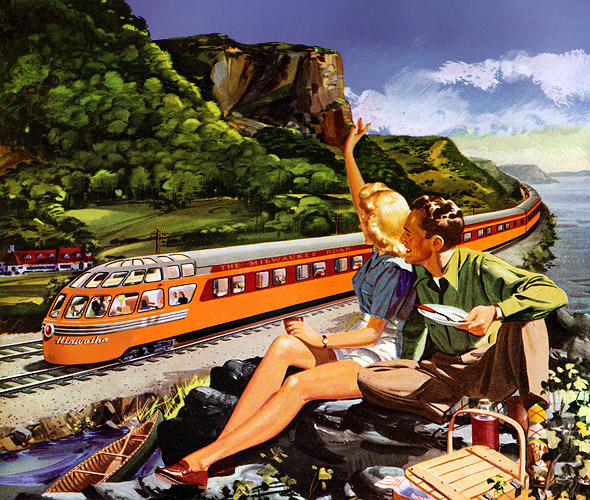
This wasn't the only train station in Chicago by a long shot, but it was the grandest. It was the place where I fell in love with trains. While Union Staton was more often than not our Sunday destination, every once in a while we'd actually hop on a train, usually one of the commuter lines, the Burlington to Aurora, or the Milwaukee Road to Elgin. Then there was our annual summer trip to Milwaukee aboard the Hiawatha with its beautiful skytop lounge car designed by Brooks Stevens. Here it is from the inside.

I remember coming back from those trips, getting off the train and the great concourse welcomed us back home like an old friend.

The end came around the time the railroads gave up on passenger service and the national passenger service Amtrak was born. Everything became stripped down and the grand concourse was deemed superfluous as there was no revenue generating possibility in it as was the case with the offices across the street in the headhouse.

I don't remember how I felt when I heard the news, as a child I was probably swayed by the propaganda of the time that you can't interfere with progress. There was an allure back then that I succumbed to of the new, the shiny, the modern, as opposed to the dingy, old buildings that symbolized the dark ages to many. I do remember my last few visits, disembarking from the Elgin train, seeing the place illuminated by the fading orange light at the end of the day and realizing that it soon would be no more. And I remember watching from the Adams Street bridge as the headache ball rammed into the clerestory window above the columns of the east side of the building as the grand old building stubbornly gave up her ghost.

The construction of the new building lasted a year or two, and during that time you'd get off the train and be guided through construction tunnels that led either to the street above or to the waiting room which back then looked a little threadbare . Eventually the new building opened and it didn't appear much different than when it was under construction. Instead of great vaulted ceilings that reached forty feet up or more, you had dropped ceilings, 10 feet high if you were lucky, covered with acoustic tiles. The new joint was designed to be functional and efficient, but was neither, and the once grand arrival into Chicago was replaced by a whimper, or more tragically a whatever.

The destruction of Union Station mirrors that of Penn Station in a few ways. The two buildings were state of the art train stations built toward the end of the golden age of rail travel. Both had similar architecture, Union Station being greatly influenced by the design of Penn's a decade earlier. And both were replaced by buildings that were so bad they had to be reworked several times during their existence. Penn Station's replacement itself has often been threatened with demolition. We're not so fortunate here.

The interior of the Union Station concourse was remodeled in the nineties. While it doesn't come anywhere close to the magnificence of what was lost forty years ago it is much more palatable today than it was when it first opened.

As for the exterior well...

Tuesday, June 9, 2009

And you think the CTA is bad...

Be glad you don't live in Rochester.
Or in most other places in the U.S. for that matter.

Actually the blogger's last statement begs the question, why not consider investing in a bike?

Saturday, February 28, 2009

Efficient Trasportation...

Is there any better argument for the funding of mass transportation?

Bad news for cruise ships.