Showing posts with label State Street. Show all posts

Sunday, November 29, 2020

Grand Avenue

The title of this post makes me think back to the smile I used to get upon hearing a particular recorded announcement on the Red Line Subway in Chicago. When the train approached the Grand Avenue station, the canned voice of the CTA would call out the stop with a hearty: 

"THIS IS GRAND!!!"

Unfortunately about ten years ago, someone saw fit to change the announcement to a more subdued: "this is Grand and State", the official name of the station. 

I always wondered how Grand Avenue in Chicago got its name. Granted, it is a major street, an east/west thoroughfare that extends the entire width of the city and well beyond into the suburbs. The fact that it doesn't run perfectly due east and west for its entirety is a sure sign that the street is older than Chicago itself and its rigid street grid system. As is the case with about a dozen major streets in this city, Grand Avenue follows what was once a Native American trail. 

Grand is an interesting street, especially for a lover of all things urban like me. It's neither pretty nor glamorous.  In its course it runs through a wide variety of neighborhoods from the trendy River North section of town, to the more rough-and-tumble sections of the West Side which themselves are going through transformations as city neighborhoods are wont to do. If you were to travel the entire length of Grand Avenue east to west from Navy Pier to where it exits the city proper at Harlem Avenue, your general impression is that the street is, and especially was, predominantly industrial.

Interesting as such, but what exactly is grand about it?

How DID it get its name?

Through many hours of tireless research, (wink wink), I learned that in the year Chicago was incorporated, 1833, its first chief executive Thomas Jefferson Vance Owen declared his toddling town to be "a grand place to live." One of the main streets at the time in the town of Chicago was you guessed it, and the name has stuck to this day. 

Granted, not a terrific story but it's the best I could come up with.

Grand isn't the only street in Chicago history to boast that lofty title. If you travel down Martin Luther King Drive on the city's south side roughly between 35th and 63rd Streets, it's not too difficult to understand why that stretch of road was once named Grand Boulevard. In stark contrast to its north side namesake, the former Grand Boulevard, part of this city's magnificent Park and Boulevard System,  is still one of Chicago's most beautiful, historic and significant streets. Decades of hard times and neglect due to segregation caused by systematic racism hasn't changed any of that. 

For reasons unknown to me, perhaps just to avoid confusion with the north side street, Grand Boulevard was re-named South Park Avenue in 1923, then South Parkway in 1940. In July of 1968, it was re-named to honor the memory of the recently assassinated civil rights leader.  

Much like Chicago's Grand Boulevard, ninety miles to the north, Milwaukee's Grand Avenue was once lined by the mansions of the wealthy, but even more so. In fact, many of the most prominent Milwaukeeans of the 19th Century, the folks whose names you still see all over town by the things named after them, had Grand Avenue addresses.  

Originally named Spring Street, the east/west thoroughfare was so opulent that perhaps as a marketing gimmick by local burghers to lure tourists (which succeeded), the street was re-christened Grand Avenue in 1876. According to this article in the Encyclopedia of Milwaukee, some Milwaukeeans at the time rolled their eyes and scoffed at the notion, saying a more appropriate name might have been "Snobby Avenue." 

Milwaukee's Grand Avenue ran from what was then the western border of the city, east to the Milwaukee River. Wisconsin Avenue, the street which continued east of the river to the lake, was the heart of Downtown. As Downtown Milwaukee expanded west of the river, a new streetcar line was built making The Avenue (as it is still affectionately referred to) a commercial thoroughfare. This encouraged the construction of apartment buildings and commercial enterprises increasing population density. As Grand Avenue became a trifle less grand (in other words, exclusive), and the original Cream City movers and shakers began to die off, their offspring pulled up stakes and moved to the tony suburbs, still exclusive to this day. 

In 1926, Grand Avenue ceased to be (in name only) as the city merged the east and west portions of the street into one Wisconsin Avenue, the city's main thoroughfare, Milwaukee's equivalent of Chicago's State Street. Today there is barely a trace of the opulence of Grand Avenue of old as virtually all of the mansions that lined the street are long gone. One exception is the Wisconsin Club, housed in the former mansion of railroad magnate Alexander Mitchell (whose grandson General Billy Mitchell was influential in the development of US military aviation during WWI, AND for whom Milwaukee's airport is named). The other is a museum in the former mansion of Frederick Pabst, a name that is perhaps familiar to you if you know anything about beer.  

If you know your Chicago history, the fate of Milwaukee's Grand Avenue might sound familiar as the stretch of Michigan Avenue originally known as Pine Street north of the Chicago River, concurrently underwent a similar transformation. Another example of typical early 20th Century American urban transformation albeit fictitious, is portrayed in Booth Tarkington's 1918 novel, The Magnificent Ambersons. 

As I've mentioned time and again in this space, I have a particular love of Milwaukee as it's a city that I've been visiting all my life. My grandparents, (well my grandmother and surrogate grandfather) used to take me there every summer, starting when I was about four years old. Why Milwaukee I'm not certain, we had no family there. My guess is that my Hannover born surrogate grandfather, Mr Willie as we all called him, must have felt at home with the German culture of the town. We'd always stay at the Schroeder, (today Hotel Milawukee City Center), a massive 1920's hotel located on Wisconsin Avenue and 5th Street, five blocks west of the river, and make a pilgrimage to at least one of the classic German restaurants, Maders or the late, great Karl Ratszch's. And certainly no visit to Brewtown was ever complete without a brewery tour. 

Visiting a place periodically as we did, makes one particularly aware of change. Over the span of the years of our visits, roughly 1962 through 1974, I personally witnessed dramatic changes to the neighborhood immediately surrounding our hotel.

One of my earliest memories of Milwaukee was the frenetic energy of Wisconsin Avenue which by the time I first came on the scene in the early sixties, was probably already on the decline. Wisconsin Avenue really did mirror State Street in Chicago's Loop in many ways; one was that the further you moved up the street, in the case of Wisconsin Ave., the closer you got to the lake to the east, the more upscale things got. East of the Schroeder was the major retail section of the city with the big department stores such as Gimbel's and the Boston Store. The really refined shopping, I suppose Milwaukee's version of The Magnificent Mile in Chicago, was between the river and the lake. The Avenue west of the Schroeder had a slightly more working class feel. From the get go, my grandparents and I explored the Avenue both east and west of the hotel.

Something that really caught my attention as a four year old and have never forgotten, was an enormous illuminated billboard attached to the side of a tall building which I believe was the 1930 Art Deco Wisconsin Tower (originally the Mariner Tower), just west of the hotel. Here is a photo pulled off the Web, made around 1935 which shows in the background, the tower on the left with an early iteration of its billboard, and the Schroeder Hotel in the center. 

An interesting testament to the dual nature of the Avenue east and west of the hotel is that viewed from the posh east, the sign-less silhouette of Mariner Tower, made for an elegant contribution to the skyline whereas from the day to day west, the enormous billboard gave off an entirely different vibe, especially at night when it evoked the feeling of film noir or a hard boiled detective novel.

Incidentally, advertised on that sign c.1963 was Canfields 50/50 Soda which is still produced. To this day every time I pass a six-pack of 50/50 at the store I'm immediately transported back to that time and place.

Another indelible memory of the Avenue west of the Schroeder is that of the Holloway House Cafeteria, which we frequented every visit until its closing. Back in those days, before restaurant cream came in packages hermetically sealed at the factory, it was served in little glass containers made to contain exactly one serving of cream for a cup of coffee. At that particular establishment, those little shot glasses had the image of Elsie the Cow, the symbol of the Borden Milk Company imprinted upon them. I'm not sure how one came into my possession, either we asked for it or my grandmother just slipped it into her purse, something she wasn't beyond doing, but that little cream container became one of my most cherished possessions as a small child. Call it my Rosebud moment, it disappeared long ago, but the memory remains. If my last word on this earth happens to be "Elsie", you'll know what I'm referring to.

At the same time, I remember the construction of a twenty story office tower just west of our hotel. The construction took place over several visits and I remember being fascinated by the progress of the tower from visit to visit. Unfortunately the completed building, once known as the Clark Building, now referred to simply by its address, 633 Wisconsin, has to be one of the ugliest buildings in the city, if not the nation. Built in a truly uninspired Modernist style, soul-less buildings such as this one I believe, contributed to the general public's repulsion for contemporary architecture. Making matters worse, the building housed the city's Greyhound Bus terminal which I have no doubt contributed to the steady decline of the neighborhood west of the hotel. By the time of our last visit, that part of the Avenue, what remained of it that is, became seedy and run down. 

By our last visit, (Mr. Willie died in 1976),  the shopping avenue east of the hotel remained intact albeit in somewhat faded glory. Again it's a story repeated time and again in major urban areas all across the country as downtown shopping districts began their slow and steady decline after WWII when the middle class began to follow the well-to-do into the suburbs. The advent of the suburban "shopping center" attracted customers by their readily available parking and the one quality that reigned supreme in those days, they were new. Nonetheless, in the sixties and into the early seventies when I was still a child, going downtown with the theaters, the big stores and their fancy restaurants, was still special. 

Unfortunately not special enough to make it feasible to keep those establishments afloat. In Downtown Milwaukee as in virtually every other big city downtown in the United States, one by one, stores, restaurants and theaters that had been fixtures for decades began to shut down.       

Clearly thought the urban planners, something was drastically wrong with the design and even the concept of Downtown as we knew it. The idea was that the heavy street traffic on major shopping avenues was not conducive to a pleasant shopping experience. One of the earliest and most successful attempts to transform an American central business district was Niccolet Mall in Minneapolis. There, eight blocks of the main thoroughfare, Niccolet Avenue, were shut off from vehicular traffic, except for public transportation. Trees were planted making for a park-like atmosphere. In addition, indoor arcades were constructed to connect adjacent shops, and skyways were built to traverse streets, enabling visitors to roam from shop to shop in virtually all of Downtown Minneapolis without having to go outside, something very welcome especially during the brutal Minnesota winters. 

Eventually cities all over the country emulated Niccolet Mall in one or more of its features. In Chicago, the commercial section of State Street like Niccolet Avenue, was closed to vehicular traffic except for busses. The sidewalks were widened somewhat, public sculptures were installed, and trees were planted in the median. One problem was that so many busses still ran up and down State Street, that the steady stream of them in addition to the reduced width of the roadway, created a constant traffic jam and pollution, even worse than before, completely defeating the purpose of a supposedly user-friendly pedestrian mall. Another problem was that the mall was created during the period that was probably the nadir of design in the United States, when architects had little or no interest in creating work that had any respect for what existed before. Consequently the thing looked awful, even when it was new. Thus the State Street Mall was doomed from the outset and removed in 1996.

Milwaukee took the opposite approach. Like State Street, Wisconsin Avenue was the major artery for bus traffic, which is the only form of public transportation in that city. So they turned inward and created and indoor mall which connected all the shops on the south side of the Avenue with bridges and skyways. They already had a head start as the lovely Plankington Building, named after another former resident of Grand Avenue, banker an industrialist John Plankington, was designed in 1916 with an indoor atrium that (nearly but not quite) rivals the Cleveland Arcade in its beauty as an interior space.   

Plankington Building
as part of the Grand Avenue Mall, c. 1983

The indoor mall which extended from the Boston Store all the way east to the old Gimbel's which was by then re-branded as Marshall Fields, was given a very appropriate historical name, The Grand Avenue.

Unlike the State Street Mall, which was not only hideous but barely transformed its surroundings, The Grand Avenue, indeed something completely different, was a rousing success from the outset, drawing people back downtown, not just from the Milwaukee area, but from all over the state, as my wife can testify. 

Not surprisingly, much of its appeal, something Chicago never addressed, was the ample parking created to accommodate the new mall. A massive parking lot with an indoor connection to the facility was built, and an entire square block at Wisconsin and 5th, across the street from the Schroeder was levelled to provide even more parking. 

One unfortunate result of the mall is that it sapped all the life out of Wisconsin Avenue. Consequently the businesses that existed on the north side of Wisconsin, across the street from the Grand Avenue, were left to wither and die, which they eventually did. 

Within about a decade, the novelty of the Grand Avenue wore off, and it too began to fade. Unlike the State Street Mall which could be simply swept away returning the street to some semblance of its past, the damage wrought upon Wisconsin Avenue between the river and 5th Street thanks to the Grand Avenue Mall was much more profound. 

Here is a link to a thoroughly depressing 2017 YouTube video made by a guy who created a series of videos of dying shopping malls. 

Despite my family's continued visits to Milwaukee through the years, the Grand Avenue Mall fell off my radar about thirty years ago. After all was said and done, it was just another mall; we have lots of them here in Chicago just like it, so there was absolutely no reason to visit it because as I've pointed out time and again, there's plenty to see and do in Milwaukee. But in our most recent visit last week, my sports fan son wanted to see Fiserv Forum the new Milwaukee Buck's stadium downtown. After that we decided to take a drive west on Wisconsin Avenue before heading home. 

Sure enough much to our mild dismay, the Grand Avenue is no more. Turns out, one year after the dying mall video was made, the doors were finally closed and currently the space is being redeveloped as a mixed use business-residential-retail center. That means the grand old Wisconsin Avenue I knew as a child, save for the Schroeder Hotel, is gone for good. 

Which isn't necessarily a bad thing. Cities need to re-invent themselves from time to time in order to survive. In addition to being a hub for business and government, Downtown Milwaukee is still thriving as a sports, entertainment and convention center and as such, an economic engine for the rest of the city. Needless to say it took a hit during the pandemic. Hardest of all I'm sure was the cancellation of the Democratic National Convention which was scheduled for this past summer. 

But if by chance it doesn't bounce back from that hit, Milwaukee I'm sure will re-invent itself yet again, it just does that. 

Milwaukee, more than any city I know, seems to live its life inspired by these words of the character Eugene Morgan from The Manificent Amersons:
There aren't any old times. When times are gone, they're not old, they're dead. There aren't any times but new times.
For those of us who are not pleased with that, well we always have our memories to comfort us. 

Speaking of which, Elsie, where are you?

Friday, March 7, 2014

Sign of the times...

The good news: this gentleman found some part time work.

State Street, Chicago, February, 2014

The bad news: everything else.

Friday, February 24, 2012

Ready or not...

...here it comes. At long last the much rumored Target at Carson's is starting to make its presence felt in the landmark Louis Sullivan building on State Street.


Let's all hold our breath.

Friday, January 20, 2012

Streetwise

Berlin has the Ku'damm, St. Petersberg has Nevsky Prospekt, and New York City has Broadway. Great cities are defined by their iconic streets. Think of them - Bourbon Street,  the Champs ÉlyséesRegent Street, the Via Veneto and La Rambla all evoke images of and are inexorably tied to their respective cities.

Chicago's iconic street is State Street.

Michigan Avenue is more glamorous, the money's on La Salle Street, and Dearborn is a veritable history lesson of American commercial architecture, but no street evokes this city more than State Street. It's been that way since before the Great Fire of 1871.


The view above, a 1907 hand-colored postcard published by the Detroit Publishing Company, looks south down State from Lake Street. The second building on the left is Burnham and Root's long lost Masonic Temple. Just to the south of that is the Marshall Field Building (now Macy's). Louis Sullivan's masterpiece, the Schlesinger & Mayer, (Carson Pirie Scott) Store barely visible, is two blocks south of Fields.

Below is how State and Madison, at one time called the world's busiest intersection, looked ten years earlier in 1897 footage shot, or at least credited to Thomas Edison:

video

In the clip we're looking north, the Masonic Temple towering over neighboring buildings, is visible in the distance.

State Street is one of the longest streets in Chicago, covering over thirty miles from its beginnings in Crete, Illinois to its northern boundary, Lincoln Park. It is the dividing line between east and west in Chicago's grid system. That significance is lost on North Siders as the Lake cuts into what would be the east side,  just north of North Avenue. It's a much different story on the South Side where State is one of the major thoroughfares.

But its the one mile stretch of State, between Congress Street and the River, that gives the street its fame.

The credit for making State the Main Street of Chicago belongs to one man, Potter Palmer. In the 1850s, all the fashionable shops and hotels had Lake Street addresses, while State Street was a festering swamp. Palmer, who himself owned a dry goods store on Lake Street, bought up much of the property along that swamp. At the same time George Pullman devised a system of raising up buildings and sidewalks from grade level. A short time later, the streets themselves were raised out of the muck. Once dry, Palmer sold some of his State Street property to two former retail partners, Levi Leiter and Marshall Field, and developed much of the rest of State Street himself, most famously the hotel that still bears his name, the Palmer House.

In 1871 the Great Fire destroyed everything in its path, but in a few years, most everything was back in place, and State Street, rather than Lake Street, would reign supreme. With it, the major axis of Chicago changed from east/west, to north/south, from perpendicular to the lake, to parallel, much to the benefit of the city.

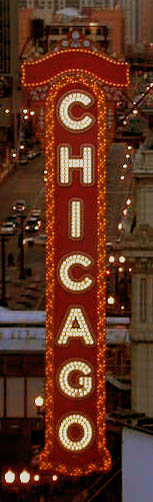
Before there was a Michigan Avenue north of the River, State Street was the shopping and entertainment heart of Chicago. All the local department stores had their flagship stores on the street, Sears, Montgomery Wards, the Boston Store, the Fair Store, Goldblatts, Wieboldts, Carsons, and of course, Marshall Fields. Smaller specialty shops as well as restaurants, night clubs and movie palaces filled in the gaps between the great stores. From early morning to well past midnight, the street was teaming with life. To this day, the marquee of the Chicago Theater proudly advertises itself and its city as the focal point of the view up State. The terms Downtown Chicago, The Loop, and State Street, were at one time, synonymous.

State Street's heyday as the preeminent Chicago street lasted around 100 years. I've written about the decline of the street here. Suffice it to say its fortunes were tied to the rest of Chicago. When the population of the city began its outward expansion after WWII, suburban shopping malls lured customers with the convenience of free parking, the perceived lack of crime, and that all important virtue, they were something new. Combine that with the massive commercial re-development of North Michigan Avenue in the seventies and eighties and the fact that State Street, with the exception of the construction of a half hearted mall, didn't adapt to the times, left the former Main Street virtually in the dust.

Yet there was a silver lining in that inertia. Eventually the suburban malls became old and boring and cities became hip. Unlike other cities that transformed their aging downtowns into clones of suburban malls which themselves became obsolete and barren, State Street remained essentiaily the same, physically anyway, and needed little work to get back to its original form. While it's a shadow of its former self, (it still has Michigan Avenue to contend with), there have been signs that the city and businesses are willing to gamble that there might yet be hope for State Street:
  • The Reliance Building, one of Chicago's architectural gems, was gutted, returned to its original splendor, and turned into the Burnham Hotel.
  • Bucking the trend, after a long absence, Sears opened up a new department store on State Street, in the building that once housed the Boston Store.
  • A major development was built on Block 37 bounded by State, Washington, Dearborn and Randolph, which was cleared 20 years before to make way for another more ambitious development that fell through the cracks.
  • Target announced that it will occupy the old Carson's store, (which was also restored). 
  • The Hilton Corporation recently sunk 170 million dollars into a major renovation of the aforementioned Palmer House Hotel.
The restorations of Carsons and the Reliance Building in my book are unqualified successes.

Unfortunately as The Grateful Dead pointed out several years ago: "every silver lining's got a touch of gray." Architecturally, Sears is a welcome addition to State Street with its semi-circular awning that mirrors the curved entrance to Carsons sitting catty corner from it on State and Madison. But there's not much to say about the inside which is as lack luster as any suburban version of the store. Needless to say, because of its parent corporation Sears Holdings' interest in profits for its investors over that of its retail business, the future of the store is much in doubt.

Block 37 in my opinion is a wretched piece of architecture, perhaps the worst building in Chicago given its prominent site. As I've pointed out before, the empty lot that occupied the site after the wanton destruction of many fine buildings, was probably better than the building that replaced it.

Another disappointment is the Palmer House renovation. Granted this disappointment is not in the same league as the fiasco over at Block 37, it's just another project that could have been handled so much better. Last week I was involved in an exchange in the comment section of another blog. In a post, the author commented on how the replacement of a vintage Modernist storefront on the block (by the same developer that renovated the Palmer house) was justified. Here's the money quote:
While the old Bakers Shoes was a great piece of history, it was not preserved as such.  If it was kept in pristine condition, people might have appreciated it.  But the fact of the matter is that it was another dark, grungy, dirty storefront that didn’t fit into State Street’s increasingly squeaky clean image. 
I wrote a comment on the post expressing my feeling that restoration of the storefront was preferable to the renovation of Baker's, and added my concern about the developers diminishing the Palmer House's State Street entrance to little more than a service entrance.

Original 1940s storefront shortly before its demolition
Of the two unfortunate choices by the developer Thor Equities of New York, I'm having difficulty deciding which is the greater transgression. Until last year, the entrance to Baker's Shoes (originally Chandler's) was one of the last extant examples of a vintage Loop storefront. "Dark and grungy" as it may have been, it didn't take much imagination to conjure up how beautiful it once looked and how little it would have taken to return it to its former glory. It was an original work with its undulating lines, asymmetry, and open display area that, in the words of Chicago Tribune architecture critic Blair Kamin: "sacrificed interior square footage for a visual drama meant to suck pedestrians in the door." "Drama" is not a word often used to describe the storefronts of Chicago, nor are the terms "abstract", or "work of art" for that matter. This storefront was all three, to me on closer inspection it evoked the whimsy of the Catalonian Surrealist painter, Joan Miró.

Baker's renovation, January 12, 2012
Well it's gone now, the space has been divided in two,  and even though it's a separate building, its public face will "fit in" with the Palmer House's new State Street arcade of storefronts. The photo on the right is how the building looked last week, still under construction, shortly after the barriers were removed. This is much the same view as the photograph taken in the late forties that opens Blair Kamin's article on the transformation of Baker's last February. From that sixty year old photo you see three Modern storefronts, Chandler's in the middle, the clothier Baskin in its own Modernist Building (by the same architectural firm) on the right, and another unidentified storefront on the left. The Baskin building was replaced about twenty years ago by the structure you see on the right of the contemporary photograph that houses a cooling unit that services much of the Loop. The storefront on the left was replaced I'm guessing in the sixties by the absurd clapboard facade of the Beef and Brandy restaurant. And while all traces of Modernist design are gone from this view, a replica of the old gaslight inspired lamp post, identical to the one in the old photograph, has made a triumphal return. The contrast between the the modern photograph and the one in Kamin's piece, clearly illustrates how little respect is given in this city to the Modern era.

Lynn Becker's post, on the subject, the inspiration for my original post about Baker's, includes a heartbreaking photograph of another long gone Modernist storefront on State Street, Alfred S. Alschuler's Benson Rixon store. See it and weep. *

Pictured on the left are some of the Palmer House storefronts that Baker's will soon fit in with. They're good enough I suppose, if not very interesting. Looking carefully at the photograph, click on it to enlarge if you have to, you'll notice that between the Aldo and Crocs shoe stores, is the new State Street entrance of the Palmer House. This is the current presence of the most iconic institution on the city's most iconic street, that I alluded to in my comment on the blog post.

The decision to re-configure the Baker's storefront was an economic and aesthetic one. The alteration of the Palmer House State Street entrance was a symbolic one. The hotel whose founder created what would become the most important street in the city, has turned its back on that street.

The author of the blog responded to my comment with a suggestion that did not occur to me. Perhaps the city may have cut a deal with the hotel to reduce its presence on State Street in order to discourage taxis from tying up traffic by dropping off, picking up passengers and queuing up in front of the hotel. The two major hotel entrances on Monroe Street and Wabash Avenue would serve that purpose (as they have for decades) and improve traffic on the major artery, State Street. It's a plausible theory.

Whatever the reason for diminishing the Palmer House's presence on State Street, it's a lousy idea as far as State Street is concerned. If the author's theory is correct and the city is responsible for the changes, it's clear that the city is more interested in improving vehicular traffic than in revitalizing State Street.

If the idea came from the hotel, then it's a clear message that State Street, with its mid to low level shops, (including the ones housed in the hotel building), predominantly targeted toward teenagers and young adults, is not worthy of the clientele the hotel hopes to attract. That point is even clearer from the interior of the hotel where before the renovation, there was a clear passageway between Wabash Avenue and State Street. Today you can still walk through the hotel between those two streets, but you do a double take as you approach State, where the passageway diminishes greatly and it's not altogether clear that the way to State is even publicly accessible. The Palmer House in no subtle way is directing its guests eastward, toward Michigan Avenue and Millennium Park, and away from State Street.

The streets I mentioned at the top of this post all owe their greatness to the fact that they attract people. When crowded, those streets are vital, they constitute the lifeblood of their respective cities. When they are empty, they're just collections of storefronts.

State Street is no exception.

Its life force is evident in the two pictures above from over one hundred years ago. That vitality was still very much evident in my childhood, it diminished throughout my teens, and all but died in my early adult years. In its heyday, State Street belonged to all of Chicago, its shops appealed to young and old, black and white, rich and poor. Goldblatts the workingman's emporium filled up its magnificent terra cotta building that stood only a few blocks from the upscale Marshall Fields. The street's culinary delights ranged from the continental Fritzels, to the lunch counter at Woolworths. Its entertainment ranged from live stage shows featuring Frank Sinatra and Count Basie at the Chicago Theater to live burlesque shows in the strip joints at the other end of the Loop.

State Street was the setting for all the great parades, most notably the St. Patrick's Day Parade, Chicago's version of the old May Day parade in Moscow's Red Square. Even when the holiday fell on a work day, it seemed that everyone in Chicago turned out for it. Never before in my life or since have I experienced the crush of humanity than at some of those parades, especially across from the reviewing stand at State and Madison. It was terrifying and exhilarating at the same time.

Nowadays there's hardly ever a big crowd on State Street, let alone a crush. All but two of the big stores are gone as are most of the old theaters, and the interesting shops. Fritzels is long gone and so is Woolworth's. The parades are a thing of the past. Not that there aren't worthwhile bits and pieces to State Street. The much needed and pathetically underutilized Harold Washington Library forms an anchor for South State Street. DePaul University and the School of the Art Institute have a strong presence and bring a much needed infusion of young people (read, the future), to State Street. The Gene Siskel Film Center forms another cultural anchor on the north side of the Loop. Of course the Chicago Theater and its grand marquee still stand as a reminder of what once was and what could be.

While it's a bit of a mixed bag architecturally, State Street does boast some of the greatest buildings in Chicago. It has also lost more great buildings than any other street in the city.

I think the biggest loss on State Street today is its complexity, that incredible mix of the elegant, the tawdry, and everything in between that defined the street for over 100 years. Today everything is neat and respectable, nothing too out of the ordinary, and certainly nothing offensive. But with the exception of a handful of great buildings, there's nothing outstanding either. That goofy Beef and Brandy facade is looking better and better to me every day. Of course that'll be gone soon enough, replaced by another tasteful, bland storefront.

State Street today is a little like a pair of dull ice skates where the edges are gone and all that's left is the middle which just doesn't grip the ice very well.

Clearly, State Street's importance to this city isn't merely as a conduit for traffic. The recent steps to bring life back to the street are a good beginning for the most part. The old department stores aren't coming back and State Street won't ever be what it once was. But I believe the city could do a better job of mixing things up by encouraging small and big businesses alike to open up shop, and integrating the old street, turning it back into the premier thoroughfare it deserves to be.

One way they can start is to bring back the parades.

After all as Sinatra and Mayor Washington famously sang:
On State Street that great street I just want to say,
they do things they don't do on Broadway.
They have the time the time of their life,
I saw a man he danced with his wife,
in Chicago, Chicago my home town.
Sorry, I couldn't resist.


* The building that once housed the Benson Rixon store still exists in altered form but the storefront is gone. It is now a McDonald's.

Friday, August 26, 2011

Gone...

I was walking on State Street yesterday when I noticed that the wonderful art-moderne storefront of Baker's shoe store on State Street is gone.

Strangely enough, the wonky clapboard facade of the Beef and Brandy restaurant next door lives at least for another day.

Wyatt Earp would be pleased.

Friday, March 18, 2011

The 2011 Chicago Seven

Here is Preservation Chicago's 2011 list of the seven most endangered buildings and districts in Chicago. I am personally familiar with six of the seven sites, have very close personal ties to two of them, and walk by two of the buildings on the list almost every week day.

Preservation of buildings is a mixed bag, in a perfect world we'd like to be able to save every good building (not to mention the great ones), or buildings that have historical significance. In the real world however there are so many factors that can make preservation impractical or impossible. Usually it all comes down to economics, public safety, law, or a combination of all three.

Two of the buildings on the list are houses of worship which by their very nature automatically gives them historical significance. They also prove to be the most difficult buildings to save, as our laws prohibit government from meddling in church affairs, including their architecture. Even if the government had a say, it would be difficult to make the argument that a church should devote its resources toward saving a building rather than ministering to its people. Consequently we can't landmark a church as we would another type of building. This has come up previously in this space regarding the fate of the once magnificent St. Boniface Church on the near northwest side that continues to stand and decay as it awaits an uncertain future. St. Lawrence Church in the Grand Crossing neighborhood on the south side, the one building on the list I have never visited, has not been empty for as long as St. Boniface and it appears to be in fairly good shape. Preservation Chicago urges creative re-use for the building. I have mixed feelings about converting churches to secular use but I suppose that saving a church building as a community center, or anything else is preferable to not saving it at all.

In the case of Shepherd's Temple on Douglas Boulevard on the west side, the building is a testament to what was once a major center of Jewish life in Chicago. It is one of the most striking examples of synagogue architecture on a boulevard lined with many. Its loss would leave a tremendous void in the neighborhood. Here is a link to some photographs of the interior of the gutted Temple which later was converted to a Baptist church.

The Pullman Historic District is already a landmarked community, but as Preservation Chicago points out, the area north of 111th Street which includes a small residential neighborhood as well as the burned out remnants of Pullman Works, is suffering from terrible neglect. South of 111th you will find Hotel Florence and a community that is still very much intact. The charm of the neighborhood belies the turmoil of its past as a company town conceived and built by one of the greatest, and also perhaps most despised industrialists of 19th Century Chicago, George Pullman. Here is the Encyclopedia of Chicago's article on the neighborhood of Pullman.

The sites where I have the closest personal connection are two hospitals, Children's Memorial, which is moving its campus south to Streeterville, and the former Prentice Women's Hospital. Presntice was the site of the births of both our children, and many anxious moments have been spent with our kids at Children's Memorial. Of all the buildings mentioned in the list, Prentice is perhaps the most architecturally significant, designed by Bertrand Goldberg, employing his signature cylindrical motif. It's an innovative, unique design that would be a shame to lose, especially given the fact that it could be adapted to any number of alternate uses. It is also by far the newest building on the list, barely over thirty tears old. It has been replaced by a state of the art facility a block away and while it could be converted, its location in the midst of a hospital campus makes that scenario a little more complicated. It is showing its age, my wife pointed out that the concrete facade gives the building the perpetual appearance of being dirty. Yet for obvious reasons I would be brokenhearted to see it go.
.
The University of Chicago's purchase of the Chicago Theological Seminary along with its plans to convert it to the Milton Friedman Institute for Research in Economics threatens three important Chicago interiors of the Gothic Revival style. Several magnificent stained glass windows have already been removed and more are to follow as the University deems them "inappropriate" for an Economics school. Preservation Chicago also expresses concern for the entire 5700 block of south Woodlawn, a residential block slowly being taken over by the rapacious University. This is truly one of the loveliest blocks in all of Chicago and the destruction of all or part of it would be a crime.

Finally, two skyscrapers on State Street that share one block, 202 and 220 S. State Street are threatened by an unlikely source, the Federal Government, who has expressed interest in demolishing them and redeveloping the block. This would be a sham as these buildings are significant as part of the fabric, albeit diminished of State Street. The 202 building, pictured at the top of this post, was designed by Holibird and Roche and is in fact one of my favorite buildings on State Street. You may recall last year I mentioned it in connection with the late great Republic Building designed by the same firm, that once stood directly across the street to the east. 220 South State is another fine, if not exceptional building whose loss would be a travesty.

Of all these unfortunate new members of the threatened architecture club, Preservation Chicago makes the strongest case for saving and rehabilitating these two wonderful buildings. Read it for yourself here on a PDF.

Goodness knows that State Street, once this city's premier thoroughfare, has suffered enough indignities over the past fifty years. One would only hope that the government will see the light and find a way to creatively adapt these fine buildings to their needs, or at the very least, let them stand until they find someone who can. A city that claims to be an major architectural capital can't afford to let go of any more significant buildings in the heart of the city.

Tuesday, February 22, 2011

You don't know what you've got 'till it's gone...

... are the words of the wonderful Joni Mitchell song "Big Yellow Taxi." And ain't it the truth? Quite honestly I never gave much thought to this storefront until Blair Kamin and later Lynn Becker wrote about its imminent demise. I have passed this store literally thousands of times in my life, never thinking of it as anything special, just another women's shoe store.

Well shame on me. Granted this storefront dating back to the late 1940s on State Street has seen better days. Like all architecture of the period, it has to be kept in ship shape condition to retain its luster, the steel has to be polished, the glass regularly cleaned and all minor imperfections corrected. Here the coup d'gras has to be the metal spikes placed to prevent pigeons from roosting on top of the display windows.


Still it doesn't take much imagination to see this store as the gem it once was, the work of the estimable firm of Holabird, Root & Burgee, one of the finest examples of Modernist storefront architecture in the city. Unfortunately its current owners see the elegant undulating surfaces that reflect the Chicago skyline, and the ample entrance, display area as wasted space. They plan to correct this "problem" by bringing the entrance up to the property line, creating more workable space inside the store, enabling them to divide the space in two, clearly an astute business decision.

But what a loss to the city.

Friday, February 18, 2011

You win some and then...

The day after the optimistic news of Target's plans to set up shop in the old Carson, Pirie, Scott store on State Street, came the terrible news of the bookstore chain Borders going into Chapter 11 bankruptcy.

The headline of the Tribune article about Borders said the chain would close half of its Chicago area stores. Checking the list of closures however, it appears they plan to close 100 percent of the stores that my family and I frequent on a regular basis. As I mentioned in my previous post about Carson's, I spent a lot of my life wandering around department stores but never spent much money in them. Bookstores are another story. I've spent countless hours browsing, and seldom have I left a bookshop without money changing hands.

The Borders store where my family and I have spent the most time is about ten minutes from home, in downtown Evanston. It has been a fixture of our lives for as long as our children have. We have many happy memories of that store. Countless children's books that mark the passing of time in Theo and Rose's young lives were purchased there, not to mention the books and magazines that illustrate my wife's and my passions over the last ten years. Saddest of all will be the loss for the people who work there, for the most part folks who care deeply about their work, and passed along their love of books to their customers. I wish them all the best in their future endeavors.

That store was the main draw for us to the town of Evanston, but not the only one. Evanston has a vibrant downtown and we consider ourselves fortunate to live so close. Besides, there is a Barnes and Noble about a block away so our lives in that respect will probably not change much as a result of the store's closing.

The same can't be said about the Borders store on Lincoln Avenue near Devon. More happy memories there as well as we found ourselves spending a lot of time in that shop if we happened to be coming up Lincoln or from points west of our home. There is no other reason for us to visit the otherwise uninspired Lincoln Village shopping center, so that chapter of our life is closed.

A little farther afield, there was the Northbrook store that we'd sometimes drop into if we were in the vicinity. I bought my copy of "The Sibley Guide to Birds" in that shop.

Once in a while on the way home from work, I'd stop in the Borders in the old Goldblatt's building in Uptown. That closing is perhaps the saddest of all to me as its presence signaled one spark of life in a shopping district of faded glory.

Then there are the two Borders closing on the south side of Chicago, the store in Hyde Park, a neighborhood that does not have a scarcity of book shops, and the store in Beverly, a neighborhood that does.

There are those who feel little sympathy for stores owned by a corporation they feel has engaged in predatory tactics. As mentioned above, Borders set up shop in Evanston very close to an existing Barnes and Noble, a comparable store. In the neighborhood of Lakeview on the north side, not only did they open up across the street from another B & N, but also down the block from an older, local independent chain store, Barbara's Bookstore. Barbara's could not compete with the two mega stores and closed that shop as they did also in Oak Park after Borders opened up in the old Marshall Field Building on Lake Street, one block from another long, established Barbara's.

That Oak Park Borders will remain open for now, but the Lakeview store is a goner.

The bookseller that is most associated with Chicago was Kroch's and Brentano's. At one time they dominated the scene, having stores in all the major shopping centers in the area and at least three in the Loop alone. Their closing in 1995 left an enormous void, leaving the Loop for a time with no quality booksellers. Borders opened up their State Street store about five years later to fill the void. Barnes and Noble followed suit shortly thereafter in the South Loop. The State Street store will be the one remaining Borders in Chicago proper.

Unlike their retail counterparts in other areas, the big chain booksellers didn't offer discounted merchandise in a no frills atmosphere. If anything, they went in the other direction, creating customer friendly environments that invited visitors to stick around and browse to their heart's content. Service was also a priority. The vast resources of a Borders or a Barnes and Noble insured that you could almost always get what you wanted, if they didn't have it on the shelves, they could get it for you asap. I dare say that some of these stores even surpassed the independents in many respects. There were a few big, discount book chains that resembled Walmarts more than traditional bookstores, but they didn't survive for long.

Still it is appealing to root for the Davids against the Goliaths. Independent booksellers have been going out of business at an alarming rate over the past thirty years. But the same can be said for independent retail merchants of all varieties. There are many reasons for this, not the least of which is the fact that for years, children, in this country anyway, have been encouraged to study hard, go to college and go for the golden ring, usually meaning getting into a profession. Few kids today I imagine dream of opening up or running a retail store when they grow up. The work is simply too hard, not glamorous enough, fraught with too much risk, for too little in return. The people who do open stores usually have passions for what they are selling, which is probably why today you'll find more independent booksellers than say, butcher shops or dry goods stores.*

The biggest culprit in Book Wars and the decline of the traditional bookstore of course is the computer. If they do it right, buyers can purchase books on-line for a fraction of what they pay at a brick and mortar store. To add insult to injury, some people use the generous comfort of the traditional bookstore to select what they want then go home and order the book from Amazon. I must admit to having done this myself a couple of times. Speaking of Amazon, they've also brought us the e-book which is wreaking havoc with the publishing industry and promises to do a lot more wreaking in the future. There is speculation that part of Borders' problems is that they did not address the e-book phenomenon as Barnes and Noble has.

So is the bankruptcy of Borders the death knell of the brick and mortar bookstore? Quite honestly I don't think so. I think back to the days when movie theaters urged their customers to "fight pay TV." They understood way back in the 60s that the day was coming when people would be able to access movies from the privacy of their own homes. Once that happened they figured, no one would go out to the movies. Of course that day did come and movie theaters closed at an appalling rate all over the country. But they didn't all close. People still feel the need to get out of the house and commune with other people. The collective experience of seeing a movie in public is a much different experience than watching a movie at home.

Shopping in public is a similar experience. For me as I suspect for countless others, there is no shopping experience that matches the joy of spending time in a bookstore. The presence of a bookshop is a sign that all's not lost in a neighborhood. As books are an essential part of my life, every bookshop that closes represents a little death for me. I know I'm not alone in this sentiment. The fact that Borders is not going away completely is cause for guarded optimism.

I wish them well along with their competitors, independent and otherwise.

Tuesday, February 15, 2011

The new face of State Street

In lavishing praise upon the big box chain Target for their plan to open a store in Louis Sullivan's masterpiece, the former Carson Pirie Scott Building on State Street, Mayor Daley in his typical "there you have it" fashion said this:

"State Street's not just State Street,....It's Michigan Avenue, it's Wabash, it's Dearborn, it's Wacker, it's Clark, it's Roosevelt Road. It's all of it. It's not -- it has to be more than just one street, and that's what it is. I mean, everything's connected."

Now I'm not entirely sure exactly what he was getting at, but one point I'm able to gather is that he feels State Street is no longer the State Street it once was.

The Huffington Post in their story about the new Target posted an on-line poll asking their readers the following:

How do you feel about Target moving in?

Great! More convenience, low prices, what could be wrong?

Terrible. Another giant corporation draining the character from our city.

I didn't vote because I could have easily chosen both options.

Those of us long time Chicagoans still think of State Street as special, the heart and center of our city, the street of (among other things) grand department stores, perhaps the greatest concentration of them anywhere in the world. We once proudly boasted that the intersection of State and Madison Streets, the location of the Carson's Building, was the busiest intersection in the world. Back in the day, State Street was definitely NOT Roosevelt Road, Wacker Drive, Michigan Avenue, or any other street in Chicago or anywhere else. State Street was State Street, period.

As for the building, it was the pinnacle of the career of Louis Sullivan. It was also The Master's swan song as never again would he see a commission as grand as this. Two magnificent curtain walls flanking a beautiful rounded bay and a highly ornate but not over the top arcade express all that Sullivan and the Chicago School of Architecture stood for. It is arguably the greatest building in Chicago.

Target on the other hand, is the epitome of automobile culture, of one stop, no frills, in and especially out convenience shopping. It symbolizes the suburban shopping strip, the vast wasteland located in Anywhere, USA. And it symbolizes a culture that cares only about corporate image and the bottom line, little if any at all for local history or culture.

I should know. Hardly a week goes by when I am not to be found at the local Target. As for the experience of shopping there, well I'll just say I simply cannot afford to pay for a pleasant shopping experience, so I shop at Target. In other words, I'm just as much to blame for this sad state of affairs as anybody else.

We have to face the fact that the State Street of our childhood is gone and is not coming back because the era of the department store is also history. Like me, most people love to wander around them and reminisce about the great department stores, but they prefer to spend their hard earned cash in the places where it goes the farthest. Volume is the name of the game and the big boxers have turned low overhead, sophisticated distribution models, and marketing into an art form. No company without their vast resources can possibly compete with them.

Which is precisely why I'll be buying my milk, toothpaste and paper towels at the new Target on State Street when it opens sometime next year. It will be convenient for me as it is smack dab between work and the train. I won't have to drive to the one in our neighborhood so often.

The building, now officially called the Sullivan Building, has undergone a massive restoration which began in 2006, ironically the same year that Carson's (as it is known in Chicago) announced it was leaving. Most noticeable is the reconstruction of the original cornice, the collumnade and the facade of the top floor. Save for one temporarily boarded up window, never in my life, and probably not since it was built at the turn of the last century, has the building looked so good. It has also been empty for the past five years. As we saw in the case of Block 37 a couple of blocks away, the city believes that something, anything in fact is better than vacant space in the heart of the Loop. Having spent some time in the new behemoth development (I can't bring myself to call it a building) that occupies the entire Block 37, I would have to say, well, maybe something could be said for nothing.

That's not to say I think that the Sullivan Building should remain vacant, not in the least. I think that if designed properly, the new store that the company in a departure from their traditional business model is billing as an "urban Target", will be a welcome addition to the Loop. These days after all, the Loop is a heavily residential neighborhood. I've often asked myself: "where do all those people shop?"

That said, while it will serve those of us who are already there, it's hard to imagine that a Target store would be a big draw to bring people into the Loop. Ideally I think it would have been better to have something a little more special, a destination, say like what Marshall Field's used to be. On the other hand it could have been much worse, it could have been a Walmart.

My biggest fear like everyone's, is that in their zeal for corporate identity, the Target folks will destroy the character of the building. Goodness knows the company has splattered their unavoidable logo everywhere possible, as Edward Lifson pointed out a few years ago on his blog. One only needs to look two blocks to the north to see what happened to the aforementioned late, great Marshall Field's store. While the company that bought it (ironically from the Target company), had the sense to leave the Field nameplates in front of the building, they have done everything possible in the name of corporate identity to destroy the character of the old Chicago institution by removing practically every vestige of the Field's legacy.

Now it's true that as a department store, Carson's was no Field's, neither as a store nor as an icon. Frankly I don't know many people who even miss it. It's also true that Sullivan designed the building to be a retail store, not an art museum, a school or anything else. It is entirely appropriate that it should continue to function as such. But the building is special and I would urge the brass at Target and their designers to downplay their "image" as much as possible, and let the design of the great building take center stage. They now have in their possession of one of our city's crown jewels, let's hope they don't mess it up.

Thursday, February 10, 2011

That once great street...

Here are links to a couple of articles about the pending destruction of yet another splendid storefront on State Street. What is about to be lost is a beautiful example of 1940's modernism, the entrance to Baker's Shoes which has recently closed this location and will re-open in what the developers hope to be a "new and up-to date" storefront. Lynn Becker's post includes a rendering of the new design which is inoffensive but certainly has none of the elegance or flair of the current storefront. The developers, Thor Equities, also own the Palmer House on the same block. Their recent renovation of the storied State Street hotel has indicated that they have turned their back on what was once Chicago's premier street, reducing the grand entrance on State to a service entrance, and a bland one at that.

Becker says:

"You don't build brand equity for State Street by making it a generic could-be-anywhere. You do it by building on its unique, historic qualities to set it apart and give people a reason to want to take a pass on the local strip mall to go there."

This seems to be a losing battle, especially on State Street as I remarked earlier here in a piece about the unfortunate demise of the splendid banking floor of the (less than splendid) Home Federal/Bank of America Building just to the south.

Chicago Tribune architecture Blair Kamin in his post carefully explains the motives behind the renovations and goes on to point out their short-sightedness.

Becker's post: "Killing State Streets character, one storefront at a time", couldn't be more aptly titled. Although State Street has arguably two of the finest extant examples of the Chicago School of Architecture, the Carson Pirie Department Store and the Reliance Building, it once boasted several magnificent buildings of varying styles that today are either long gone or were remodeled beyond recognition. Becker's post has a few photographs of other great, lost Modernist designs on State Street. Be sure also to check out his link to an archive of photographs of the Loop from the forties and fifties.

See the pictures and weep.


Monday, March 16, 2009

The de-mall-ition of State St.

Thinking about Chicago St. Patrick's Days of yore made me think about State Street and the former State Street Mall, that failed 70s attempt to attract shoppers back to "that great street".

In case you don't remember, the Loop experienced a serious decline in retail business during the sixties and seventies. The causes were many, not the least of which was the construction of suburban shopping malls. With the "if you can't beat 'em join em" spirit, city planners and officials joined cities all over the country and set into motion what turned out to be a well intentioned flop that not only failed to stop the hemorrhaging , but at least to most critics, exacerbated it.

The removal of the Mall in 1996 is credited with bringing life back to the Loop. In a recent article, the Boston Globe uses this as justification for returning automobile traffic back to Downtown Crossing, the pedestrian mall that closed off Washington Street to traffic in Downtown Boston.

Although I agree that getting rid of the mall of State Street was a good thing, I would probe a little deeper before rushing to judgment in removing these things elsewhere. Here are my recollections of the SSM:

First of all, having been constructed during the nadir of architecture in the US, the 1970s, the State Street Mall was terribly designed, implemented and constructed. The sidewalk was made of flagstones that were never properly laid giving it an undulating effect. Friends referred to it as the State Street Wide Sidewalk because little seemed to have changed, other than having replaced a perfectly good sidewalk with a crappy one.

Secondly, only private vehicles were banned, busses and municipal vehicles still used State Street. Unlike Nicollet Mall in Minneapolis where one, maybe two buses drove through every minute, here there was a continuous flow of them.

While the wider sidewalks reduced the density of pedestrian traffic, the narrower street increased the vehicular density. Ironically the overall effect was more vehicles and fewer pedestrians.
As the devil is in the details, they replaced distinctive vintage 50s metal streamlined subway entrances with awkward vintage 70s ones complete with plastic bubble tops. The whole thing just looked bad.

During the lifetime of the SSM, Sear's, Goldblatts, Montgomery Wards, Wieboldt's, Bond's, Baskin's and other stores all closed up shop on State Street. So did theaters and other smaller businesses.

The area became desolate especially at night, and people assumed (wrongly) that the Loop had a particularly high crime rate.

Leaving the question, had the mall not been built, would things have been different?

I don't think so. I believe that the trend away from downtown was inevitable given the growing dependence on the automobile. For basic shopping, why drive downtown, pay for parking and schlepp around in the elements when you could go to the burbs, park for free, and do all your shopping under one roof?

That was the logic of the time pure and simple. And it still is.

The mistake I believe was that the planners thought urban downtowns could compete at the same game as the suburban shopping malls, which of course was impossible. Once they realized that the city offered an experience that the cookie cutter malls couldn't, they got back on the right track.

But getting back to the State Street Mall and its failings; in retrospect I don't think it was such a bad thing. While North Michigan Avenue just a few blocks away was undergoing a renaissance at the time, the city could have easily turned its back on State Street in the Loop.

It didn't.

Reducing the use of private automobiles and encouraging public transit is a good thing. It just wasn't realized very well on the SSM.

What could have happened was a major overhaul in the design and infrastructure of the Loop as happened in Downtown Milwaukee. There they built a full scale indoor shopping mall called the Grand Avenue. They turned Wisconsin Avenue, the equivalent of State Street, inside out, putting all of the storefronts inside, away from the street. Parking was easily accessible if not free. The thing was a success when it was built in the 80s but today it has become tired and faded. Consequently no storefronts remain on Wisconsin Ave. and there is little or no life remaining on what was once a vibrant street.

At least Chicago's (pardon the expression) half-ass solution enabled the city to return State Street back into a street, if not to its former glory, yet anyway.

Still the return of the automobile did not prevent Carson Pirie Scott from closing its historic flagship store on State Street a couple of years ago.

In Boston people are split over the decision to open up Washington Street. Filene's is gone, business is down, some blame it on the mall and think returning the automobile will bring back business.

Here in Chicago, much of the development in the Loop has been residential not retail. Michigan Avenue not State Street remains Chicago's premier retail thoroughfare. Cities all across the country are experiencing similar issues with their downtowns, walking malls or not.

From my experience, Chicago's Loop is better off than most downtowns across the US.

But I don't believe that returning private cars to State Street is the reason.