Showing posts with label Chicago Parks. Show all posts

Thursday, July 26, 2018

Summer in the City

Summer of late has lost its glimmer for me, especially this one which so far has been unfortunately defined by the death of a dear loved one. I remember talking with my late cousin Bob when my children were small about the fate of a parent. He said: "Small children small problems, big children...". He didn't need to complete the thought. Truth be told, my wife and I have been blessed with two wonderful children who hardly give us any problems. Yet it is a fact of life that as kids get older and more independent, parents are faced with ever increasing challenges. but that's a story for another day. The bottom line as far as this story gores is this, summer just isn't as much fun as it used to be when the kids were small.

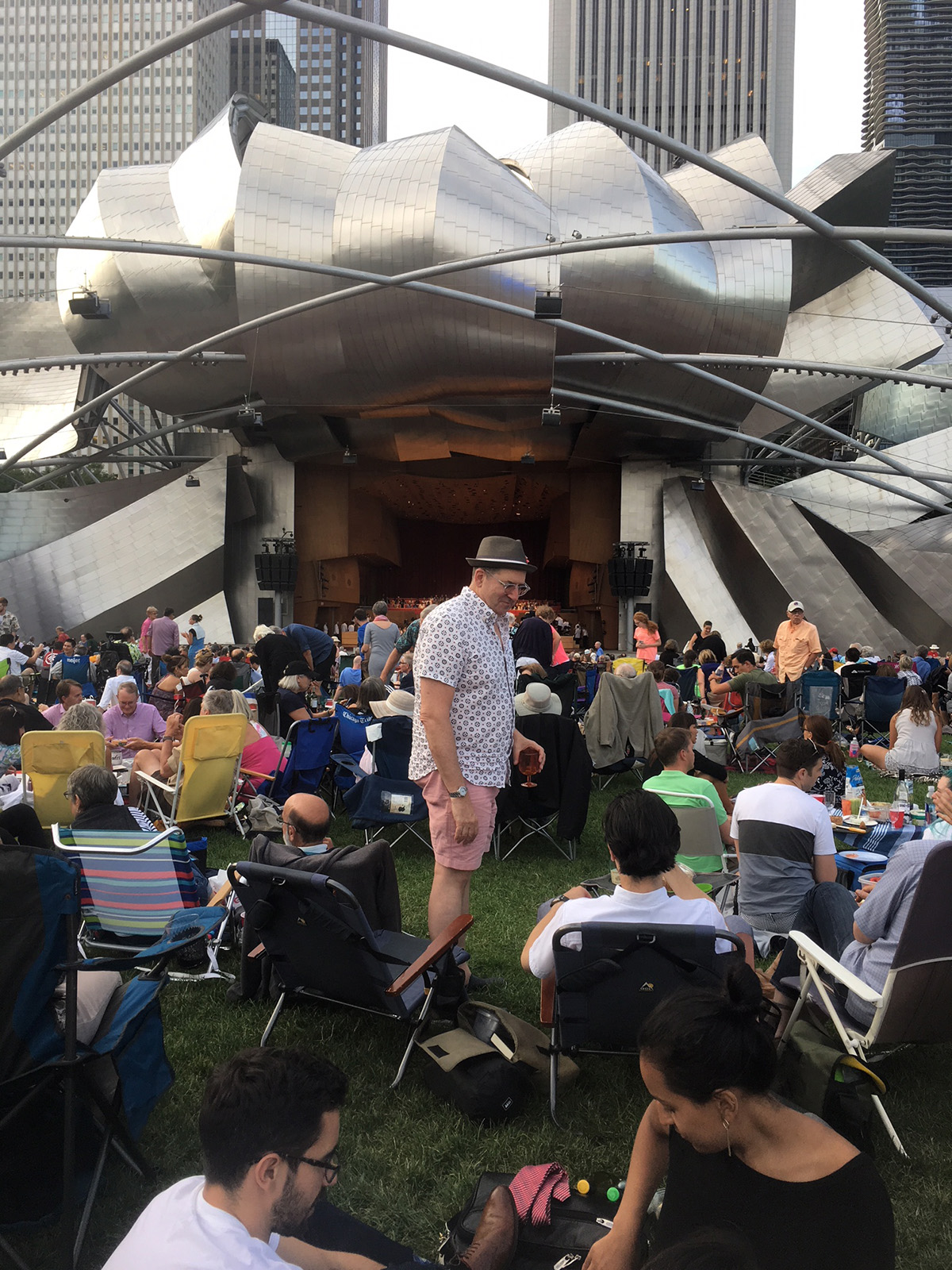
That said, my daughter and I took advantage of a lovely summer evening last week to go to one of this city's premier summer attractions, a concert in the Pritzker Pavillion in Millennium Park. Sadly it's something we don't take advantage of enough as the park is across the street from where I work. The last time we wre there was nine years ago when we attended a performance of Beethoven's Ninth Symphony. As I wrote in my post about it, that night wasn't exactly my finest moment. I was appalled by the crwod who were practically oblivious of being in the presence of over one hundrend young musicians and chorus members working their butts off performing one of the greatest works of music ever written, Judging by the way they carried on their conversations at full volume as the music played, they could have just as easily been at a barbeque in their backyard.

Anyway, I didn't behave well that evening as the people who were with me at the time, namely my wife and children keep reminding me.

Nine years older and wiser, I now realize that you cannot expect much from an outdoor audience at a free concert, I resolved to behave myself this year during the program that featured works of Haydn, Beethoven again, and Wagner.

Armed with that resolve, it was wonderful, even though the quiet strains ending the obscenely beautiful Tannhauser Overture, the piece that ended the concert, were all but drowned out by the crowd. 


Well at least we got our money's worth and then some, it was a lovely evening, one that I, and hopefully my daughter will remember for a long time.

Monday, May 30, 2016

A Walk in the Park

The brouhaha surrounding the Lucas Museum makes it easy to forget that the mission of the so-called "elitist" organization, Friends of the Parks, doesn't end at the lakefront. Rather, Friends of the Parks advocates a commitment to and the preservation of the parks and open spaces throughout the entire Chicago area.

The industrial ruins and decaying residential neighborhoods of the west side are the last place you might expect to find the crown jewel of Chicago's storied park system. But there it sits at the intersection of Central Park Boulevard and Lake Street, Garfield Park and its magnificent Conservatory.

Before the Great Fire of 1871, architect and engineer Willam Le Baron Jenney was hired by the commission who oversaw the parks on Chicago's west side to lay out plans for three major landscape parks and the boulevards to connect them. Jenny is most famous for having designed the first multi-story commercial building whose interior metal skeleton would support the outside wall, or in pure Chicago parlance, the world's first skyscraper. Fourteen years before the Home Insurance Building opened, the parks Jenny laid out would become Humboldt Park on the north. Douglas Park on the south, and appropriately enough, Central Park in between. Central Park would get a new name in 1881 after the assassination of the 20th president of the United States, James Garfield.

A tiny bit of the landscape of the Garfield Park community peaking though
the lush plants of the tropical house of the Conservatory.
One might consider Humboldt, Garfield and Douglas Parks and their connecting boulevards to constitute one greater park, much as you would the south side Jackson and Washington Parks and Midway Plaisance, the wide swath of park and boulevard that connects the two. The idea of a Chicago boulevard system creating a ring of parks that would connect the city and the lakefront goes all the way back to the 1840s and was the brainchild of one John S. Wright, an early real estate speculator and developer. Alas politics and the economy got in the way as they usually do, and no action was taken until the idea was picked up upon by the Chicago Times newspaper who in 1866 published a plan of a park system "one quarter mile wide and fourteen miles long" that would encircle the existing city starting at the northernmost part of the Chicago lake shore and ending at the southernmost.

The three west side parks of Jenny's would be among the first sections of the boulevard system to be realized. Unlike today's emphasis on recreation, the west side parks were designed with the typically mid-nineteenth century principle that parks were intended first and foremost to be a relief from the city, in the words of Lewis Mumford, they provided "refuge against the soiled and bedraggled works of man's creation."

Jenny's west side parks did just that. Curving carraige paths and walkways contrasted sharply with Chicago's practical but relentless street grid. Berms and strategically planed flora would wall off the everyday functions of the city from the parks' interiors. Quite the contrast from the typical architecture found in the city, the parks were filled with fanciful, ornate buildings that served as bandstands, conservatories, observation towers and field houses. The limited area set aside for the west side parks inspired Jenny and his associates to import species of plants from all over the world to make up for less than promising land features. Most of all, Jenny's liberal use of water, especially in Humboldt and Douglas Parks resulted in over fifty percent of their respective areas comprised of lagoons and small rivers.

Some of Jenny's plans were realized but yet again, fate, the economy, and a trait at which Chicago particularly excels, political corruption, all got in the way. It would take a scrupulous laborer from Denmark who had a particular talent in horticulture to see the project through to its completion. Along the way, Jens Jensen would become one of the most influential landscape philosophers and architects of the late nineteenth and early twentieth centuries.

It's well known that Jensen began his career in Chicago as a laborer in Humboldt Park then quickly made his way up the ladder to become park supervisor. Just as quickly, he lost that job because he wouldn't play along with the "Chicago way." Soon bygones became bygones and Jensen found himself as the director of the West Parks as well as their chief architect. Jensen, who came to love the prairie landscape of his adopted home, the American Midwest, was a strict advocate of using only native species in his plantings. Unlike his predecessors and many of his peers, Jensen did not believe you could improve upon nature.

"A great Midwestern haystack" The southern facade of the Garfield Park Conservatory
Slowly but surely, Jensen transformed the Humboldt, Garfield, Douglas trifecta into a glorious reflection and tribute to the landscape in which we inhabit. Gone were many of the trappings of Victoriana including the exotic buildings and more exotic flora, replaced by Prairie Style buildings and plantings. Jensen was not only a great landscape architect but he knew his way around a building as well. He designed the current Garfield Park Conservatory along the same principles of adherence to regional influence as his philosophy of planting. In an interesting contrast to the Lincoln Park Conservatory which looks like it could have been plucked straight out of nineteenth century London, Jensen's building, according to Julia Bachrach, author of The City in a Garden: A Photographic History of Chicago's Parks, is designed "to emulate the simple form of a great Midwestern haystack."

Throughout his career, Jensen had an on again off again relationship with Chicago and the West Park Commission. (The Chicago Park District which consolidated the many different park commissions in the city was not organized until 1934.) During one of those off again times, the baroque style  "Gold Dome Building" was built in 1928 to be the headquarters of the West Park Commission. After the establishment of the CPD, it would become the park's field house. Surely Jensen hated it, despite the fact that it and its eponymous dome are enduring symbols of the Garfield Park neighborhood that has to put it mildly, had its ups and downs over the years.

The Conservatory too has had its ups and downs, but in the last dozen years or so, much effort has been put into its restoration and today, despite being slightly off the beaten path, is one of the premier cultural institutions of this city.

Certainly in my lifetime and perhaps since it was built in 1908, the conservatory and its environs have never looked better. Most recently, several acres of land directly to the west of the conservatory were turned into The City Garden. 

Bridge spanning the vast lily pond of The City Garden.
As the newest public garden in Chicago, The City Garden, much like the great Palmisano Park on the site of a former limestone quarry in Bridgeport, embraces the industrial landscape surrounding it rather than walling it out. Built upon land that once was the site of tennis courts and a wading pool, The City Garden, according to the Garfield Park Conservatory website,
takes urban greening as its guiding principle, and it gives expression to that principle at multiple levels, from its structure to its materials and plantings. It also provides an important link in an ever-growing lacework of boulevards, gardens, and open spaces scattered beyond its borders.
City Garden in front of reminders of the west side of Chicago's industrial past
It is a little disconcerting to hear the rumbling of the L as you stroll through the multiple "garden communities" of The City Garden, including a grove of hawthorn trees supposedly planted by none other than Jens Jensen. But as Elwood Blues told his brother Jake when he spent the night at his place whose open window was about ten feet from the extremely busy Loop elevated structure, "you get used to it."

Although not as well known nor understood as Chicago's commercial and residential architectural history, Chicago has a distinguished history of landscape architecture. The legacy of Jenny, Jensen, Frederick Law Olmsted, Calvert Vaux, Alfred Caldwell and others, is one we can be proud of, one worth caring for. The City Garden, the Conservatory, Garfield Park and its sister parks Humboldt and Douglas, remain treasures to behold, no small effort, thanks in part to the tireless efforts of groups like Friends of the Parks.

Thanks folks for a job well done.

Saturday, May 28, 2016

Friends of the Parks

The advocacy group Friends of the Parks, has gotten a lot of flack lately for their efforts to block the building of the much ballyhooed George Lucas museum on Chicago's lakefront. They've been called an elitist organization out of touch with the needs of the city, chastised for their (in the views of some), myopic view that the lakefront is to remain forever inviolate at all costs. It has even been suggested that the organization is racist because of their perceived obstructionist stance against development and the possible opportunities that development would bring to, in the words of Mellody Hobson, the wife of George Lucas, "the black and brown children of Chicago."

I expressed the opinion in my previous post that the construction of the museum on what is now the Soldier Field parking lot would not be so horrible as the stretch between the Field Museum and McCormick Place is already loaded with institutions that intrude upon the lakefront in one form or other, so what harm would there be in one more.

I also stated that FoP is fighting a battle of principle here, and that battles of principles are worth fighting, they're just not always worth winning.

Therefore I unequivocally support Friends of the Parks' efforts to do the job spelled out in their mission statement:
...to preserve, protect, improve and promote the use of parks and open spaces throughout the Chicago area for the enjoyment of all residents and visitors.
This is a fact the mayor, the Lucases and all the supporters of the museum need to understand. If they are truly committed to building the museum in Chicago, they need to be willing to sit down and listen to lakefront advocacy groups such as Friends of the Parks, who do in fact have legal precedent on their side, and work out a plan that will benefit all the citizens of Chicago, not just the egos of a couple of billionaires.

Tuesday, May 10, 2016

Star Wars Wars

Shame on me for having so long avoided the subject of the construction of the George Lucas vanity museum known officially as the Lucas Museum of Narrative Art. Frankly it's a subject that hasn't exactly piqued my interest. Unlike the Obama Library which I think would be a tremendous asset to the city and the people of Chicago, I'm lukewarm about the Lucas venture. And unlike the plan to build the presidential library in an existing historically significant park, a move I strongly oppose, plopping down the Lucas museum in the Soldier Field parking lot, or on the current site of the old McCormick Place building, doesn't irk me much at all.

Plop away I say.

The real problem as I see it, is that the controversy surrounding the construction of the museum has become yet another symbol of the dysfunction that has come to define the way this city has been run for the past several years.

In an article written in Friday's issue of Crain's Chicago Business, Greg Hinz asks the question: "Who gets the blame for the Lucas Museum fiasco?"

According to Hinz, just about everybody involved is to blame and for the record, I couldn't agree more.

Hinz's list begins with Mayor Rahm Emanuel for his failure to make a convincing case to build a privately owned venture on Chicago's most valuable public land. He also scores very low in Hinz's book either for not anticipating the inevitable dispute over that land, or his sheer arrogance in believing that by the power vested in him, he could just steam roll over a century's worth of opposition to building on the lakefront.

According to Hinz, Lucas and his wife, Chicago investment banker Mellody Hobson are to blame because they also failed to properly sell the museum to the public, acting as if their "philanthropy" alone were just cause to grant them their every wish, including the location and choice of the design of the building. That design, to my eyes resembles a headless Jabba the Hut, clad in gleaming white Storm Trooper garb. Oh I forgot, this is not supposed to be a Star Wars museum so any resemblance must be purely coincidental.

Rahm-bashers come next on the blame list; you know them as the folks who according to Hinz, believe that anything the mayor supports, "has to suck."

Last but far from least in Hinz's opinion is Juanita Irizarry, the director of Friends of the Parks, the organization who has filed a lawsuit against the city to stop construction of the museum on the grounds that it violates the public trust doctrine, which grants title to all land created out of formerly submerged portions of the lake. to the state whose responsibility is to preserve that land for public use. In this case, one would be hard pressed to view the proposed site, currently the parking lot between Soldier Field and McCormick Place, as public space. In addition to the building housing the museum, the new project would add public green space to the site where there currently is none.

According to Hinz, the intransigence of Irizarry and Friends of the Parks, whom he claims, bear the biggest responsibility for the impasse, is due to their arrogance and myopia. They are according to Hinz,  "so utterly stuck on their own view of the universe that they ignore any other reality or need." The Rev. Michael Pfleger goes even further. He claims they are racist.

Excuse me?

Pfleger might just be parroting the views of Ms.Hobson, who along with her husband, Lucas Skywalker, has given a substantial amount of support to Pfleger and his church over the years. Hobson claims that the real losers, if her museum is not built, will be the "young black and brown children of Chicago." On the Friends of the Parks' actions regarding the Lucas Museum, Pfleger, not known for subtlety, says:
...it is unacceptable that a group of un-elected, unaccountable elites have the temerity to stand up and say they speak on behalf of our city's "public trust." 
Let me be clear—the Friends of the Parks have proven that they are no friends of Chicago. They have shown that they speak not for my community, not for the people who are dying every day in our city's streets; rather, they speak for a small group of elites obsessed with preserving the past and imperiling our collective future.
Now I buy into the idea that building the museum will provide job opportunities, directly through the museum and indirectly through the added tourists who will come to the city to visit. It will no doubt engage in outreach programs for disadvantaged children, a handful of whom will be inspired by the experience to do great things with their lives, just as kids today who come to similar programs in all the other major institutions in the city. But I'm not clear how the museum would address the needs of the people who are dying every day in our city's streets. Perhaps the Lucas's hired gun Father Han Solo Pfleger believes potential victims will learn self-defense techniques from the museum's proposed Jedi in training program.

As for Princess Leia Hobson, if she were truly concerned about the "young black and brown children of Chicago", one would think it would be of little significance to her on which side of Lake Shore Drive her museum was built. I'm not suggesting as many have to build the museum in disadvantaged neighborhoods on the far south or west sides (as if that would ever happen), which would really have had an impact on the communities that Father Pfleger describes. Rather I believe a good compromise would be to build it just a few hundred yards to the south and west of the currently proposed site, say on the recently cleared site of the former Michael Reese Hospital, a patch of land ripe for development. There the Lucas Museum would be a tremendous anchor to a burgeoning new community. 

Some claim that since it's the Lucas's money, they should get to choose where their museum goes and what it should look like. Well perhaps, but then please don't call the "gift" of the museum an act of philanthropy, call it an act of self-aggrandizement. 

On the other hand, while deep down I respect the Friends of the Parks and their mission, I do believe that in this case, they are going overboard with their assertion that the museum violates the public trust doctrine in any practical way. Since 1960 with the construction of the original McCormick Place (an egregious violation of the public trust doctrine), the ten block stretch of lakefront between the Field Museum and the south point of McCormick Place has blocked the view of Lake Michigan if not access to it. There are many who believe this unfortunate situation can and should be rectified by the demolition of the underused second McCormick Place building, built after the first was destroyed by a massive fire in 1967. The problem with that plan is the cost of tearing down the enormous structure, which would be borne by the taxpayers, would run in the hundreds of millions of dollars, perhaps more. That would be a bitter pill to swallow, especially during lean times for the city and state coffers. If the Friends of the Parks win their lawsuit and prevent the construction of the Lucas Museum, it's more than likely that the site in question will remain in all its lackluster glory, barely distinguishable from the desert planet of Tatooine, for the foreseeable future.

Personally I believe the Lucas Museum would be a welcome if not particularly essential addition to the cultural landscape of Chicago. Judging from its PR conduit, its slick website, the Lucas people are bending over backwards to distance the museum from the Star Wars franchise. No, it is to be a museum featuring the vast art holdings of the Lucases, displayed with the intent of using them within the context of telling stories. The web site is vague in explaining how they intend to pull it all off, the only clue is the catch phrase: "this is to be a 21st century museum designed to change the way we think about museums."


All this talk about the cultural value of the joint is sure to sway some of the "elite" folks  derided by Father Pfleger. However I'm not so sure keeping Star Wars at an arm's length is such a good idea. If stimulating job growth and opportunity in this city by drawing as many visitors as possible to the place is the city's main concern, perhaps a Star Wars theme park would do a better job than a museum of narrative history. After all, George Lucas's place in history is as the creator of one of the most successful entertainment empires of all time, not as a museum curator. I'm sure name recognition alone will draw people to the place at the outset, but once word gets out that once there you can't participate in a mock light saber battle, enter a sound booth where you can change your voice into Chewbacca's, or experience hyperdrive behind the wheel of a virtual Millennium Falcon, people might lose interest.

If that were the case, it wouldn't be the end of the world if the museum doesn't get built in Cbicago. But as always, nothing is ever so easy. The failure of Mayor Obi Wan Emmanuel and the city of Chicago to secure the development of what should have been a no-brainer of an asset that would benefit many and harm no one, would send out to the world the unequivocal message that this city is an impossible place to do business. 

If that happens, rest assured the Friends of the Parks will bear the blame and their chairman, the dark lord Darth Juanita, will be placed in the unenviable position of being known throughout town as the person who crushed the hopes and dreams of the "young black and brown children of Chicago." Furthermore, the entire conservation/preservation community of Chicago will be held guilty by association for being impractical, unyielding, and an unwelcome obstacle to this city's development and progress. Rest assured that whatever credibility there exists between most of the people of Chicago and these groups will be lost.

For the Friends of the Parks, this is a battle of principle. To them, every inch of the lakefront must forever remain inviolate, regardless of the current status of the area in question. If the Lucas museum is built as planned, nothing of value will be lost, no dangerous precedent will be set, and if anything, the lakefront would gain public green space. If Friends of the Parks succeed in preventing the construction of the museum, the open lakefront movement would gain little if anything, other than bragging rights. I have nothing against fighting battles purely out of principle, but there are times when those battles are simply not worth winning.

In a short while. a federal appeals court will decide whether or not to proceed with the Friends of the Parks lawsuit to halt construction of the Lucas Museum. For the sake of the entire conservation/preservation community of Chicago, all the landmark parks, buildings and institutions in desperate need of our help saving, and especially for the sake of Friends of the Parks, I hope they lose this battle.

Monday, May 25, 2015

Humboldt Park, again

From DNA Chicago, here is a piece about the conception and building of the Humboldt Park inland beach that the Chicago Park District has decided not to open this year. You'll find within that piece, a link to an article from the Chicago Tribune, dated June 10, 1973 describing the plans for the conversion of the century old lagoon into a beach, as well as a photograph showing the dredging of the lagoon to make way for the beach. 

I remember it well. My family left Humboldt Park in 1968, but on ocasion my father and I still visited the park where we used to spend our Sunday afternoons together.

We paid a visit as the dredging work was underway. It was a scene that nearly broke my heart. As the water was drained from the lagoon, neighborhood residents were invited to harvest the thousands of fish who once inhabited the lagoon. In a scene that could best be described as resembling Sebastio Salgado's photographs of the mines of Serra Pelada in Brazil, hundreds of individuals, covered head to toe in mud, plodded through the former bed of the lagoon, plucking the helpless fish, mostly carp, out of the remaining puddles of water in which they were stranded. The fish not "lucky" enough to find a small pocket of water to briefly keep them alive, suffocated as they lay in the mud. The sight, smell and pathos of the scene is something I will never forget.

For my father and me, it was the end of Humboldt Park as we knew it; I don't recall the two of us ever visiting it again together.

According to the DNA Chicago piece, the new beach was an instant success, drawing up to 20,000 on peak days, flying in the face of my memories of having never seen more than a handful of people using the facility. Mayor Richard J. Daley promised that more beaches similar to Humboldt Park's would be built, but in the end, only one came to be, that one in Douglas Park, another west side park that is virtually the mirror image of Humboldt. That beach closed sometime in the 1990s with little fanfare.

The article implies that City Hall broke its promise to the city by not building more of the inland beaches. As I pointed out in my previous post, an inland beach is a tremendously expensive venture, as well as environmentally unsound and destructive to the historical integrity of the parks where they would have been built. As the seventies, the nadir for historical preservation came to a close, it shouldn't come as a surprise that the idea of building these inland beaches in our historic parks, lost its appeal.

In my opinion, we can be thankful for that.

Much of the strong sentiment for keeping the Humboldt Park beach open comes from the fact that building it in the first place was a hard fought battle waged by the Puerto Rican community who still has strong ties to the park and the neighborhood, despite the re-gentrification that has been taking place for the last generation.

There has been resistance to the changes going on in the community. One recent effort has been the successful eviction of an annual event called Riot Fest, a Punk Music festival and carnival that has taken place for the last three years in Humboldt Park. Last year, rainy weather combined with record crowds took their toll on the park. The organizers of the traveling festival held in several cities across the country, agreed to pay the city for the cleanup of the park to the tune of $182,000.

The opposition to Riot Fest led by Alderman Robert Maldonado and a group calling itself Humboldt Park Citizens Against Riot Fest, cited the festival's taking over virtually the entire park for their activities.

Charlie Billups, a spokesman for the citizen's action group said:
We cannot allow big corporations that are making a lot of money to have blanket access to the parks.
The group also cited "ecological damage to the park" as another of its grievances.

In an attempt to ingratiate the folks who wanted them out, the producers of Riot Fest offered to contribute $30,000 toward the effort to keep the Humboldt Park Beach open.

The opponents of the festival weren't moved by the offer (30K being a mere drop in the bucket compared to the one million dollar annual upkeep for the beach) and last week, it was announced that the festival will be moved to Douglas Park.

Although they overstate the ecological damage, I entirely agree with the citizen group's concerns about the festival taking over the park in mid-September, both for the event itself, then the subsequent cleanup time. Despite the indisputable money the festival brings into the community, it is simply wrong to close off a public park to accommodate a privately sponsored event that charges admission for the privilege of entering the park.

Unfortunately some of the community's objections to Riot Fest are troubling. It is understandable that the Puerto Rican community has concerns that many of its members are being priced out of Humboldt Park neighborhoods. Along those lines, there have been comments that imply that much of the objection from the community toward Riot Fest has to do with the fact that it attracts non-Puerto Ricans to the park.

This quote is taken off a Facebook post from a group (or possibly an individual) calling itself "Chicago Puerto Rican Community":
Now that the Riot fest has been taken out of Humboldt Park those in heavy favor of the fest lashed out and said that Humboldt Park is not Puerto Rican and even threaten to have our alderman kicked out in favor of someone that will side with those that want Puerto Ricans Gone. (emphasis mine)
The Puerto Rican community certainly has left its mark on the neighborhood. Totems of la comunidad Boriqua were erected on Division Street (which runs through the park) in the form of two enormous sculptures a half mile apart representing the Puerto Rican flag. The street between the sculptures has been dubbed Paseo Boriqua. In a couple weeks following a parade downtown, a huge festival commemorating Puerto Rican Day will fill Humboldt Park as it has for nearly forty years. The Institute of Puerto Rican Arts and Culture is housed in the park's ornate Stables and Receptory Building.

Humboldt Park unquestionably remains the heart of Chicago's Puerto Rican community.

In my previous post, I described the annual Polish Constitution Day Parade that ended up in Humboldt Park at the base of the statue of Tadeusz KoÅ›ciuszko where a huge celebration took place. For many years, Humboldt Park was the center of Chicago's Polonia. Before that it was the heart of other communities as testified by the monuments and institutions in and around the park. The Norwegian American Hospital, where I was born, borders the park. The apartment building and immediate neighborhood where my mother lived between 1940 and 1968 were predominantly Jewish. The church down the block where my son and I were both baptized was built by Irish Catholics. The city's most beautiful Russian Orthodox Cathedral, Holy Trinity, designed by Louis Sullivan is a few blocks east of the park as is the community known as Ukrainian Village. The park itself was named for the German naturalist Alexander von Humboldt, and much of what we know of it was designed by a man from Denmark.

Statue of the Norse explorer Leif Ericson looking toward the East Lagoon
of Humboldt Park.
Noting the pride of the Norwegian Community who is responsible for the statue,
the boulder upon which he stands is inscribed:
"Leif Ericson, Discoverer of America."

Yet no one would have ever dreamt of calling Humboldt Park, Polish, or Norwegian, or Danish, Jewish, Irish, Russian, Ukrainian or German, even though all those groups left indelible marks on the community.

The Puerto Rican community continues to be a vital and integral part of Humboldt Park and its environs but no, Humboldt Park is NOT Puerto Rican, because no one group can legitimately claim exclusive rights to it.

Simply put, Humboldt Park, as is the case with all our public parks, belongs to everyone.

The discussion of the future of the beach, much like the discussion over Riot Fest, has been framed around the context of socio-economic justice and race. Along those lines, the inevitable rhetoric over money spent on downtown parks, (namely the new Maggie Daley Park), versus neighborhood parks has been voiced. But all this is little more than demagoguery; the real issue regarding the inland beach is finding the practical means, and a legitimate rationale to keep open an enormously expensive amenity used by relatively few people for only three months of the year.

So far, no one has come up with the dough or short of that, a credible reason to choose the beach over the other essential features of Humboldt Park. My prediction is that the beach will remain closed this summer and a potential impasse between the community and the Park District will keep the twenty acres of Humboldt Park devoted to the beach, drained and useless to anyone for the foreseeable future.

The only winners in that scenario would be a handful of activists who will claim bragging rights for having stood up to the Park District.

If that happens, it would be a terrible waste of a precious resource.

Tuesday, May 19, 2015

Humboldt's Folly

The Humboldt Park Beach as it looks nine months out of the year. 
It seemed like a good idea at the time. Take half of the Humboldt Park lagoon and transform it into an inland beach. Instead of the dangerous age-old practice of opening up fire hydrants on blistering hot days, a new beach would provide the residents of the community a safe place to get cool relief from the summer heat. It would give kids a place to go during summer vacation, keeping them off the streets and out of trouble. And in true Chicago fashion, it would be a bone to throw at a community that was growing impatient about being ignored and disenfranchised.

My mother wasn't buying any of it. A resident of the Humboldt Park community since 1940, my mom had a great fondness for the park, its history and its beauty. Upon that lagoon she was a passenger on countless row boat rides in the summertime. She learned to skate as I did upon its frozen water in the winter. She'd stroll as a teenager, later as a mother pushing me in a stroller along the park's miles of paths along the lagoons, prairie river, and the artesian well that fed them. In her youth, the park was accessible day and night when people in the neighborhood would bring chairs, sit, and discus the affairs of the world until the wee hours. Some brave souls would even camp out all night to escape the summer heat in the days before air conditioning. Humboldt Park in the forties, still retained most of what made it one of the crown jewels of Chicago's park system.

That nighttime tradition was long gone, but another was still going strong when I arrived on the scene and lived three blocks from Humboldt Park in the sixties. A regal equestrian statue of the Polish (and American Revolutionary War) hero Tadeusz KoÅ›ciuszko stood proudly near the north entrance to the park. Every year, on the Sunday closest to May 3rd, a parade would pass in front of our home on Humboldt Boulevard. It was Chicago's annual Polish Constitution Day parade, which would terminate at the base of the KoÅ›ciuszko monument. There, politicians of all ethnic stripes gathered to address the assembled throngs of Chicago's Polonia. It was at one of these celebrations, most likely in 1966 or 1967, where upon my father's shoulders, I caught my first glimpse of the ruddy complexion of Mayor Richard J. Daley, and my one and only glimpse of Senator Robert F. Kennedy who made an annual pilgrimage to the festivities in front of that magnificent 1904 statue, the work of Kasimir Chodzinski.


Polish Constitution Day festivities, Humboldt Park, 1935. The lagoon
that was replaced by the current beach is visible in the background, behind the monument.
The monument was moved to its current location on Northerly Island in 1978.
(photographer unknown)
By the seventies, much had changed. Due to neglect both from the city, and the users of the park, Humboldt Park started to become rough around the edges. Trash carelessly strewn about was not collected, park buildings were vandalized and boarded up, and the statues of Alexander von Humboldt, Leif Ericson and KoÅ›ciuszko, symbols of the ethnic communities who once called Humboldt Park home, were covered in graffiti.

Eventually the park became rotten to the core as gang violence, drug deals, prostitution, and the detritus that followed them, became as much a part of the park's landscape as Jens Jensen's prairie river, the Schmidt Garden and Martin boat house/refectory and the two Edward Kemeys bison that stand guard in front of the rose garden. No one in their right mind would dare venture into the park after dark, unless they were looking for drugs, sex or trouble. To many residents of the city even to this day, the words Humboldt Park evoke danger and despair.

Part of my mother's attitude about the inland beach which was built in 1973, was just sour grapes. She re-affirmed those feelings of long ago the other day when she told me she always felt the project was unnecessary as she got along just fine growing up without a beach in Humboldt Park. Why on earth she felt, couldn't the people living there at the time do the same? After all, there were plenty of other amenities in the park, including a perfectly functioning swimming pool. If folks had the urge to stick their toes in the sand, the beaches of Lake Michigan were a just short bus ride away; heck in a pinch, you could even walk there and back as she did many times in her youth.

But I think her feelings went deeper than that. The decline of the neighborhood where she spent her formative years and beyond, hit my mother harder than she ever let on. Back when the idea of replacing the lagoon with a beach was made public, she intimated that the people in the community who did not care enough about the park to take care of it or at the very least, pick up their own trash, had no business making demands to change it. In those days as an idealistic teenager, I thought her feelings were harsh, inflexible, and mixed with a touch of intolerance toward the community. After all, the whole world had changed since 1940, not just Humboldt Park.

Restored walk along lagoon and the most iconic building of Humbolt Park,
the Boat House and Refectory, May, 2015
Like I said, to me the inland beach seemed like a good idea.

Of course at the time, I had little understanding of the history and architecture of the park. Humboldt Park and its two sister west side parks, Garfield and Douglas Parks, were laid out back in the late 1860s. Their first architect was William LeBaron Jenney, most famous for being credited, at least here in Chicago, as the father of the skyscraper. Jenny's designs for the parks, much of them never realized, were very much based around the lagoons, with water comprising up to fifty percent of the area of his plans.

The man who today is most associated with these three great parks, is Jens Jensen, a native of Denmark, whose first job in the Chicago parks was as a laborer in Humboldt Park. Through hard work and talent with all things horticultural, Jensen quickly worked his way up the ladder to become that park's superintendent, only to find himself out of a job when he refused to play along with the corrupt administrators who were running the west side parks. His unemployment didn't last long, Jensen was soon re-instated and ultimately became the superintendent of Chicago's West Park District, this in the days before the umbrella organization, the Chicago Park District, back when the city's parks were governed by several smaller administrative bodies.

Build it and they will come: planting natural flora
in a park will inevitably attract natural fauna.
Case in point, this Great blue heron looking for
his dinner in the Humboldt Park lagoon. 
Jens Jensen fell in love with the landscape of his adopted home in the American Midwest. The plans for his parks called for features that embraced the local prairie landscape rather than rejecting it as was the custom of the day. Unlike his contemporaries, Jensen did not believe that he could improve upon nature. As landscape architect, he was particularly adamant about the use of native plants and materials in his designs. Jensen described the philosophy of his art in these words:
Every plant has fitness and must be placed in its proper surroundings so as to bring out its full beauty. Therein lies the art of landscaping.
Beyond Jens Jensen's philosophical ideals of reflecting nature by using native materials, there is a pragmatism to his approach as native species require little human intervention to keep them thirving. Long before the word "sustainability" crept into the common lexicon, Jensen's landscapes with their native species of plants which attracted and sustained native species of animals, required little maintenance compared to the work of his contemporaries featuring exotic plants which required constant attention. Jensen's landscapes, literally grew themselves.

That is certainly not the case with an inland beach. When the word came out last week that the Chicago Park District does not intend to open the beach this summer, they cited the astronomical cost it takes to sustain it. Water that supplies the beach has to be continually pumped in, filtered,  and chlorinated in order to make it safe for swimmers. Unlike a swimming pool, the used water in an inland beach cannot be recycled, it all ends up in the sewer. Sand, which is imported from the Indiana Dunes also has to be continually replenished. By the Park District's estimate, the cost of sustaining the Humboldt Park inland beach is about one million dollars per year.

Simply put, an inland beach is not only ecologically unsound, but financially impractical as well,  As the terrible state of the finances of the city of Chicago and the state of Illinois force drastic cuts in the operating budgets for each park, serious choices have to be made.

Unfortunately the Chicago Park District did itself no favors with it's tactic of not publicly announcing its plans to keep the beach closed this summer. Instead they chose to keep their cards close to the vest in the hope that by keeping the issue out of sight and mind, no one would notice the fact that the beach simply wasn't going to open this year.

Well the community did notice and not surprisingly, its members were not happy.

At a public meeting, hastily convened at the Humboldt Park Fieldhouse adjacent to the beach last week, Park District officials enumerated their reasons for not opening the beach, and community members expressed their reasons to keep it open. The PD folks suggested the money could be better spent in other ways that would keep the residents of the community happy and wet. They were figuratively speaking, booed off the stage.

It's a bitter pill to swallow for a community to have something taken away from them, but the Park District has compelling reasons to shut the beach down.

I don't have numbers to back this up, but from my personal experience, the Humboldt Park Beach never seemed to be heavily used. In the considerable time I've spent in the park, I rarely saw more than a handful of folks use it at any given time, it was in fact not unusual to see as many lifeguards on duty as visitors. Now this is not necessarily a bad thing. I've stated before that a park's success should not be measured entirely upon the number of people who use it. In fact, sometimes the exact opposite should be a factor, as one of the joys of a city park is being able to escape the maddening crowds. However given the tremendous expense and amount of land devoted to the this one amenity which is open for only 90 days out of the year, it may be hard to justify keeping the beach. On the 275 days every year when the beach is closed, the area taking up dozens of acres of precious parkland is partially fenced off, and resembles a construction zone. Combined with the mechanical equipment necessary to keep the beach running, for three quarters of a year, this considerable chunk of real estate in Humboldt Park is a no-man's land, and an eyesore,

Then there is the historical significance and the architectural integrity of Humboldt Park. Much work has been done in the past decade to restore Jens Jensen's Prairie River back to its original splendor. Unfortunately, the waters of the river have to be restricted by a levee in order to avoid mingling with the the beach water. Other smaller lagoons to the north and east which once were part of the greater lagoon, have been closed off as well. These transitions are ugly and disrupt the continuity of the system of lagoons and rivers that were so carefully planned by Jenny and later Jensen.

Lagoon split in half: on the levee that separates the waters of the restored prairie river, right, from the beach,
Of course most users of parks are not concerned about historical significance and architectural integrity, they are interested in the amenities that cater to their needs. This is entirely reasonable, as a public park is many things to many people. For that reason, our parks are the most democratic of all our public spaces. Jens Jensen, Frederick Law Olmsted, Alfred Caldwell, and all the great landscape architects responsible for our parks understood this.

My son and I visited our old stomping grounds this past Sunday. As he went off to play basketball, I ran into a friend who was exploring the nooks and crannies of the park with his daughter, as I did with my children and my parents did with me. As I continued my own exploration, I came in contact with people of different ages, ethnicities and tax brackets. They were engaged in all sorts of activities: fathers playing soccer with their kids, families picnicking, old men (and a heron) fishing, children on swings and monkey bars in the playground, couples (and several turtles) sunbathing, nature lovers enjoying nature, ballplayers playing ball, bikers biking, joggers jogging, and folks just strolling, taking in a lovely spring day in what is still one of the most beautiful places in Chicago. All the while, salsa music blasting from a large party at the east end of the park, no doubt a preview of the massive Puerto Rican Festival to be held in a few weeks, provided the soundtrack for a magnificent urban experience.

Tanks containing chlorine and no swimming sign in front of the no-man's
land that is the site of the Humboldt Park Beach when it is not in use,
which is most of the time.
The architects of our parks knew that in order to achieve the goal of providing as many functions a park could reasonably accommodate, a careful balance had to be reached where one function flows seamlessly into another, contributing but not interfering. On top of that, the great landscape architects like the ones mentioned above, designed their parks to appear effortless and natural, as if they were not designed at all.

Unfortunately, the Humboldt Park beach disrupts Jens Jensen's thoughtful balance in every respect; it could just as well have been dropped into the park from outer space. The inland beach is a very nice perk for the people in the neighborhood who take advantage of it. But given the fact that the beach serves only a handful of people for a brief part of the year at a great cost, in terms of the environment, aesthetics, economics, and space, I believe that its ultimate fate needs to be seriously questioned. At the risk of sounding like my mother, perhaps the thing should never have been built in the first place.

I have no doubt the Humboldt Park community who struggled to get the beach built in the seventies, will not let it go without a fight, which of course is their right. As I said, it's a very difficult proposition to take something away from a community, especially a lovely amenity like a neighborhood beach. Humboldt Park today may not be exactly what it was during my mother's childhood, but what is indisputable, is that today it is light years ahead of where it was forty years ago when the beach was built. Inside the park's boundaries are limitless year round opportunities for visitors to take advantage of, just as Jens Jensen intended. Much has been lost in the nearly one hundred fifty years of the park's existence, such as boats upon the lagoon, camping out under the stars, and KoÅ›ciuszko. But other great things have come along to replace what has been lost, and I dare say that Humboldt Park today is as vital and vibrant as ever.

Sad as the possible loss of the neighborhood beach may be, reclaiming the enormous amount of space it takes up has the potential of making Humboldt Park all the better. Painful as it might be, in the end I believe rethinking the beach is the right choice for the park and vast majority of people who use it.

Friday, February 27, 2015

Washington Park

View of Washington park looking toward South Open Green
I've spent a lot of my life in Chicago's parks. Ever since I first laid eyes on the magnificent sculpture by Loredo Taft, known as The Fountain of Time, there's always been a soft spot in my heart for Washington Park on the south side. I got to know the park in earnest in the mid-nineties when I began my extensive photographic survey of the parks of Chicago. Of all the landscape parks of this city, Washington stands apart in its great expanses. The field seen in the photograph above, originally called South Open Green, (today officially referred to as "Common Ground" Meadow), is certainly the widest expanse of open land in all the city's parks. As you can see, ball fields occupy the meadow as they have for nearly 150 years, ever since Paul Cornell, the founder of the community of Hyde Park who originally laid out Washington Park, convinced landscape architect Frederick Law Olmsted to put them there. In addition to the numerous baseball, softball, and football leagues that play their games in the meadow, Chicago's premier cricket league also calls the meadow it's home.

The biggest event the park hosts, is the picnic that follows the annual Bud Billiken parade which terminates in Washington Park. On any given weekend during the warmer months, you'll find it brimming with humanity in this, one of Chicago's loveliest parks.

But not today on a frigid late February afternoon, where aside from a couple of joggers and one solitary gentleman on foot, my only companions were a pair of cardinals and a few dozen black-capped chickadees, gleefully chirping and flitting from branch to ground and back, keeping me company.

With a fresh blanket of snow on a bright winter day like today, a park will reveal itself in ways it cannot during the summer when foliage and people are around. Being able to see from one end to the other, the landscape architects' work becomes readily apparent. Here you begin to understand that the great meadow is not just a flat patch of open land, but a carefully planned clearing, arranged brilliantly within the context of the rest of the park. Setting the meadow apart from the city to the west, is a ribbon of contoured land forms called berms. This undulating landscape, subtle as it is, serves two purposes. From the inside, it keeps the city beyond the park, with its visual clutter and traffic noise, out. From the outside, by hiding the ball fields within, it emphatically states to the world that this is first and foremost a landscape park, not a playground.

Section of Washington Park included in the University of Chicago bid for Obama Presidential Library
I'm afraid we don't put too much importance into the role of the urban landscape park anymore. To the designers of nineteenth century parks like this one, there was a premium put on open space in a naturalistic setting, intended for nothing more than walking or sitting, a place to get away from the frenetic activity of the city, including throngs of people. Today, big parks occupied by few people are seen as wasted space. Newer parks like Millennium Park and the new Maggie Daley Park downtown, cram as many activities, and people, as possible within their boundaries.The overall design effect is a jumble, not altogether different from an amusement park. Landscape parks if they're successful, give us a unified design with one feature effortlessly flowing into the next. New York's Central Park is a good example. Prospect Park in Brooklyn is even better. Not surprisingly, those two magnificent parks were designed by the same team of architects who designed Washington Park, Olmsted and Calvert Vaux.

The ribbon of berms, trees and walkways on the western edge of Washington Park that Olmsted and Vaux carefully designed, about twenty acres in all, is in itself the size of a small park. This is the section of the park that Chicago mayor Rahm Emanuel has offered to swap with the Park District for vacant city property, so it can be lumped together with nearby property as part of a bid for the Barack Obama Presidential Library. The board of the Chicago Park District, following the mayor lock, stock, and barrel, has agreed to carve up Washington Park. It hasn't been disclosed exactly how the western edge of Washington Park would be used in the proposed design, but if built, it would definitely change the character of the entire park.

It's easy to see why this patch of park land is coveted by the planners of the bid. Just west of the park, on the other side of King Drive, lie acres of vacant land, much of it owned by the University of Chicago, the sponsors of the bid. The site is perfectly situated in terms of transportation, less than a mile away from the Dan Ryan Expressway and directly underneath a CTA elevated station. While the available land is large enough to build a sizable building for
Vacant land immediately west of Washington Park
the presidential library, there may not be enough real estate necessary for the inevitable parking requirements, not to mention the landscaping around the library building that seems to obligatory as far as these things go. As others have pointed out, underground parking, similar to what currently exists at the Museum of Science and Industry, might solve that problem, and the willingness to scale back on the footprint of the entire library complex, would make this site feasible without intruding on Washington Park. There is also additional vacant land directly south of the site, across Garfield Park, just visible on the right of the photo that could possibly be incorporated in the design of the library complex.

I mentioned in the previous post, my opposition to taking over any part of Washington Park for the site of the library on the grounds that public land should not be surrendered for a private venture. In the case of this park, it's completely ridiculous to suggest that real estate located elsewhere could possibly make up for the loss of existing parkland that as we have seen, plays an integral role in the design of the rest of the park.

Furthermore, Washington Park has great significance to this city, as testified by its listing on the National Register of Historic Places. Unfortunately that distinction carries no weight as far as preservation is concerned, and as our mayor has shown before, he has no qualms about running roughshod over preservation issues regarding this city's architectural treasures.

They say that all politics is local yet in an interesting turn, this issue may be a 180 degree reversal of that old axiom. In a few weeks time, the president will have the final say about the location of his legacy library. That decision will more than likely be made before the runoff mayoral election between Emanuel and his opponent Jesus Garcia in April. I imagine it would be a tremendous slap in the face to the mayor if Obama chooses New York or Honolulu over Chicago, especially coming right before the election involving that president's former Chief of Staff. If that should occur, you can bet Garcia will make hay of the fact that the mayor couldn't bring home a prize that many in this town think is rightfully ours.

The land grab of public property that the mayor is advocating, is controversial, and it may be subject to law suits. If those suits become a reality, they could very well become the deciding factor that kills Chicago's chances for getting the presidential library.

And if that comes to pass, Garcia would indeed have a point that by not coming up with a more workable plan, Emanuel blew our chance of getting the library. Who knows, that might even be just enough ammunition to swing the election Garcia's way.

I'm on the fence right now but there are certainly loads of people in this city right now who would love to see Garcia become Chicago's first Latino mayor. They just may get their chance.

And Rahm Emanuel will have only himself to blame.

Monday, August 19, 2013

My park

Humboldt Park, 1995
I've been thinking about parks lately. Our book, The City in a Garden, A History of Chicago's Park's has recently been revised; you can buy it here. Fourteen years ago, Judith Bromley and I were sent by the book's author Julia Bachrach all over the city to photograph parks in various states of disrepair. Julia sent me back in 2010 to revisit some of the parks that had work done in the intervening years and other parks that did not exist a decade before, including of course Millennium Park. That park caused a furor among some people who believed that the money spent to create the extravagant downtown park would have been better spent on the neighborhood parks instead.

Well I have first hand experience that gives credence to my belief that those critics had no idea what they were talking about. Beyond the boon to the city that Millennium Park brought, obviously the critics have not visited the neighborhood parks in the past ten years, as a great deal of time, money, and effort have gone into their restoration and rehabilitation.

What attracted me to Chicago parks in the first place, photographically speaking that is, was their design. Some of the most renouned landscape architects this country had to offer designed parks in Chicago: Frederick Law Olmsted, Jens Jensen and Albert Caldwell to name only three. Over the years their parks have been neglected (to put it mildly), and much work has been done in the last decade to bring back a semblance of what these designers originally intended.

Needless to say, a lot of things have changed in the hundred plus years since most of Chicago's parks were conceived and built, including the very function of the urban park itself. Once the "lungs of the city", parks provided a refuge for urban dwellers from the inexorable grind of the industrial city. In a time of few options for city folk to get away from it all, urban parks were the essential civilizing institutions of the city. Today we have far more options for our free time, and in this day and age of play dates and organized sports, the folks who run the parks place their emphasis on structured recreation for their visitors over spontaneous activities such strolling or simply watching the world go by. The carefully nuanced landscapes laid out by the parks' architects often have to compete with ball fields, basketball and tennis courts and playgrounds.

Regardless, much to the city's credit, both aspects of Chicago's parks, the landscape and the recreational facilities have been vastly improved since the time The City In a Garden was first published in 2001. One of the prime examples of this urban renaissance is Humboldt Park.


I lived the first ten years of my life in an apartment building on Humboldt Boulevard on the northwest side of Chicago. Technically we were in the community of Logan Square, but everyone on our block considered themselves Humboldt Parkers, after the great park three blocks south of our home. To some Chicagoans today, the very mention of Humboldt Park inspires fear, evoking images of street gangs, poverty, drugs, and crime. To others the park with its rose garden, expansive lagoons, splendid Schmidt, Garden and Martin boathouse and refectory, and miniature prairie river fed by a natural spring, represents a magnificent work of design, the work of one of the great prophets of landscape architecture, Jens Jensen. Still to others, Humboldt Park is the heart of Boriqua, Chicago's Puerto Rican community.

To me, it's simply my Humboldt Park.

Some of my earliest childhood memories are of riding on my father's shoulders in Humboldt Park as he whistled the Colonel Bogey March while strolling past the hill that I would later sled on, and the lagoon where I would learn to ice skate and play hockey. During the summer we'd use two perfectly spaced trees as soccer goal posts where we'd take turns shooting at one another. Or we'd just go for long walks through the park, which was really the best thing of all. Where the Loop was the domain of my mother, Humboldt Park was where I spent time with my dad. As he worked long hours on weekdays and Saturdays in his paint shop, the limited time we had together on Sundays in that park was special.

Drawn by the the American Dream of owning a house in the suburbs, my family moved out of our old neighborhood which had become shall we say, rough around the edges by 1968. That was the year of the assassination of Martin Luther King and the riots that followed. We weren't touched directly by those riots that decimated the West Side of Chicago, but the parkway in front of our house served as a staging area for troops from the Illinois National Guard (who were issued the famous "shoot to kill" order from Mayor Daley the Elder), as they prepared to engage the rioters only two miles away. But none of that phased me. Responding to my protests about leaving our home, I'll never forget my father pointing to a discarded broken bottle on the sidewalk saying: "don't you want to get away from all this?" I can't recall my response but it was probably no.

We moved out of the city and into the suburbs in August of that year, exactly during the time of the infamous Democratic National Convention and the riots that took place downtown. The whole world may have been watching but not us, we were too busy moving. On the surface things seemed pretty idyllic. Our house had a big basement where I could permanently set up my trains, and we had our own back yard with its own trees, perfectly spaced for goal posts. On the other hand, in the suburbs I experienced for the first time in my life bullying, political intolerance and bigotry. Shortly after we moved, in the middle of the night I heard gunshots, also something new to me. To add insult to injury, my beautiful five speed Schwinn Stingray bike which I rode without incident in Humboldt Park, was stolen from our garage.

Our new house in the suburbs did have a park only three doors away. But it wasn't Humboldt Park, not by a longshot. My spirits were lifted briefly when one Sunday my father took me to Columbus Park, not too far away. I felt right at home there, little did I know at the time there was good reason for the similarity, that park was also the work of Jens Jensen. But we had little reason to schlep ourselves down to Columbus Park when we had a perfectly serviceable park practically next door. After that, Sundays were never quite the same.

That first year in our new home was probably the toughest year of my life; I didn't fit in at my new school and I missed my old friends and my old home. Suffice it to say, that experience only intensified my love of Humboldt Park. I went there every chance I could, going so far as moving back into the old neighborhood many years later.

This little trip down memory lane is a story the likes of which is told in big cities all over this country. Most people tend not to stay put, they move on, and the memories forged during the formative years of childhood are the ones we grasp and hold onto our entire lives. Perhaps because Humboldt Park was taken away from me (so to speak) at an early age, I never let go. Even though I spent far more of my formative years in the suburb, Oak Park to be exact, forging lasting friendships and determining the future course of my life there, I still tend to answer the question: "where did you grow up" with "Humboldt Park".

We no longer live within walking distance of Humboldt Park as we moved up to Rogers Park on the far north side of the city ten years ago. But our son spent his first two years worth of Sundays in Humboldt Park, on top of his old man's shoulders as I whistled the Colonel Bogie March while strolling past the hill where children still sled in the winter, and the lagoon where no one in these days of liability concerns is permitted to skate upon. Today we have three parks within walking distance of our home and take advantage of them every chance we get. My children learned to skate, sled, and do lots of other great things in those parks, they even learned the pleasures of just walking around taking in the scenery. Since we don't plan on leaving our current digs anytime soon, our children may not develop the same wistful relationship with their parks as I did with mine.

But I certainly hope they do. Those memories of Sundays in the park with my father, and later with my children, are some of the sweetest of my life. Despite its shortcomings and all the heartaches and tragedies that have taken place within its borders and the surrounding neighborhoods, it will always be a part of me, my beautiful Humboldt Park.

Humboldt Park with Jens Jensen's Prairie River, 1997. In the first decade of the 21st Centrury the park underwent a major restoration and the Prairie River, the centerpiece of Jensen's design, was returned to its original splendor.

Friday, April 30, 2010

Fixing a Hole


Dig an enormous hole in an industrial area in the middle of the city for over one hundred thirty years. Then fill it with garbage for thirty more years. What would you do with such a piece of land after it is used up? You may not think this would be a promising site for a city park but that's exactly what has been done in the Bridgeport neighborhood on Chicago's south side.

Stearns Quarry provided the limestone blocks that shored up the city against the lake, as well as lime and crushed stone for concrete and other purposes from 1833 to 1970. When the quarry closed, the site was used as a dump for construction refuse and ash from a north side incinerator. This activity created a landscape of ridges and valleys, not exactly of Grand Canyon proportions to be sure, but quite unusual for a region whose natural topography has all the contours of a Formica counter top.

The creators of Stearns Quarry Park, which opened in 2006, took advantage of this unlikely site and created one of Chicago's, newest, most unusual, and in my opinion most spectacular parks.

Chicago parks traditionally place landscape at one end of the functional spectrum and recreation at the other. Most of the city's larger parks combine carefully designed landscapes emulating nature in one guise or other in one part of the park, and recreational amenities such as ball fields, playgrounds, and field houses in another.

The former Stearns Quarry is located directly north of McGuane Park, one of only a handful of parks in Bridgeport. Its location could not have been more serendipitous when it was turned into a park as it provided the landscape counterpoint to the strictly recreational McGuane. As a landscape, SQP is not a traditional landscape park which in Chicago implies a design that attempts to be as invisible as possible. By contrast, here the human element is ever present employing an elevated boardwalk and arrow straight trails that lead you through the park under the architect's direction. One may be put off by this highly regulated style of landscape design but in the context of this particular park, it works to stunning effect.

The centerpiece of the park is what's left of the quarry at the northwest corner of the park. Here the limestone bedrock of Chicago is exposed forming at 25 foot cliff surrounding a pond that is stocked with game fish. This corner of the park resembles in miniature the canyon area of Matthiessen State Park about 100 miles southwest of Chicago. The pond is fed by a stream that flows down a terraced rock bed from a fountain which is fed in turn from runoff rain water diverted from sewers in the neighborhood. This is just a small part of the push toward sustainability, which is an integral part of the park's design.

Another "green" feature of the park is limiting the introduction of plants to species native to this region. Apart from a specific philosophy of landscape architecture, this eliminates the need for any excessive fertilization or irrigation.

From the depths of the quarry, the paths lead you up to the heights of the mounds, the highest of which is 33 feet above street level. While not exactly a dizzying height, the mounds do provide a fantastic view of the neighborhood and the Loop some five miles away.

Bridgeport was settled by immigrants from diverse cultures, attracted by the employment opportunities made possible first from the construction of the Illinois-Michigan Canal, then the stockyards and dozens of other industries. The number of church spires visible from the tops of the mounds attest to this fact, as do the modest, well kept homes that surround the park.

The genius of the Stearns Quarry Park is that it does not hide the industrial legacy of the neighborhood but embraces it. From the mounds on the east edge of the park you gaze upon the small manufacturing companies that continue to do business across Halsted Street. The larger panorama from up above provides a view of miles and miles of residential neighborhoods mingled with industry. The view is peppered with smoke stacks, water tanks, power lines and the Stevenson Expressway. Beyond the expressway is a terrific view of the skyscrapers of the south Loop skyline. Jets frequently pass above making their way to and from Midway Airport, about five miles southwest of the park. While the industrial features may not be enticing to all, anyone with an interest in Chicago, its history, and the city environment in general will truly marvel at the magnificent view.

Most significant of all is that this is a neighborhood park serving the needs of its community. The day I was there, a beautiful Saturday in early spring, the park was populated with a diverse crowd, all seeming to get a terrific charge out of strolling through this unique park. And virtually everyone I encountered smiled and said hello. Not bad for an old pit in the middle of a big city.

The Chicago Park District has put together as one in a number of a series of audio guides, this excellent tour conducted by my friend, CPD's official historian Julia Bachrach. In the tour you will also hear the voices of the park's architect Ernest Wong, and Park District project managers Claudine Malik and Bob Foster. From the linked page there is another link that will take you to a PDF map of the park.

By all means go and experience this amazing view of Chicago's past, present and future.

Sunday, August 9, 2009

A magnificent drive

As anyone who has visited Chicago in recent years has discovered, automobile traffic has become a nightmare. It's not unusual to find oneself in a traffic jam at any hour, day or night. Sometimes weekends are the worst, especially during summer when festivities may occur every few blocks or so. Such was the case this weekend with the Lollapalooza music festival downtown, the Bud Billiken Parade on the south side, a couple of White Sox games, a Bears public workout at Soldier Field, and countless parades and neighborhood festivals. Such is the life of a vital city.

This afternoon we decided to brave the traffic and visit the Hyde Park Art Center, basically at the other end of the city from where we live. The Center was terrific, if you're there in the next couple of weeks be sure to check out a wonderful site specific piece by my friend Glenn Wexler in one of the stairwells. We met up with some friends at a kids' art workshop, then had the best gelato and espresso in town at Istria Café, adjacent to the Center.

Then came the question of getting home. I convinced my hot and tired family that the best way was to avoid going through the Loop in favor of unquestionably the best drive in the city, the Boulevard System. I have lots of experience with the boulevards as I spent several years documenting them and the parks (with very few exceptions, the most significant in the city) that they connect.

Contrary to popular belief, the ring (actually a horseshoe) of tree lined boulevards that connect Jackson, Washington, Sherman, Gage and McKinley Parks on the South Side, and Douglas, Garfield and Humboldt Parks on the West Side, was not the result of the Burnham Plan. In fact the system predates the plan by several decades, most of it was planned and realized well before the Great Fire of 1871. The boulevards originally surrounded the city limits and were speculative developments designed to encourage people to move out to what were at the time the suburbs. Magnificent homes, apartment buildings, public sculpture, and places of education and worship were built along the boulevards. They became among the most fashionable addresses in the city.

Today many of the boulevards run through the most challenged neighborhoods of the city. The drive is at times hit and miss as many of the buildings that once graced the system are long gone, replaced either with ramshackle vernacular structures or worse, vacant lots. Yet very many magnificent buildings survive. With a little creativity one can imagine what was there, and even better, what could be. It is encouraging to see bits and pieces of new development even in the most difficult areas.

I have to say that in the eight or so years since I wrapped up the Park/Boulevard Project, there have been a number of improvements, along with a few setbacks. The city does seem to be committed to the boulevards, to a greater extent I think than is realized by the general public. The landscape architecture of Jens Jensen , Frederick Law Olmsted and his sons among others has gained new appreciation. Their work is beginning to be returned to its former glory after many years of neglect. Unfortunately not all the users of the parks share this apprecation and continue to carry on their slovenly ways. The same can be said of the parkways along the boulevards which are looking better than they have in years, save for the bad behavior of a handful of people.

Given all that, Chicago's parks and boulevards are urban treasures that need to be taken care of, by and for us, and for future generations.