Showing posts sorted by relevance for query steve jobs. Sort by date Show all posts

Tuesday, November 1, 2011

A man of his time

The camera slowly climbs a wire fence upon which is mounted a "No Trespassing" sign. It is nighttime. We hear dark, foreboding music as a series of establishing shots show us a mansion and its grounds, deserted save for a few monkeys perched on the front gate. The enormous Gothic house looks sinister, it could belong to Doctor Frankenstein. As the camera approaches, we see light coming from one of the windows. The music builds in a crescendo, then suddenly stops and with it, the light is switched off. Cut to inside the room where we see the form of a person lying in bed. Dissolve to a snowstorm, then cut to a small house covered in snow. Camera pulls back to reveal this is the inside of a child's snow globe. Next we see the lips of a man as he says his dying word: "Rosebud." His hand drops the snow globe, it falls to the floor and shatters. In the reflection of the broken glass, we see a nurse enter the room. She checks for a pulse, then pulls the blanket over the lifeless body

Cut to newsreel: "NEWS ON THE MARCH". "Obituary: Xanadu's Landlord" opens the film within a film that chronicles the life and death of the great man, publisher of the syndicated Inquirer newspapers, Charles Foster Kane.

When the film short ends, the projector in the screening room is abruptly shut off and we realize this newsreel is still a work in progress. The producer wants more. "It tells us Charles Foster Kane is dead..." he tells the reporter, "I know he's dead, I read the Inquirer!" He says: "It isn't enough to tell us what a man did. You've got to tell us who he was." The producer and reporter settle on attempting to discover the meaning of his enigmatic last word, as perhaps that would be the key to unlock the secret of his life.

The rest of Citizen Kane features the reporter, Mr. Thompson, conducting interviews with friends, enemies and acquaintances of the deceased, deconstructing Charlie Kane's life in a series of flashbacks, all in the futile (for them) attempt to determine the true identity of Rosebud, and with that perhaps Kane himself.

This is pretty much how the last several weeks have played out as the media have been examining the life of the recently deceased Steve Jobs. Every day it seems, a new angle or twist on the life of the co-founder and CEO of Apple INC is revealed from a friend, enemy, former employee, or all three rolled into one, putting the pieces together of the life of a remarkable, complicated man.


Stevejobs Macworld2005

Honestly I was not prepared for the tremendous outpouring of sympathy and grief following Jobs' passing, the likes of which I haven't seen since the death of Princess Diana. My own take on the guy was that he invented a lot of really cool stuff. Now my cappuccino machine is also really cool, yet I don't know who invented it, nor do I particularly care. Media pundits who expressed similar faint praise of Jobs, have been raked over the coals by those who hold him in high esteem as the man who changed the world.

Jobs' esteem has only meteorically risen in the last month. Since his death Jobs has been placed well within the hallowed halls of the Pantheon of the greatest innovators, creators and inventors this world has ever known.

Here is a New York Times piece that favorably compares Jobs with Thomas Edison. Jobs indeed made his presence felt in a number of industries. In addition to personal computers, he played a significant role in the motion picture industry with his involvement in the animation company Pixar, in the music industry with the development of Apple's iTunes, and in the communications industry with the iPhone. The folks who compare Jobs with Edison use these points to make the comparison, but consider this:
  • Jobs' role in the motion picture industry was to financially back a film company. Thomas Edison was one of the inventors of the motion picture camera.
  • Jobs' contribution to the music industry involved changing the way music is distributed. Thomas Edison invented the phonograph.
  • Thomas Edison did not, contrary to popular lore, invent the incandescent light bulb, he was just the first to make it work. In order to make his light bulbs work, he first had to come up with a system to generate, then supply electricity to homes and businesses. He did that too.
In other words, if you were to pull the plug on Thomas Edison's most important contributions to society, every one of Steve Jobs' contributions would become very slick looking paperweights.

Here's a Forbes piece that claims Jobs is Henry Ford and Walt Disney rolled into one.

Unlike Disney, Steve Jobs' involvement in Pixar, was for the most part financial, not creative. Nevertheless, like Disney he demonstrated vision, in advancing a relatively new art form, and commitment to putting out a quality product. Pixar proved once and for all that it's not simply enough to wow the audience with technical mastery, but that good storytelling and humanity are really the most important aspects of the art of film making. The technical side should always be the servant to creativity, and the work that Pixar has produced to date, without fail, has demonstrated this.

I think there is even a more plausible connection between Steve Jobs and Henry Ford. Neither man invented the product(s) that made them famous. But each in his own way brought those products to the general public. Henry Ford was instrumental in developing the system of mass production that made automobiles affordable for the middle class. Steve Jobs, at the forefront of the development of the personal computer, gave us with a little help from his friends, the Apple II, a powerful (for its time) machine that people of average means could afford, and the Macintosh with its Graphic User Interface (GUI), a machine that the average person actually wanted to use. The Mac and the software that runs it never became the top selling personal computer system on the market, but the user friendly GUI, (Mac's version was often imitated, never duplicated), became the industry standard for the vast majority of personal computers, and enabled anyone who desired, to become computer literate.

It is impossible to downplay the effect of the automobile and the computer on society, Here I'm quoting myself from an earlier post:

The industrial revolution that Ransom E. Olds, Henry Ford and others started in Detroit is largely responsible for creating the middle class as we know it in this country. It was one of the first times in history where factory workers would build something that they actually could afford to buy. The automobile brought a kind of freedom, previously enjoyed by only the upper strata of society, to just about everybody.

The computer also brought a new independence to the general public, but like the automobile, not without a cost.

In recent months, the Occupy Wall Street movement has brought the issue of income disparity to our attention. Here is a graph that documents the percent of wealth controlled by the richest ten percent in the nation between 1917 and 2008. As you can see, the percentage of wealth controlled by the elite began to shrink at the outset of the Great Depression, but really took a nose dive at the end of World War II in 1945. This post-war period could be called the golden age of the Middle Class in this country, when American Industry was the most powerful in the world, when unemployment was relatively low, and blue collar workers, especially in big industry, made a very decent living. Things began to change in the mid eighties when big industry, including the auto industry, began to shut down or move their operations overseas. During the economic boom of the nineties, blue collar jobs continued to evaporate at an alarming rate, while the rich just kept getting richer. This is reflected clearly in the graph.

There are many reasons for the decline of industrial jobs in this country, but certainly one enormous factor is the loss of jobs to the computer. The upswing in elite control of the wealth of this nation in the seventies and eighties corresponds directly to the start of the high tech revolution. With the explosion of the internet in the 1990s, came the longest and steadiest upward trend in income disparity in ninety years, peaking at the Dot com bust in 2000. A few years later, around the time Steve Jobs started turning Apple around with his iStuff innovations, the line trends up again.

It may not be a stretch to say that while the automobile had a strong role in creating the American Middle Class, the computer played an equally strong role in its downfall.

At this point, Steve Jobs advocates, at least those in the OWS movement, might want to get off the bus and leave their man as a mere bit player in the computer revolution, and give all the credit, or blame, to Bill Gates.

With all the revelations coming out about Jobs, it may not be far fetched to add another comparison, the fictional Charles Foster Kane.* True the two characters could not have been more different, Jobs' background was solidly middle class while Kane's family found itself literally on top of a gold mine. Kane's primary business interest, the Inquirer, was inherited while Jobs founded Apple Computer, along with his partner Steve Wozniak, in his parents' garage.

Yet there are parallels that are worth noting. Both men were separated from their birth parents. Neither earned a college degree. Jobs dropped out of a community college, and as for Kane; "Harvard, Yale, Princeton, Cornell, Switzerland... he was thrown out of a lot of colleges. "

Kane and Jobs both owed their success to the inspiration of their adopted fathers, but in diametrically opposite ways. Steve Jobs credited his father for teaching him how things work. Jobs said of his adoptive father:

I was very lucky. My father, Paul, was a pretty remarkable man."

Paul Jobs, a machinist at as laser manufacturing company gave a piece of his workbench over to his young son. Again here are Steve Jobs words:

...he gave me some of his smaller tools and showed me how to use a hammer and saw and how to build things. It really was very good for me. He spent a lot of time with me... teaching me how to build things, how to take things apart, put things back together. He showed me the rudiments of electronics and I got very interested in that.

In a moment of self reflection late in life, here is Charlie Kane in a conversation with his long time associate Mr. Bernstein and his adopted father/guardian/caretaker, the Wall Street mogul Walter P. Thatcher:

Kane: You know, Mr. Bernstein, if I hadn't been very rich, I might have been a really great man.
Thatcher:
Don't you think you are?
Kane: I think I did pretty well under the circumstances.
Thatcher:
What would you like to have been?
Kane: Everything you hate.

Neither Kane nor Jobs were primarily driven by money.

Kane of course didn't need the money; here he is, again to Thatcher:

"You're right, I did lose a million dollars last year. I expect to lose a million dollars this year. I expect to lose a million dollars next year. You know, Mr. Thatcher, at the rate of a million dollars a year, I'll have to close this place in... 60 years."

Jobs was clearly driven to make his mark on the world by creating products of the highest standards of design as well as technology. That was certainly the key to his success, but his monetary compensation was chicken feed compared to that of other moguls in his industry. Of course you could feed a lot of chickens with his 8.3 billion net worth. Anyway, as CEO of Apple INC, Jobs received a salary of one dollar per year. Obviously in the end, he didn't need the money either.

I think it would be fair to say that Apple's success is largely a victory of style over substance. True, Apple products are well made, high quality items. Most of all, they look great, whether its an iMac sitting on your desk, the super sleek MacBook Air on your lap, or the iPhone pressed against your ear. What's more, they're fun to use. Small wonder that most Apple users are fiercely devoted to Apple products.

There are other products out there that do the same or even better job, usually for less money. PCs for example are more flexible than Macs. When you buy an Apple product, you buy into Steve Jobs, Apple and all that entails. You are forced to play by Apple's rules, their limited, dedicated software, the lack of backwards compatibility, and a whole range of limitations that most Apple diehards don't care about or simply overlook.

Charles Foster Kane when questioned by his first wife what "people will think..." about his incessant attacks on the President of the United States, barked back: "What I tell them to think."

Steve Jobs essentially had the same relationship with his customers, and they listened to him with relish.

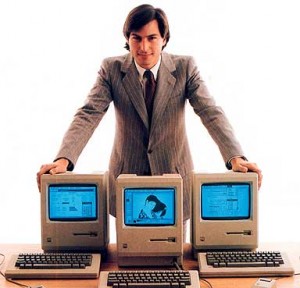
Both Kane and Jobs enjoyed being in the spotlight. Jobs was almost as good as marketing himself as he was his company. His trademark black mock turtleneck and blue jeans created a look that fit in well with Apple's casual, hip, up to date image. The problem with being hip and up to date is that what's hip and up to date today is stale and out of date tomorrow. This is not only true about fashion, but also products. Look at this picture of Steve Jobs taken in the eighties with early models of the Mac. What at the time was a man and a product who were both at the cutting edge of technology, today looks like a forlorn piece of useless junk being sold by a (sharp dressed) Maxwell Street huckster. Since they are practically obsolete from the moment you take them out of the box, computers don't age well. Unlike automobiles, there is not much of a market for vintage computers, unless as a prop for a period piece movie or play. My vintage 2002 iMac G4, the one that that I'm typing on now, in its day blew people away with its sleek, elegant design, but today looks tired and dated in not an entirely charming way.

Steve Jobs must have thought long and hard about his own legacy, he hand picked the man who wrote his authorized biography, Walter Isaacson. Isaacson, who like Jobs has CEO credentials in his resume, had previously written three biographies, one on Benjamin Franklin, another on Albert Einstein, and still another on Henry Kissenger. Jobs clearly saw his place in history residing next to at least two of those subjects.

As for me, well I'm not so sure. We're currently in the midst of the computer revolution and can't possibly gain correct perspective on it. Things sort themselves out over time, in one hundred years, those few who might be interested the end of the 20th Century, might remember Steve Jobs' name in connection with Apple's development of the Graphic User Interface. But I think there's little doubt that Bill Gates will be forever known as the father of the personal computer revolution.

Probably the biggest difference between Steve Jobs and the fictional Charles Foster Kane is that Kane died long after his relevance to society did. At the time of his death, he was already a relic of the past. Steve Jobs left this world while still on top. He was so important to his company that on the day he announced he would be stepping down from his post at Apple a few months ago, stocks in the company tanked. With the vacuum he has left, it's difficult to say what direction the company will take in the future as far as product development goes. Apple products today are highly valued and serve as upscale status symbols. In their day, so were Packards and Studebakers. People however still drive Fords. Walt Disney's name is still on his studio as Edison's is in the industry he helped found. Edison, Ford, Disney, and more than likely Bill Gates, are names for the ages. Steve Jobs was very much a man of his own time. He shook up the industry and the world with his terrificly cool and innovative products. But products come and go and when all the iPhones and iPads and iWhatevers end up in the recycling bin, something even cooler will come along to take their place. Without Jobs, it's quite possible that they will come from somewhere other than Apple.

None of this is intended to in any way disparage Steve Jobs, his life or all he accomplished. His was a charmed, brilliant, and creative life, one that will be missed. The reaction following his death says more about us than it does about him.

Some people say that everybody thinks their own generation invented sex. In other words, we're so wrapped up in our own little worlds, we forget that the folks who came before us experienced much the same things we do, including radical changes in their own world. I don't know if historical amnesia is unique to our own time, but it sure is rampant. Our world is indeed changing before our eyes. Yet I look at my grandmother's life and realize that the changes that have taken place in my own lifetime pale next to hers.

My grandmother could remember a time when there was no electricity in her home. When she was a child, the streetcar was the primary means of transportation about town if you didn't want to walk, or if you weren't rich and could afford a horse and buggy. If you wanted to get someplace far away you would need to hop aboard a train powered by a steam locomotive. She lived through Prohibition and the Great Depression. She lived thorough two world wars and several other wars, including a cold one. She lived through the assassination of two presidents. My grandmother experienced a time when there was a distinct possibility that the world might come suddenly and violently to an end. My grandmother could remember a time before there was radio in the home, and the time when the airplane had yet to be invented. Yet approaching the twilight of her life she saw a man walk on the moon, live on TV.

Did Steve Jobs change the world? Of course he did, just as millions of people did before and millions will after him. I think it's fair to say that he had a little bit of Edison in him, some Ford, Disney, Ben Franklin, with maybe even a little Einstein thrown in. I'd add a little Charlie Kane and a whole lot of P.T. Barnum to boot.

In the end he was the guy who made people fall in love with computers, including me. No small accomplishment. In my book I'd say that, all by itself, is pretty cool.

RIP.


*The character of Charles Foster Kane in Orson Wells' Citizen Kane was based loosely on the life of the famed newspaper publisher William Randolph Hearst. Even though the film took pains to differentiate the two as Hearst's name appears more than once in the movie, the similarities were not lost on WRH, who unlike Kane, was very much alive throughout 1940. Hearst did everything in his power to prevent the movie from being released, unsuccessfully of course.

Sunday, November 13, 2011

George Eastman

In my post about Steve Jobs and all the innovators, inventors and creative geniuses he is in company with, I forgot about poor old George Eastman.

Here is an article by Bob Greene that draws some interesting comparisons between Google and the company Eastman founded, Kodak.

Like Jobs, it was Eastman who brought his product, in his case cameras and photography, to everyday people. In the process he not only changed photography, which already had been around for a half century, but the world.

Today, photography like so many other fields of endeavor, is being transformed by the digital age. Greene makes an interesting point using traditional silver (film) based photography versus its digital based counterpart as a metaphor for our current society. In the old film era, (boy I'm really starting to feel old), you would have to wait to shoot an entire role of film, take it to the lab, then wait a few days more for the film to be processed. There was a sense of glorious anticipation in that time, wondering how the pictures would turn out. Opening that envelope with the prints, or a box with slides, would be akin to opening up a birthday present as, hoping for the best, you'd never know exactly what you'd get. All that's been lost with digital photography and its instant feedback, and gratification.

Unfortunately Kodak has not been very good at the instant gratification business. As everyone in the photography world, and the city of Rochester knows, the company has been floundering for quite some time, and may not survive. That would be a terrible shame.

Ironically, Google, the company that all but invented instant gratification, is no longer instant enough. Competition from Twitter, Facebook and others have forced Google to improve its search algorithm to make it even faster. *

Another lesson to all of us in changing times, either go with the flow or get off the boat.


* Which reminds me of an old Groucho Marx bit. While in a passionate embrace with a woman, she asks him to come closer to which he replies: "If I were any closer I'd be behind you."

Sunday, January 28, 2024

Then and Now: Part I

Several years ago when I commemorated the passing of Steve Jobs and his career that helped change the world, I contemplated my grandmother's life and many of the changes she experienced during the first nine decades of the twentieth century.

I focused on the earth-shattering innovations she witnessed, perhaps the most obvious being the fact that she was alive when the Wright Brothers made their first flight in 1903, but wouldn't have known about it for at least four years when mention of it finally was published in the newspapers. Sixty years later, she was still very much alive when we watched together as Neil Armstrong and Buzz Aldrin walked on the moon, live on TV.

Now consider this: when my grandmother was born, much of the world was still under the dominion of a handful of imperial powers. In the year of her birth, Spain and Great Britain could both legitimately claim the sun never set upon their empires. It just so happened in that very year, 1898, Spain would lose its claim as the last remnants of its once vast empire, the Philippines and Cuba would be lost to them forever. 1898 continues to be a year of infamy to many Spaniards. In fact, "well it's not so bad, at least you didn't lose Cuba" is still a popular message of consolation in Spain.

After two world wars, the two-thousand-year-old world order of imperial domination would come to an end and national self-determination, or at least the desire for it, would take its place. We have a globe at home that was manufactured when my grandmother was in her forties. The names of regions printed on that globe, unrecognizable to those today with little concept of history attest to that fact, as does the omission of familiar place names such as Nigeria, Kenya, Pakistan, Iraq, Russia, and of course, Israel.

I think it's fair to say the world my grandmother left in the 1980s was unrecognizable from the world she entered in the 1898. 

The world didn't change as drastically for me, although things are considerably different since I came on the scene in 1958.

I was reminded of this after watching a program called "Thank You Mr. President" which features excerpts from some of the sixty-five presidential news conferences conducted during the John F. Kennedy administration. 

That number alone attests to the changing times as Kennedy, in his nearly three years as president, participated in an average of 22.9 news conferences per year while the current president Joe Biden's number is less than half that, 11.3. Only Richard Nixon's and Ronald Reagan's number of annual press conferences, 7 and 5.8 respectively are lower for all the presidents since Calvin Coolidge.  

The "modern" news conference where a president meets in a formal setting with members of the press which is broadcast to the public live on television, began during the administration of Kennedy's predecessor, Dwight D. Eisenhower. But I think it's fair to say that Kennedy raised the event to an art form with his charm and quick wit, his wealth of historic and cultural knowledge, and his ability to think on his feet.  

However, Kennedy's job was made easier compared to that of his successors by the tacit limits placed upon the reporters. There is no question that the public's attitude toward the office of President of the United States, and especially to the person who holds that job has changed drastically in the past sixty years. Like all presidents, JFK had his detractors, but in his time, there was enough respect for the office to mean that certain questions were off limits. 

Today, after his tragic demise, Kennedy in some circles is best remembered for the many indiscretions in his personal life. These were not unknown by members of the press during his presidency, but publicly disclosing them would have meant professional suicide as the public did not have the voracious appetite we have today for salacious information on the private lives of public figures. More importantly, an indiscreet journalist would lose his or her most valuable asset, access to the president. 

That was no longer the case some thirty years later when at a presidential news conference, a CNN reporter asked then President George H.W. Bush flat out if he ever had an extramarital affair. By then, after the public disillusionment and cynicism surrounding the government's handling of the Vietnam War, Watergate, the Iran-Contra affair and numerous other issues, nothing was considered off limits anymore. Bush's indignant response to the question only fueled suspicions which may have played a part in his losing re-election in 1992 to Bill Clinton, himself no stranger to personal indiscretions. 

Attitudes about the office of POTUS barely scratch the surface of the differences between then and now as illustrated by the Kennedy news conferences. 

As one of the first prominent women journalists on the national scene including her stint as a World War II correspondent, May Craig was a true pioneer in the struggle for equal rights for women. You can read about Miss Craig here

In a time when the cause for women's rights was a back burner issue at best, Craig often found herself at odds with the most powerful men in the country including presidents, who while respecting her credentials, did their best to downplay her concerns. 

If you go to YouTube and type in "the wit of JFK", you will find dozens of videos featuring humorous responses from the 35th president during his 65 news conferences. Inevitably in each video there will be at least one appearance by May Craig addressing her concerns about women's issues, among others in the midst of a barrage of questions from male reporters about other "pressing" issues of the day such as nuclear weapons, the economy, the Cold War, segregation and Civil Rights.

Here's one of Miss Craig's questions verbatim, one that could easily be asked today:

The platform of the Democratic Party in which you ran promised to work for equal rights for women including equal pay to wipe out job opportunity discriminations. Now, you have made efforts on behalf of others, what have you done for the women according to the promises of the platform?

To which the president responded without missing a beat:

"Well, I'm sure we haven't done enough and uh..." 

That drew a roar of laughter from the predominantly male press corps. When the guffaws subsided, Kennedy assured Miss Craig that he was completely in favor of equal pay for equal work and that we ought to do better, adding sardonically: "..."and I'm glad you reminded me of it Miss Craig."

Which drew another round of laughter.

Imagine a male politician today with the exception of one, so blithely dismissing the rights of one half of the population.

As I said, times have changed, and not all for the worse.

Public officials in a democracy should be held accountable and taken to task by a vigilant press asking at times, difficult questions.

Up to a point that is. 

To be continued...

Wednesday, February 19, 2014

The Carriage Trade

Riding in a horse drawn carriage through Central Park on a snowy winter's day is a unique urban experience.  I wouldn't personally know since I've never shelled out the fifty bucks not including tip for a twenty minute buggy ride, but it sure looks swell. If the new mayor of New York City, Bill de Blasio gets his way, that iconic 150 year New York institution will soon go the way of Gage & Tollner, Penn Station and the automat.

One of de Blasio's campaign promises, along with other "progressive" issues such as universal pre-K, and the growing problem of income equality in the Big Apple, was to ban the the horse carriages. Citing cruelty to animals, the mayor said:
We are going to quickly and aggressively move to make horse carriages no longer a part of the landscape in New York City... They're not humane; they're not appropriate to the year 2014; it's over.
While de Blasio's other big ticket issues are on the back burner, the mayor is going full steam ahead with his plan to put hundreds of New Yorkers, both human and equine, out of work. Not to worry says the mayor, the future of the horses is secure as provisions for all of them have been assured on farms designed to take care of former work horses. As for the humans, the mayor has told them there will be jobs waiting for them as drivers of the new electric powered "vintage style" automobiles that are planned to replace the carriages. That is of course if they can come up with the $150,000 medallion fee.

Two groups, the American Society for the Prevention of Cruelty to Annimals (ASPCA) and a group called New Yorkers for Clean, Livable and Safe Streets (NYCLASS), are staunchly in favor of the ban. The director of the New York branch of another another animal advocacy group, Friends of Animals had this to say about the condition of the horses:
They are shackled into their carriages, pulling through streets of a chaotic unnatural environment and go back to their cells... They need the ability to graze and roam freely. They never get that in New York. They live a life of total confinement, day after day.
Some of that may be correct, however there are strict rules in place governing the treatment of the animals. The horses get every other day off, they are not permitted to work in temperatures below 18F or above 90F, and they each get five weeks vacation in the country every year. From all the accounts I've read, each carriage horse resides in a well maintained stall whose size is mandated by the city to be no less than 64 square feet, about the size of a great many New York City apartments and hotel rooms.

Many New Yorkers of the species Homo sapiens in fact would be more than happy to live under those conditions.

It's true the streets of New York City may have been a chaotic, unnatural environment for the horses' distant wild relatives. Not so for the horses of today which are the result of domestication and breeding that has gone on some say for over 6000 years. The carriage horses are draft horses, bred specifically to pull heavy loads. Draft horses have been doing this kind of work in the county and city alike for millennia; it is in their nature to pull things just as it is the nature of a thoroughbred to run, a retriever to retrieve, and a sheep dog to herd. One can say these animals are just as much the creation of human beings and as such are just as unnatural as cars, streets and traffic jams.

The big difference of course is that animals are living beings. Just as we created them, we have the responsibility to care for their welfare. With a few rare exceptions, the people in New York's carriage industry have proven to do just that. The most sensible piece I've read about the horses themselves was written a couple years ago and was published on a web site devoted to sustainability issues called, (what else?) Tree Hugger.com. You can read that piece written by Jaymi Heimbuch here. In a nutshell, she writes that the horses of New York City live and work in no worse conditions than the humans.

Not surprisingly, the people working in the industry are less than thrilled with the prospect of losing their livelihoods. Most of them consider themselves horse people, not gearheads. Driving a car through the busy New York streets while being expected to give tours at the same time, is not the same thing as doing it while at the reins of a carriage. Clearly it's not a slam dunk by any means that the horse people will make a successful transition to the cars, even if they wanted to.

The New York City horse carriages provide a valuable service not only to tourists who can afford to ride in them, but also to the countless men, women and children, New Yorkers and visitors alike, who get the chance to see, hear, to of course smell, and on occasion interact with the animals. My own experience of observing the horse drawn carriages while walking through Calvert Vaux and Fredrick Law Olmsted's beautiful Central Park, smack dab in the middle of the magnificent concrete jungle of Manhattan is this: an overwhelming feeling that all is right with the world. They just happen to be one of those lovely things that make New York, well, New York.

Incidentally, the cars that Mayor de Blasio and others have proposed to replace the carriages look similar to the car used in the 1968 movie Chitty Chitty Bang Bang. If you're old like me and can remember the film, that car could fly. If the mayor's new cars could also fly, even I would pay the fifty bucks for a short ride. Grounded however, I can't imagine many people would find the experience appealing for that price.

One might assume the new mayor of the largest, most important city in this country would have more pressing matters at hand than 250 or so well cared for animals. A cynic might even suggest that beyond an overwhelming concern for the horses' well being, the mayor might have an ulterior motive. Well it turns out he does.

It just so happens that one of the major contributors to the mayor's election campaign was a fellow by the name of Steven Nislick. Nislick founded NYCLASS, one of the the organizations mentioned above. For years he has been a major critic of the carriage companies and the stables that house the animals. He also gave a significant amount of money to a group focused on defeating de Blasio's primary opponent, City Council Speaker Christine Quinn, who was opposed to the ban. Nislick also happens to be a very successful real estate developer. While he denies it, it has been widely speculated that Nislick has set his sights on the land where several horse stables currently sit upon, valuable Manhattan real estate on the West Side. With the carriages and stables gone, one would assume that the land they occupy would become available, and someone (hmmm someone like Nislick perhaps?) could get in on the action. Adding fuel to the fire, an anti-carriage leaflet in 2008 distributed by Nislick stated:
Currently, the stables consist of 64,000 square feet of valuable real estate on lots that could accommodate up to 150,000 square feet of development. These lots could be sold for new development.
Again it's only speculation that Steve Nislick and Mayor de Blasio's motivations are not entirely pure. But it would seem if they were truly concerned about animal welfare, especially the fate of domesticated horses, there would be bigger fish to fry. Why for example doesn't the mayor go after the horse racing industry? One of the most storied race tracks in America sits within de Blasio's jurisdiction. It's called Aqueduct Racetrack and it has been a fixture in South Ozone Park in Queens since 1894. The racing industry has a dreadful record when it comes to animal welfare. Where the carriage industry often takes in animals that would otherwise be rejected, breeders of race horses annually produce thousands more animals than can adequately be taken care of after their racing days are over. Given that the life expectancy of a horse is about fifteen years longer than the average racing career, most race horses face uncertain fates after retirement, many of them are shipped off to slaughterhouses in Mexico and Canada. In some cases, those are the lucky ones.

As far as I know, de Blasio has not uttered a word about the humaneness, or lack thereof, of horse racing. The jobs and revenue that the horse carriages bring into the city are a mere drop in the bucket compared to the vast potential of the racetrack and it's adjacent "racino." If you believe that Mayor de Blasio will make an impassioned demand to make Aqueduct and its casino go away for the sake of the horses' quality of life, then I have a nice bridge spanning the East River you may be interested in buying.

The mayor's prompt action regarding the ban has drawn ridicule in many circles from the New York Times to Rush Limbaugh. Already a favorite target of Limbaugh's, the horse issue has given the bellicose right-wing commentator/entertainer plenty of fodder for his diatribes against the mayor and his progressive agenda. At best, if the mayor is indeed sincere (and I have every reason to believe he is) in his concern for the animals' well being, putting this particular issue at the forefront of his administration in City Hall makes him appear frivolous and out of touch, given all the serious issues he must deal with. At worst, given his relationship with Nislick, even the suspicion of impropriety which certainly exists now, makes the new mayor appear to be a demagogue and a hypocrite, playing on the emotions of a small but vociferous group of well intentioned people, (the carriage opponents), as a springboard for his political ambitions. His actions as far as this issue is concerned will do little to promote his ambitious plans of helping the less fortunate people of New York, and perhaps will even go a long way to destroy them.

On the first day of this year, addressing the state of economic inequality in NYC in his inaugural address to his new constituents, newly sworn in Mayor de Blasio had this to say:
So let me be clear. When I said we would take dead aim at the Tale of Two Cities, I meant it. And we will do it. I will honor the faith and trust you have placed in me. And we will give life to the hope of so many in our city. We will succeed as One City.
By attempting to destroy an industry, its infrastructure, the other businesses that support it, and the working class jobs that go along with them, Mayor Bill de Blasio is perhaps unwittingly taking his city yet another step closer toward his stated goal of "One City".

One City that is, made up entirely of millionaires.

Sunday, June 29, 2014

Florence vs. Atlanta

Florence, left, and an Atlanta highway interchange compared in photos of the same scale
This comparison of two satellite photographs has been making the rounds over the past few years. It originally appeared here on a blog post written by Steve Mouzon. We see from the two photos that an unnamed highway interchange in Atlanta takes up roughly the same amount of space as the entire city of Florence.

Despite his blog's objectives spelled out in its title: Original Green: Common-Sense, Plain-Spoken Sustainability, Mouzon argues against the 20th/21st Century American paradigm of devoting so much space to the automobile in strictly economic terms:
Busy streets, for almost all of human history, created the greatest real estate value because they delivered customers and clients to the businesses operating there. This in turn cultivated the highest tax revenues in town, both from higher property taxes and from elevated sales taxes. But you can't set up shop on the side of an expressway.
In another blog post that revived the above photographs, Lloyd Alter writes this:
You could spend days walking the streets of Florence... and find three hundred and fifty thousand residents shopping, eating, selling wonderful leather goods, going to fabulous galleries and palaces and museums...
Because of the need for speed, Atlanta has a great big expensive hole the size of Florence that does very little beside getting a small fraction of Atlanta workers to their jobs a bit sooner, barring any accidents.
Compelling as these two photographs are, finding any real meaning behind them is not as easy as it might seem on the surface. With two entirely different cities built in different times in different cultures, you could spin this comparison any number of ways. Florence is the size it is precisely because the automobile was about 400 years from being invented during the Renaissance when the city took its current shape. Had the Tuscan city been planned in another technological era, Florence certainly would be a much different place. The same is true of Atlanta.

Perhaps the most prescient words I've ever read about the automobile came from the author Booth Tarkington in his 1918 novel, The Magnificent Ambersons. Responding to the comment, "Automobiles are a useless nuisance", the character Eugene Morgan, himself an early pioneer in the automobile industry, takes a philosophical view of his life's work:
I'm not sure he's wrong about automobiles. With all their speed forward they may be a step backward in civilization - that is, in spiritual civilization. It may be that they will not add to the beauty of the world, nor to the life of men's souls. I am not sure, But automobiles have come, and they bring a greater change in our life than most of us suspect. They are here, and almost all outward things are going to be different because of what they bring. They are going to alter war, and they are going to alter peace. I think men's minds are going to be changed in subtle ways because of the automobiles; just how, though, I could hardly guess. But you can't have the immense outward changes that they will cause without some inward ones, and it may be that George is right, and that spiritual alteration will be bad for us. Perhaps, ten or twenty years from now, if we can see the inward change in men by that time, I shouldn't be able to defend the gasoline engine, but would have to agree with him that automobiles had no business to be invented.
The urbanologist Jane Jacobs argued that it was not the automobile per se that altered civilization, but the way we designed our cities in order to accommodate it. The thriving street culture of Florence as seen in the photo and described by Lloyd Alter above, compared to the relative emptiness of area surrounding the Atlanta highway is a perfect illustration of her point. With the exception of the River Arno, one can explore on foot practically every nook and cranny of Florence as I can personally attest. I don't know Atlanta that well but I've certainly experienced similar landscapes as the one pictured on the right. Super-highways create no-man's lands of inhospitable landscapes divided by impenetrable borders. It's unlikely that anyone would choose to get from any given point A to point B in the area shown the photo on the right on foot as the journey would prove to be not only hazardous, but highly unsatisfying. Boring streets Jacobs argued, made for boring cities that people would ultimately move away from. Her prediction sadly became reality as we have seen time and time again in great cities across America.

The city of Florence today does not exclude cars, it just puts them in their place. On the other hand, Atlanta and similar cities, continue to put cars front and center.

I'll get on the bandwagon and spin this story in the direction of my own biases by using two instances that I've sited before, one personal, one taken from the news:

My parents retired to a community in greater Phoenix, another sprawling city where car is king. They had a very nice life and my wife and I greatly enjoyed our visits, in fact we were married there. My father's health eventually deteriorated and as my mother was caring for him in his final days, she was diagnosed with macular degeneration which rendered her legally blind, unable to drive. Not having something as basic as a grocery store closer than two miles from home, and no public transportation whatsoever, my fiercely independent mother could only rely on the kindness of her friends and family for so long. She ended up moving back to Chicago where at eighty-something she continues to live a very independent life, relying on public transportation to get her to the places too far away to walk. Ironically, "The Valley of the Sun", a region that draws retired people by the score, was unable to provide a sustainable life for her once she could no longer drive.

In Atlanta earlier this year, a mere two inches of snow completely incapacitated the city. Commuters were stranded in their cars for up to 24 hours as the city's three snow plows were no match for the unusual weather event. One only has to look at the two photographs above to understand why Atlanta was in such a sorry state. It might take an hour to transverse the distance from one end of the area represented by each photograph to the other on foot. Despite the two cities being somewhat comparable in population, that distance represents the entirety of Florence but only a small fraction of the average commute in Atlanta. I have no idea how well Florence is equipped to handle snow, but I'm sure two inches of the white stuff would hardly incapacitate a town where you can walk everywhere.

Time and time again we have seen how putting all of our eggs in the same technological basket is not a good idea. Technology is a wonderful thing, that is until it stops working as planned. Anyone who has gone through a power outage of any length of time can testify to that fact. The internal combustion engine and the automobile, great, earth shattering inventions as they may be, still have their limitations. The real question we must ask ourselves in the 21st century is this:

Are we to control our technology or are we going to let it control us?

Wednesday, June 21, 2017

Brush Up Your Shakespeare

The recent brouhaha over this summer's New York City Shakespeare in the Park production of Julius Caesar begs the question: can people really be that stupid?

OK I know things have been touchy, especially since Republican congressman Steve Scalise was shot by a Bernie Sanders supporter last week. The Trumpers are taking full advantage of the unfortunate incident to promote their world view that Democrats, liberals, progressives, Trump detractors, in other words, all the people who are destroying this country, are entirely responsible for the acrimony that is currently dividing the land. Then comes this Fox News report: New York is staging a play where an actor dressed as Donald Trump is assassinated at the end of the play. Given that limited information, even I would be appalled. Much as I can't stand Trump and all he stands for, I cringe at any suggestion that the president of the United States could or should be assassinated.


But let's get real, this is William Shakespeare. His Julius Caesar is a 400 year old play that everyone in this country with a high school education should at least be tacitly familiar with. For starters, there has been a long standing tradition of producers taking liberties with the staging and timelines of Shakespeare's plays. Then there's the work itself; the title character, no matter who he is dressed up to look like, doesn't get assassinated at the end of the play, but smack dab in the middle. The rest of  Julius Caesar deals with the consequences of the assassination. Things don't work out so well for the the conspirators, for Rome, or whatever government the producers wish to evoke, or in fact, for democracy. The play is after all, a tragedy, at least if you're paying attention.

The moral of the story, expressed in Cliffs Notes fashion that one would think, everyone should be able to understand is this: "be careful what you wish for."

Given that, the genius of producing the play with Caesar dressed as Trump, sends a not too subtle message to Trump detractors, myself included, that perhaps our single-minded obsession with the premature termination of this presidency by any means, needs to be re-examined.

That point was lost on many Fox viewers, (aka Trump supporters), who saw the on-stage murder of a character who looked like Trump, as a credible call to assassinate the president. At least two major corporate sponsors pulled the plug on their support of The Public Theater, the producers of the play. Even Shakespeare himself is taking a hit. Taking a cue from the president, who is himself chronologically challenged, repertory theaters around the country have been receiving threats from right wing nut jobs, because they too produce plays by that no good leftist snowflake known as "the Bard".

The nonsense started to calm down a bit after conservative media star Laura Ingraham tweeted: "How many would storm the stage if Obama was stabbed?" As many were quick to point out, in 2012, the Guthrie Theater in Minneapolis staged a production of Julius Caesar where the title character was indeed dressed up to look like Barack Obama. Hardly anyone complained. It turns out that Delta Airlines, one of the sponsors who pulled the plug on their contributions to The Public Theater, continues to support the Guthrie, despite its alleged affront to the former president.

After it became clear that the hysterics were unjustified, with egg on their face, many of the play's detractors wisely dropped the subject.

But there are still folks out there who just don't, or won't get it. Here is a New Yorker article about a pair of right wing activists who disrupted the New York play during the murder scene. Not surprising, right wing commentators including Ingraham, and Donald Trump's personal lap dog, Fox's Sean Hannity, support the hecklers, proclaiming their removal from the theater, and subsequent arrest for trespassing and disorderly conduct, is a violation of the pair's "freedom of speech."

It just so happens that the other day was the anniversary of the Watergate break-in. I watched a TV documentary made by Robert Redford commemorating the event. It got me thinking about Richard Nixon and his fall from grace. Those of us who remember him tend to think of Nixon in broad generalities, his arms raised above his head while both hands give the "V" for victory salute, his head shake, his scowl, and his unfortunate, most famous quote, "I am not a crook." But Nixon was a very complicated man who accomplished a great deal of good, along with the bad, during his presidency. His fall was indeed as they say, "Shakespearian". I'm no expert on the Bard but I'm certain that you can find comparisons in many of his characters, King Richard III perhaps, or one of the King Henrys, to Richard Nixon.

Trump is not complicated in the least and is anything but Shakespearian. He's more like a cartoon villain. The one that comes immediately to mind is Snidley Wiplash, the mustachioed archenemy of the aptly named Royal Canadian Mountie, Dudley Do-Right from The Rocky and Bullwinkle Show. OK I'm dating myself, another one that comes to mind is Mr. Burns, the ancient robber-barron owner of the local nuclear power plant on The Simpsons. I wouldn't be the least bit surprised if Trump views the greedy, narcissistic Mr. Burns as a role model.

On the other hand, Shakespeare has Caesar say this shortly before he is murdered:
I could be well moved, if I were as you.
If I could pray to move, prayers would move me.
But I am constant as the Northern Star,
Of whose true fixed and resting quality
There is no fellow in the firmament.
The skies are painted with unnumbered sparks;
They are all fire and every one doth shine.
But there's but one in all doth hold his place.
So in the world: 'tis furnished well with men,
And men are flesh and blood, and apprehensive.
Yet in the number I do know but one
That unassailable holds on his rank,
Unshaked of motion; and that I am he
Let me a little show it, even in this:
That I was constant Cimber should be banished,
And constant do remain to keep him so.
Come to think of it, didn't the Donald say something very similar, in not so many words, at the Republican convention in Cleveland last summer?
I alone can fix it.
Maybe there is something to this Trump/Caesar comparison after all.

Sunday, August 10, 2014

The Quintessence of Life

At the end of a particularly draining Saturday one month ago, my wife suggested we head to a Redbox machine in our neighborhood to find a DVD for an all too infrequent family movie night. Frankly there's little in those machines that interests me. Call me a snob but I just don't care for many contemporary Hollywood movies. With their one dimensional characters, predictable story lines, interminable chase scenes, incessant devotion to special effects, gratuitous violence and sex, (well violence anyway), and their target audience, the least common denominator, I'd take an old, a foreign, or an indie movie any day.

Out of the dozens of choices in the machine, only two movies appealed to me, and one was not appropriate for the children. The other was the new version of The Secret Life of Walter Mitty, directed by and starring Ben Stiller in the title role. I always liked the James Thurbur short story, probably because I can identify with a character who spends much of his time in a dream state which he prefers to reality. My kids like Stiller, especially from his role as the security guard in the two Night at the Museum movies. My wife was just happy we could find something to agree upon. I was prepared for a much needed, mindless evening chilling in front of the tube watching a pleasant, harmless movie. I figured the worst thing that could happen was that I'd fall asleep, which is what usually happens when I plant myself  in front of the TV.

That last thing I expected was to be engaged, enthralled and overwhelmed by a film that was not only entertaining, but also touched upon several issues that are close to my heart, issues that have been dealt with in this blog.

In this version of the Mitty story, our hero begins the movie late for work having missed his train as he becomes lost in a fantasy about the woman he has a crush on, a co-worker named Cheryl Melhof, (played by Kristen Wiig). Walter's tardiness does not bode well for him as he learns upon arriving at the office that his company has just been bought out and the transition team has already arrived to eviscerate the staff. We are soon to meet the chief antagonist of the story, the leader of the transition team, a pompous, self-serving weasel of a man named Ted Hendricks (Adam Scott), dressed in a suit and ridiculous beard, (the source of one of the funniest lines of the movie).

The business Ted Hendricks's company bought could have made cars, investments, or widgets; it hardly matters to people like him who are only interested in the bottom line. It so happens that the business in question is Life Magazine. Hendricks proves time and again that he is completely in the dark about publishing a magazine. While he lacks any knowledge of the industry he's just been thrust into, his people skills are worse. In the first meeting with his new staff he tells them the bad news: most of them are about to be fired. Then the good news: before they lose their jobs they are about to have the honor of creating the magazine's final print edition, as Life was about to go entirely online. *

While the Hendricks character is merely an apparatchik for the entity who bought out Life Magazine, he serves well as a metaphor for today's corporate world that cares little about what a company actually does and needless to say, less about the people who work for it. I wrote on this very subject a few years ago, about a corporate takeover specialist named Edward Lampert who bought out K-Mart and Sears. Despite his ostensible interest in saving the two struggling national icons, it became clear that Lambert's actions were motivated out of the profit gained by selling off those companies' vast holdings of real estate, rather than selling hardware, clothing, and appliances.

Anyway, Hendricks told his stunned audience that the last issue of Life Magazine was to feature on its cover a photograph made by the esteemed photographer Sean O'Connell, (Sean Penn). According to O'Connell, his picture which at that point had been unseen by anyone but its creator, depicted nothing less than "the quintessence of life." Hendricks had no idea what that meant but was told by his two goons, also in suits and ridiculous beards, that it meant something special.

Walter Mitty's position at the magazine was photo archivist, his official title in comically ironic corporate-speak, "negative asset specialist." In that role he and O'Connell had developed a close working relationship over the years, although the two men had never met face to face. In this capacity, Walter was entrusted with the roll of negatives, (yes O'Connell still shot film thank you very much), containing the important picture. The trouble was, the roll was completely intact except for the one important frame, #25.

The rest of the film depicts Walter breaking free of his dream life by embarking on an ever broadening journey to find the elusive photographer and his missing negative. As with most literary and cinematic quests, whether it be for the Holy Grail, Private Ryan, Mr. Kurtz, or Rosebud, this search reveals at least as much about the searcher as for what is sought.

This film received by and large, ho-hum reviews. Many of the critics didn't accept the premise of a search half way around the globe for one picture. Taking the premise quite literally, Richard Roeper said: "It's hard to get too excited in the digital age about a missing photograph." Not too surprising a comment I suppose coming from a reviewer who works for The Chicago Sun Times, the newspaper that recently laid off its entire staff of photographers.

The filmmakers who made this Walter Mitty story take the medium of photography more seriously than the Chicago tabloid and their reviewer, as their movie is liberally populated with important photographs. The halls of Life are covered with decades worth of iconic photographs that graced the pages of the magazine. Peering down at us from the walls of Mitty's workplace are the images of a generation, the likes of Ghandi, Martin Luther King,  JFK, John Lennon, Muhammad Ali and John Glenn (or is it?). We see the first moon launch up close, Mt. Everest from a little more of a distance, and Moses holding up the Ten Commandments on the screen of a drive in theater.

These are not images made by just anybody with their smart phone, they were made by artists who were the best in the business. Just as having an e-mail account doesn't make you a writer, having a phone with a camera doesn't make you photographer. That inherent truth is something beyond the grasp of a businessman like Hendricks just as it is to the current owners of the Sun Times. Throughout the film, as the photographs begin to be removed from the halls of Life Magazine, we learn what is about to be lost. In one scene, a particularly alluring Marilyn Monroe looks on from down the hall as the clueless boss surveys the institution he is about to disassemble. You can almost hear her say indignantly: "really?"

I keep thinking that the late Roger Ebert, Roeper's predecessor at the Sun Times would not have missed the significance of that scene.

An important part of the movie that many critics did not buy was the portrayal of the elusive photographer Sean O'Connell. He's clearly an eccentric character marching to the beat of his own drummer, an artist led entirely by impulse, creating work for himself above all others. I suppose the most difficult thing to understand about O'Connell takes place when we finally catch up with him in one of the remotest parts of the world. He is about encounter something he has traveled half way around the world to photograph. After a long wait, the camera trained upon his subject, he observes it through his telephoto lens, then shows it to Walter. Walter asks O'Connell if he's going to take the picture and the photographer answers no:
Sometimes I don't. If I like a moment, for me, personally, I don't like to have the distraction of the camera. I just want to stay in it.
It takes a true artist to understand that sentiment.

With his long hair, scraggly beard and disheveled appearance, O'Connell is cast as the stereotypical artist directly out of central casting. If people like Sean didn't exist, you'd have to invent him. In reality, Sean O'Connell is not much of a stretch, I just wrote about two artists who would make O'Connell look no more off-beat than Aunt Bea. One is Josef Koudelka, the other is Vivian Maier.

One frequent criticism of the movie is its simplistic message that it's better to do than to dream. One critic called Walter's break out experience nothing more than an extended Nike "Just do it" commercial. I think these critics miss the point. Walter is not, as some folks see him, a simple milquetoast, everyman of a character. There is depth to the guy as we learn early on that his more or less mundane existence is the result of circumstances beyond his control. Much like George Bailey, the central character of the classic film It's a Wonderful Life, the teenage Walter was forced to abandon his youthful dreams of exploring the world because of family responsibilities caused by the death of his father. As we meet him many years later, he still takes full responsibility for the care of his elderly mother (Shirley MacLaine) and his demanding sister (Kathryn Hahn).

Walter may lead what many consider a hum-drum life, but what slowly becomes clear if you pay attention, is that he is thoroughly engrossed and passionate about his work. It is the very thing that motivates him to go on his fantastic journey in the first place. Sean O'Connell entrusts Mitty with his work knowing full well that without Walter, he would be nothing. No, Walter is not escaping from his life and his "boring" job, rather he is taking his work to a higher level. When Mitty returns from his first journey empty handed, he tells his new boss that in 16 years on the job he has never lost a negative. The heartless response is: "put that on a plaque and hang it on the wall, at your next job." But after receiving another clue about the whereabouts of O'Connell, Walter embarks on his most ambitious adventure to find the negative, after he his fired. Hard to imagine your typical 9 to 5 office grunt doing that. This film teaches us that a person's job and a person's work, are not necessarily the same thing.

I suspect that most of the negative criticism of The Secret Life of Walter Mitty comes from the fact that the movie doesn't live up to the expectations of the reviewers. As it would be difficult in this day and age to revolve a feature length movie around a the daydreams of a man during a Saturday afternoon shopping excursion with his overbearing wife, this is definitely not James Thurbur's Walter Mitty. It's also not a remake of the the 1947 version of the story starring Danny Kaye, simply because Ben Stiller is not Danny Kaye. In fact, Ben Stiller in this movie is not even Ben Stiller, as a typical comedy featuring the popular actor is driven by a frenetic comedic pace where the setup for one gag begins as soon as the laughs from the previous gag die down. There are funny moments in this Walter Mitty story and some amusing lines in the screenplay written by Steve Conrad, but you would be hard pressed to call this introspective film a comedy. The two other stars of the movie, Wiig and MacLaine, best known for their characterizations of over the top characters, here downplay their roles so naturally that it hardly ever seems they're acting.

The one universal bit of praise this film has received has to do with the magnificent cinematography of Stuart Dryburgh. The film looks beautiful, especially after we leave the confining environments of Walter's Manhattan apartment and workplace for the great unknown, in this case shot on location in Iceland. To many critics, the scenes of these remote places, while stunningly cinematic, have little to do with moving along the story, they are eye candy at best. Here I reserve my harshest critique of the critics. To me, the most memorable scenes in what I consider to be a remarkable film, are three prolonged sequences containing no dialogue. They involve, a helicopter flight, an extreme skateboard ride, and a pickup soccer game.

These amazing scenes represent transcendent moments in Walter's life where he breaks free of the restraints he has placed upon himself, finds the freedom to do the thing that comes most naturally to him, and finally accepts and lets go of at least some of his old assumptions about they way he should live his life.

Save for jumping into shark filled waters and coming face to face with an erupting volcano, much to the chagrin of critics like Roeper, Walter's excursions abroad aren't filled with scene after scene of conflict and resolution. Instead they are filled with wonder and discovery. Some reviewers speculate that those scenes are just more of Walter's dreams, but clearly they are not. In the dream sequences which we see in detail at the beginning of the film, Walter is at the center in the role of hero, whether he's leaping into a building to save Cheryl's dog from an imminent explosion, or telling off his pompous boss in front of his co-workers. Far from it during his excursions abroad where he is continually dependent on the help of strangers, including a drunken lout in a Greenland bar and an Afghan war lord who is smitten with a piece of Mrs. Mitty's famous Clementine cake. Walter's encounters along his journey are for me the most poignant part of the story. These encounters with people who are vastly different than him, and by extension, us, speak to the fact that while we all may be different, there is an essential quality of the human experience that connects us all.

By the end of the movie, things are hardly resolved for Walter. He's back in New York without a job, his future uncertain, and he's failed to come through on the promise to his mother that she would never have to sell her most prized possession. The "feel good" ending is laced with not a small amount of melancholy. I'm not giving away anything by telling you that Walter gets the girl at the end. That should come as no surprise as it's already clear by the second reel that there is a mutual attraction between Walter and Cheryl; quickly enough she becomes both his muse and soul mate. The real payoff which I'm not going to give away, comes about a minute before the final frames of the movie where we see Walter and Cheryl holding hands for the first time. To some critics, the resolution of this movie was the biggest letdown since they discovered that Rosebud was only a sled.

Personally I found the resolution of this story nothing less than sublime. The real message of the film is more complicated than: "just do it." As I see it, the message is that it may be better to do than to dream, but in order to live a complete life, they're both important. And finally, that we all hold the quintessence of life right in the palm of our hands, but sometimes we have to go to the ends of the earth to find it.

Those may not be the most profound messages in the world, and The Secret Life of Walter Mitty certainly doesn't rank up there with the great films of all time. But for the life of me, I haven't been able to stop thinking about the movie since I saw it.


*The real Life ceased publication as a weekly magazine back in 1972. It resurfaces from time to time in commemorative issues published by its parent company Time INC.