Showing posts with label tall buildings. Show all posts

Saturday, June 17, 2017

Catastrophe and Catharsis

During WWII, my father was a forced laborer from Czechoslovakia, working and living in Berlin. Late in his life I talked to him in depth about what certainly had to be a harrowing experience, enduring not only the loss of his freedom, forced exile in the country that brutally occupied his own, and life under a tyrannical dictatorship, but also living in a city under constant bombardment courtesy of the Americans by day, and the British by night. "Oh it wasn't so bad..." he told me with a wry smile, "...I was a young man living in a city where all its male citizens were off at war." He didn't have to fill in the details.

Talk about making the best of a bad situation.

I thought of this the other day as I was doing some reading about the Great Chicago Fire of 1871. Through all the tremendous devastation and loss of life*, the city not only recovered, but it prospered. Only the hiccup of a nation-wide panic and brief depression in 1873 and 1874, prevented the city from being rebuilt in half a decade. By 1880 there was barely a trace of the fire at all.

"Chicago in Flames" The Great Fire of 1871
Hand colored Lithograph based upon a sketch by John R. Chapin
published by  Currier & Ives
That's not to say there was not great suffering for the survivors, many of whom with little or no resources found their lives would be never return to normal. Many Chicago Fire survivors left the city never to return. But far more came than left. Like my father who saw an opportunity and seized upon it in Berlin, people saw the tremendous opportunity of being part of rebuilding the devastated Chicago. Between the years 1870 and 1880, the population of the city nearly doubled to half a million residents. Ten years later, over one million people called Chicago home.

I've often thought about what Chicago would be like today had it not been for the fire. Mark Twain had the same thought 134 years ago:
New Orleans, I believe, has had the good luck--and in a sense the bad luck-- to have had no great fire in late years. It must be so. If the opposite had been the case, I think one would be able to tell the 'burnt district' by the radical improvement in its architecture over the old forms. One can do this in Boston and Chicago. 
In 1891, a writer for the journal Industrial Chicago put it more succinctly:
Those fires were fortunate events for the Garden City as a whole, and none profited directly from them, so much as art and architects,  for the flames swept away forever the greater number of monstrous libels on artistic house-building, while only destroying the few noble buildings of which Old Chicago could boast.
Would Chicago really be a much different place today without the Fire? After all, the die was cast for the contemporary city well before October of 1871. By then, all rail lines in the Midwest led to Chicago. At the same time, the Illinois/Michigan Canal was still operating, the only water transportation conduit between the Great Lakes and the Mississippi River. The grain elevators and the commodities exchanges, both invented here, that would forever change the way farmers got their product to market, were well established by the 1870s and would be back up and running in a nick of time. Chicago as the transportation hub of the midwest, was already a major center of manufacturing, and much of that was untouched by the Fire.

By 1871, much of the physical layout of Chicago had already been established. The massive undertaking of raising the street grade was well underway. Chicago's property lots and rigorous street grid had been conceived, if not already established throughout town, and the boulevard greenway system and parks that would ring what were at the time Chicago's city limits had begun to take shape. Thanks to Potter Palmer and his speculative investments, State Street became the main commercial street of Chicago, taking the place of Lake Street, and with that, the major axis of the city turned ninety degrees from east/west to north/south, following the lakefront.

The major obstacle to the practical construction of tall buildings was overcome in 1864 as the first steam driven elevator was installed in Chicago in the Charles B. Farwell Store in Wabash Avenue. That alone did not solve the second obstacle, making elevators safe enough for people to want to ride in them. Great steps were made in that direction in 1870 when the first hydraulic elevator was initialed in the Burley and Company Warehouse on West Lake Street. We know that those contraptions became accepted, albeit hesitantly by the general public from the accounts of people being rescued from stalled lifts in Chicago's posh hotels during the Fire.

Chicago is known around the world for its innovative architecture, especially in regards to the construction of tall, commercial buildings. As the Mark Twain and Industrial Chicago quotes sited above suggest, we have the Great Fire to thank for that. But is that true?

Once the elevator became commonplace, the urge to cram as much rentable space into a single lot became inevitable, especially in the highly valuable property of the central business district. The race to build taller buildings was well underway before that famous blaze began near Mrs. O'Leary's barn after that long hot, dry summer of 1871.

On top of that, most of the architects who would create the new architecture that became known as the Commercial Style or the Chicago School of Architecture, including Dankmar AdlerWilliam HolabirdMartin Roche, and Daniel Burnham already lived in Chicago as young men at the time of the Great Fire. With the exception of Adler, all of these future shapers of Chicago's built environment came through in one capacity or other, the office of William LeBaron Jenney, who before the Fire was responsible for among other things, the original design of the three great West Side parks, Humboldt, Central (later named Garfield) and Douglas, and the boulevards that connected them.

The earlier generation of architects responsible for many of the buildings of the pre-fire city, most notably John van Osdel and William Boyington were still active and quite busy after the Fire. The tallest buildings in Chicago until 1895, were the works of those two architects. In fact Chicago, the Second City which sprung up almost as soon as the ruins from the fire to began cool down, didn't look all that different from the First City. You can see for yourself as a number of 1870s post-fire buildings still exist, many of them concentrated just north of the River on Clark and Wells Streets. There you can still find in tact, buildings graced by Italianate facades that were the fashion of the day, before and after the fire.

So as we've seen, the groundwork for the Chicago we know today was clearly laid well before the Chicago Fire. Would it then be reasonable to say that the Fire was a mere setback, delaying what would have been the inevitable development of the current city?

Author Ross Miller in his book The Great Chicago Fire, argues no, the conflagration was in fact Chicago's seminal moment, a catharsis that allowed the city to wash away all its past mistakes, and start from scratch, enabling Chicago to become much greater city.

Barely four decades old at the  time of the fire, Chicago was already developing bad habits. The insatiable lust for instant profit meant little attention was given toward the future.

The children of the the pioneers who settled this city, the folks whose names you see streets named after, as so often is the case, became used to a comfortable life with little sense of obligation:
Seen from a  distance, pioneers like Butler and Ogden became models of respectability, combining Eastern education with the demands of Western settlement, They became the Chicago establishment. Set up in fine houses and rich enough for philanthropy, Chicago's first generation had time for pieties and church-going. Fortunes already in hand, they looked for ways to spend their money and perpetuate their newly minted good reputations. Their sons and daughters, with the pressure of making money removed, lacked any direction. ... Playboys and dilettantes, especially before the fire, appeared to be Chicago's legacy. 
The fire was a truly democratic catastrophe, it wiped out the homes of the rich and the poor alike. Of course with greater resources at their disposal, the rich had a far easier time to get back on their feet, but the fire created a bond between people living in Chicago in October 1871, those who lived anyway. They had all been tested by fire, and survived. Consequently, the term "Chicagoan" gained currency throughout the world. Quoting from the introduction to Robert Cromie's book of the same title, Miller throws in this tidbit:
You could tell a Chicagoan in any city of the world, for he would not talk a minute, scarcely until he would let you know he was from Chicago.
Before the Fire, outrageous land speculation led to tremendous fortunes won but mostly lost. Shoddy construction, haphazard building techniques, and simple lack of attention to detail, led to a city that was an eight square mile tinderbox, a disaster waiting to happen.
On a strictly economic and political basis, Chicago in the months and years after the fire could be shown to have made a startling correction for four decades of nearly random, unplanned development, ...Real estate speculators who had suffered severe losses might in the future be less reckless; their buildings would be made of better materials. The fire because it "checked the too rapid rebuilding of the city in all directions", would lead to a rebuilding of the city's central business district. In addition, by getting rid of failing or marginal businesses, the fire could be seen as a purifying act.
A fitting metaphor could be the fires that periodically sweep through the Midwestern prairies, ridding the land of dead plants and providing nutrients to the soil to insure strong and healthy new growth. Chicago of course, is built upon those very prairies.

Just as the fire's tremendous devastation was made possible by a great storm of concurrent unfortunate events, the recovery of the city was made possible because it came precisely at the crossroads of 19th century technological innovation and creativity.
Out of necessity, the city was compelled to welcome experimentation. Chicago was burned out of an earlier and relatively primitive form of industrialization into the most modern. In this environment, techniques that might have remained dormant under normal conditions of urban growth were perfected and them rigorously tested. 
Finally, it there is any doubt that the fire inexorably altered the direction of the course of this city, take a good look at the list of Chicago architects who lived in Chicago at the time of the Great Fire. They represent an honor roll of builders who shaped the look of the city in the last half of the 19th Century and beyond. But there are two prominent names missing from that list, both of whom came to Chicago because of the Fire.

They are Louis Sullivan and John Wellborn Root.

I'll deal with them in my next post in my series on the tall buildings of Chicago.


* Until fairly recent times, city-destroying conflagrations were not uncommon. What is something of a mystery is the very unpredictable death rate caused by such calamities. I've always assumed that the 300 or so who died in the Great Chicago Fire was a remarkably low number, given the ferociousness of the fire and the enormity of damage it left in its wake. That is until I discovered that during the Great London Fire of 1666, all of six people perished. On the other hand, during the earthquake and resulting fires in San Francisco in 1906, nearly 3,000 people died.


Saturday, April 29, 2017

Are You a Skyscraper?

As you may recall, my last post began with a chronology of the tallest buildings in Chicago since 1854. As with most second cities, Chicago suffers from a notorious inferiority complex, and is particularly obsessed with the size of its buildings. Look at any description of this town written by a promoter, and you will no doubt read that Chicago is "the birthplace of the skyscraper." Now that claim either is true or not, depending upon your definition of the very non-technical term, skyscraper. However, regardless of the accuracy of that claim, any serious study of the history of tall buildings, has to go through Chicago.

I originally intended to publish the list of the tallest buildings in Chicago over the years along with photographs of the buildings. But then some curious issues came up. First, I found a couple discrepancies between two published lists. Then while searching for photographs of the old Church of the Holy Name which counting its spire, both lists agreed was the tallest Chicago building between 1854 and 1869, I could not find a single photograph of it with its spire coming anywhere close to the advertised 254 feet. A little research revealed that the while the church was built in 1854, construction on its steeple was not begun until the late 1860s and was still going on when the building was destroyed by the Great Chicago Fire of 1871. Therefore it cannot have been the tallest building in Chicago from 1854 until at least 1870, and given the state of its completion at the time of its destruction, its status as ever having been the tallest building in the city is doubtful. Another church sited on one list, St. Michael's in Old Town, may or may not have had a 290 foot spire before 1871, 36 feet taller than Holy Name's. The walls of the church survived but whatever spire existed was destroyed during the Great Fire of 1871, and not rebuilt in 1888.

Here I've taken the liberty to make my own list, slightly different from the other two, which reflects my modest research. The two caveats I have are the exact date of the topping off of the doomed Holy Name spire, and my current uncertainty about the height, and even the existence of the pre-fire St. Michael's spire, which could have been taller than Holy Name's.

BuildingDates as tallest buildingft (m)Stories
Church of the Holy Name1870(?)-1871254 (75)1
Chicago Water Tower1871–1874154 (47)1
Holy Family Church1874–1885266 (81)1
Chicago Board of Trade Building1885-1895322 (98)10
Masonic Temple Building1895–1899302 (92)21
Montgomery Ward Building1899–1922394 (120)19
Wrigley Building1922–1924398 (134)29
Chicago Temple Building1924–1930568 (173)21
Chicago Board of Trade Building1930–1965605 (184)44
Richard J. Daley Center1965–1969648 (198)31
John Hancock Center1969–19731,127 (344)100
Aon Center1973–19741,136 (346)83
Willis Tower    1974–present1,450 (442)108


One of these days I may attempt to compile an accurate list of the tallest buildings in Chicago before the Great Fire. In the last post I mentioned a photographic panorama of the city made shortly before the fire which was published in the book Chicago, Growth of a Metropolis, made from the tower of the old City Hall/Courthouse Building. The pictures do not line up perfectly as the panorama was assembled for the book from a series of photographs made at different times by different photographers. That vantage point for the photographs was most likely the highest point in the city at the time where it would be possible for a photographer to set up a camera on a tripod, Back in the day before electric fire alarm systems, that tower served as the lookout point where spotters would be posted to report fires in the city. This was how the Great Fire of October 8, 1871 was first reported to the fire department. The inefficiency of this system resulted in firefighters being originally sent to the wrong location, costing several precious minutes that could have spared much of the city from destruction.

In my book, the highest accessible floor would be the most important criterion for determining a building's height. But that's not how the big boys do it. The official arbiter of building heights, the Council on Tall Buildings and Urban Habitat, goes strictly by highest architectural element, meaning that the tops of church steeples and other purely decorative spires mark the official top of a building. In the photographs of the Chicago panorama, it appears that there are indeed church steeples that exceed the height of the camera, but just barely, so to accurately determine the highest point in the city at a given point in time, one would have to identify each church, and find a reputable source for the height, and the date of its steeple's construction, not as easy a task as it may seem.

Looking at the chronology of the tallest buildings in Chicago, with the exception of one, every building on the list until the Richard J. Daley Center, was the tallest building by virtue of a decorative appendage stuck atop the structure.

As you can see in this rendering of the Board of Trade Building, the immediate predecessor of the current iteration of that venerable Chicago institution built to replace it on the same site, nearly fifty percent of its total height is represented by its tower which topped off at 322 ft:


To illustrate the confusion about building heights, the Home Federal Insurance Building, the first tall building supported entirely by an interior iron/steel skeleton, (hence in some schools of thought, the first skyscraper) was built the following year, two blocks north of the old Board of Trade. That building topped off at a mere 138 feet. The picture below was made after two additional floors were added in 1890 bringing its total height to 180 feet, still 122 ft shorter in total height than its neighbor two blocks to the south, the Old Board of Trade:


But if you go to this Wikipedia entry on the history of the world's tallest buildings, you will find a chronology of the world's tallest skyscrapers, defined strictly as buildings supported by an interior skeleton. Indeed, the Home Insurance Building tops the list of "the buildings that were the tallest skyscrapers (in the world)– but still shorter than the tallest church or cathedral" from 1884 to 1890. 

This is a strange distinction since the tallest "churches or cathedrals" would certainly have had load bearing walls, that is to say, external walls not supported by an internal skeleton, just as was the case with the Old Board of Trade, or the Rookery Building across the street, exactly one foot taller than the final height of the Home Insurance Building. 

Below is a photograph I found mistakenly residing on a website devoted to pre-fire Chicago, erroneously labeled with the date of 1870. The tower on the left dominating the skyline is clearly the old Board of Trade, and dead center in the top third of the photograph is the Rookery Building. Barely visible, the building just to the right or north of the Rookery, is the Home Insurance Building, clearly several feet shorter than the Rookery. Since Home Insurance added two stories in 1890 bringing it to within a foot of the Rookery Building, which itself was built in 1888, we can safely pin down the date of this photograph to somewhere between those two years. 


According to the Wikipedia list sited above, the Home Insurance Building, which is hardly visible in the photograph, was the tallest skyscraper in the world at the time the picture taken, even though it was not even the tallest building on its own street.

Clearly lists such as these need to be taken with a grain of salt.

About four years after this picture was taken, a Chicago building surpassed the Old Board of Trade Building in every aspect with the exception of ground to pinnacle height. It would eventually succeed the Board of Trade as unequivocally the tallest building in its city when the latter lost its tower in 1895.

The building that succeeded the Old Board of Trade as the tallest buildings in its city was one of the most magnificent buildings to have ever been built in Chicago, the late, great Masonic Temple designed by the architectural firm of Burnham and Root.


Masonic Temple

The Masonic Temple deserves its own post which will follow shortly. Stay tuned.


Sunday, April 16, 2017

The Phantom Tower

Here's a good Chicago trivia question for you.
It's a picture clue:


In this view looking up Michigan Avenue from Monroe Street, three of the buildings pictured were at the time of their construction, the tallest building in Chicago. Name them.

I bet you can't. Well at least I couldn't name all three a week ago, as at least one of my picks would have been wrong. That in itself might be a clue, but I'll get to that in a minute.

Years ago, the syndicated columnist Sydney J. Harris used to have a regular feature called "Things I Learned on my Way to Looking up Other Things." That was back in the day before the internet when you'd look through a general interest reference book, perhaps an encyclopedia, and come across information that might catch your eye that had absolutely nothing to do with what you were looking for. Internet searches are more focused, so if the web is your primary source of information, you're less likely to be looking up say, gestation periods of mice, and find yourself engrossed in an article about the Gettysburg Address.

But I digress. As I was looking up information for an earlier post on the Sears/Willis Tower on the Emporis website, I came across a link that listed the chronology of the tallest buildings in Chicago, beginning in 1854.

It turns out the same list can be found on Wikipedia, which is what I copied here:
Building Dates as tallest building
in Chicago
ft (m) Stories
First Holy Name Cathedral 1854–1869 245 (75) 1
Saint Michael's Church 1869–1885 290 (88) 1
Chicago Board of Trade Building1885–1895 322 (98) 10
Masonic Temple Building 1895–1899 302 (92) 21
Montgomery Ward Building 1899–1922 394 (120) 22
Wrigley Building 1922–1924 438 (134) 30
Chicago Temple Building 1924–1930 568 (173) 23
Chicago Board of Trade Building 1930–1965 605 (184) 44
Richard J. Daley Center 1965–1969 648 (198) 32
John Hancock Center 1969–1973 1,127 (344) 100
Aon Center 1973–1974 1,136 (346) 83
Willis Tower     1974–present 1,451 (442) 108

Now if you know your Chicago buildings, you'll realize that the three buildings in my picture on the list of one time tallest buildings in the city are the Aon Center, (formerly the Standard Oil Building, the tower on the extreme right), the Wrigley Building, (the bright white building which you can see off in the distance in the lower left quadrant of the picture), and the Montgomery Ward Building, (also known as the Tower Building, the third building from the left).

The list contains a few surprises in its omissions. If you're an old time Chicagoan like me, you might be surprised that the Prudential Building, (or One Prudential Plaza as it's now called, the Mid-century Modern building with the huge antenna), is not on the list.  Between the time it was built, 1955, until the construction of the John Hancock Building on North Michigan Avenue in 1969, most people in town assumed the Prudential was the tallest building in the city because it featured an observation deck, and pretty much billed itself as such. Mea culpa, I declared it as Chicago's one time tallest in my appreciation of the building in this blog post. There I called it "the tallest building in the city and the most prominent building in the skyline." Well at least the second part was true. The first part was partially true, as the Prudential did once have the tallest roof and highest occupied floor in the city. But if you count the statue of the goddess Ceres atop the Chicago Board of Trade Building on La Salle Street, as the folks who compile building height stats do, that 1930 building is taller, by all of four feet! It became a moot point when the Richard J. Daley Civic Center was built in 1965, a full 47 feet taller than the Prudential. Still the top of that building is devoted to mechanical equipment so the Prudential still could claim the highest occupied floor in Chicago until 1969.

These may seem trivial distinctions until you consider the brouhaha over One World Trade Center in New York City, which was completed in 2014. The roof of that building is 1,368 feet above the ground. The roof of Sears/Willis Tower in Chicago is 1,450 ft. The difference is that One World Trade has a decorative mast on top of the building, which looks very much like an antenna, bringing the total package from ground to pinnacle, to 1,776 feet, an easy number to remember (no coincidence there). There was a huge debate at the time between backers of the two cities over which town's building was taller. The official arbiter of such things, the Council on Tall Buildings and Urban Habitat, determined that the thing on top of the New York building was indeed an architectural element, as opposed to a an antenna, which meant it counted toward the building's official height, making it by decree, taller than the Chicago building. Here, on their site you can read about their criteria, which is in agreement with the Chicago list which takes into account architectural elements like church spires and statues atop buildings, but not antennas and other purely functional elements.

Another surprising omission from the list is William LeBaron Jenny's Home Insurance Building. Topping off at 138 feet, the ten, later twelve story 1884 building was dwarfed by the 290 foot steeple of St. Michael's Church. Yet the significance of Jenny's building is far greater than the church steeple as it was the first tall building to have been supported both inside and out, by an interior fireproof metal frame. Ask any dyed-in-the-wool Chicagoan and he or she will proudly tell you that Jenny's building was the "world's first skyscraper." Given the term, one would assume that distinction alone would make it, upon its construction, the city's if not the world's tallest building. It wasn't even close. However "skyscraper" is not a technical term describing a particular construction technique, but a relative term that describes any tall building in relation to its surroundings. In Chicago, a city with today, perhaps 100 buildings with more than 50 stories, no one would call a new ten story building a skyscraper, regardless of how it is constructed.

Beyond their usefulness for providing esoteric facts and trivia game answers, if you actually put some thought into them, lists like these can be useful tools in the study of the history of a city. One might reasonably assume for example, that the tallest building in a city at a given time is an indication of the relative importance of the institution that built it. For example, if you look at the list of the chronology of the tallest buildings in Chicago, you'll notice that in the early years, the tallest buildings were churches. You might conclude that Chicagoans at the time were more concerned about building temples to God than to Mammon. This in fact is an interesting topic which has no simple answer, it is the jumping off point for such disparate topics as19th Century religion and building technology.

There is a practical reason why commercial buildings were not as tall as church steeples in the mid-nineteenth century; the first passenger elevator wouldn't appear in Chicago until the mid 1860s. Before that, it was simply unfeasible to build "walkup" buildings above a certain height as no tenant would rent a space where they'd have to climb more than six or seven flights of stairs to get to their office or home. Church steeples on the other hand, could be built at the discretion of their congregations, to great heights, some of them exceeding the height of a present day twenty story building. The taller the steeple, the greater the prestige of the congregation, and also the neighborhood in which it stood. While religion certainly wasn't the centerpiece of early Chicagoans ' lives, the presence of churches in a community gave at least the appearance of cultivation, that contrasted with the get-rich-quick, no-holds-barred, boom town mentality of Chicago, the necessary yin to the young city's yang, so to speak. In the 1860s, the great landscape architect Frederick Law Olmsted cynically wrote in his journal:
A church steeple will be built higher than it otherwise would be because the neighboring lot holders regard it as an advertisement of their property. There is nothing done in Chicago that is not regarded as an advertisement of Chicago.

Spire of St. Michael's, Old Town
The tallest of tis kind in Chicago
 With the introduction of the elevator and William LeBaron Jenny's technical innovations, multi-story buildings could now be as tall as the economic conditions of the time permitted. As commercial buildings grew taller, church steeples did not. With the exception of the 1924 Chicago Temple Building which features a church steeple placed atop an office building, (a unique temple to both God and Mammon), the tallest stand-alone church steeple in Chicago is still St. Michael's in Old Town (not to be confused with St. Michael the Archangel Church, another landmark church with an enormous steeple that defines its community, South Chicago). After the destruction of the Church of the Holy Name in the Great Fire, the steeple of its successor, Holy Name Cathedral, would be several feet shorter than it predecessor's. Rather than compete for height with the new skyscrapers, church congregations in Chicago found new ways to distinguish their houses of worship, such as placing them adjacent to parks and other open spaces.

When I first conceived this post, my idea was to simply print the Emporis/Wikipedia chronology list
accompanied by some comments and contemporary photographs of the nine extant buildings, and historical photographs of the three that have been lost. In doing a little background research, I opened up my copy of the Encyclopedia of Chicago, to their entry on skyscrapers. That article included the book's own chronological list of the city's tallest buildings. To my surprise, their list doesn't quite match the Emporis/Wikipedia List. Here is the Encyclopedia of Chicago list, as borrowed from their web site:

Building Date ft Stories Address
First Holy Name Cathedral 1854 254 1 733 N. State Street
Water Tower 1869 154 1 800 N. Michigan Avenue
Holy Family Church 1874 266 1 1080 W. Roosevelt Road
Masonic Temple 1892 302 21 State and Randolph, NE corner
The Tower Building 1899 394 19 6 N. Michigan Avenue
Wrigley Building 1922 398 29 400 N. Michigan Avenue
Chicago Temple 1923 568 21 77 W. Washington Street
Chicago Board of Trade 1930 605 44 141 W. Jackson Boulevard
Richard J. Daley Center 1965 648 31 50 W. Washington Street
John Hancock Tower 1969 1,127 100 875 N. Michigan Avenue
Aon Center 1973 1,136 83 200 E. Randolph Street
Sears Tower     1974 1,450 110 233 S. Wacker Drive

Two buildings on the Encyclopedia of Chicago's list are not on the Emporis list, the Water Tower, in place of St. Michael's Church, and Holy Family Church, rather than the old Board of Trade. Now if you look closely at this second list, there is something curious about the inclusion of the Water Tower. Built in 1869, the Water Tower's height of 154 feet is exactly 100 feet shorter than the building it succeeds, the old Church of the Holy Name. That church was destroyed in the Great Fire while the Water Tower stands to this day, so it makes sense that as the tallest building left standing intact, the Water Tower would have succeeded the church as the tallest building in the devastated city. But the fire took place in 1871, so I can only conclude that the 1869 date is a mistake.

Holy Family Church
Prevailing SW winds on the night of
October 8, 1871 prevented this
great west side church from being
consumed by the Great Fire which
started only one half mile away.
Holy Family Church, built in 1860, also survived the Fire, apparently in answer to Father Arnold Damen's prayers that the church he built to serve Chicago's burgeoning immigrant Irish population of Chicago's west side, be spared. Whether it was divine providence or merely the strong southwesterly winds that steered the flames away from his church, less than a half mile from the source of the fire, to this day lights are lit at the shrine of Our Lady of Perpetual Help inside the sanctuary of Holy Family in eternal gratitude that the church was saved. The reason why the the Encyclopedia of Chicago's date for Holy Family succeeding the Water Tower is 1874, rather than its construction date, was answered for me by Father George Lane and his seminal book on the subject, Chicago Churches and Synagogues: An Architectural Pilgrimage, which points out that the spire of Holy Family wasn't completed until 1874.

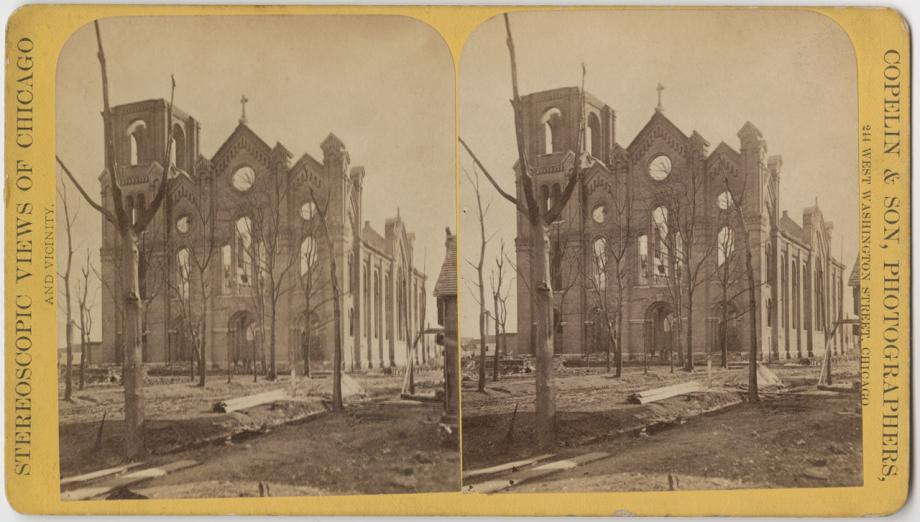
But what about the spire of St. Michael's, which is 24 feet higher than Holy Family's? Unlike Holy Family, St. Michael's was directly in the path of the fire. As this stereo-photograph of the devastation of St. Mike's shows, had there been a 290 foot tower at the time of the fire, it did not survive.


Confirming what's visible in the stereograph, in his book, Father Lane notes in his book that the fire, "... gutted St. Michael's leaving only the walls and part of the tower standing." According to Lane, the great spire and landmark of the near north side of the city wasn't completed until 1888. I haven't been able to ascertain whether the pre-fire tower was the same height as the one we see today, but it simply cannot be true that the church could claim title of city's tallest structure between October, 1871 and 1885 as the Emporis list claims.

I have no answer at the moment why the Encyclopedia of Chicago omits the old Board of Trade Building from its list. Here is a photograph of it standing on the same site as its Art Deco successor, where LaSalle Street meets Jackson, with the estimable Rookery Building visible on the left. Again it is the tower which puts this building over the top. The old Board of Trade lost its distinction as tallest building in the city in 1895 when its (in my opinion) inelegant clock tower was removed. The opulent building designed by W.W. Boyington, the architect of the Water Tower and many other mid-nineteenth century Chicago buildings, was demolished in 1929 to make way for its successor.


The real mystery surfaced when I began to assemble historic photographs of the buildings on these lists. Although its great size encouraged the Archdiocese of Chicago to use it for official diocesan ceremonies, the Church of the Holy Name, built in 1854, was, contrary to what it is called on both lists, never Chicago's official Roman Catholic cathedral. That distinction went to St. Mary's Cathedral in the Central Business District, what today we call the Loop. Holy Name was built in conjunction with the original St. Mary of the Lake University, Chicago's first university. Continually plagued with debt, both the university and the church struggled to keep afloat, and the university closed its doors in 1866. (The university re-opened in 1926 as St. Mary of the Lake Seminary in the Chicago suburb of Mundelein, IL). The photographs I found of old Holy Name Church were few and far between, but I was unable to find a single photograph with a tower anywhere close to the advertised 240 feet. I don't have the dates on these first two pictures but based upon what I learned, more on that later, I'd say the first photograph was made around 1862, give or take a couple of years.


You can clearly see the base for what would be the tower, hadn't yet reached much beyond the roof line of the church. The next picture shows the second stage of construction of the tower complete. I'm guessing it had to have been made not more than a couple years after the first, judging by the height of the tree on the right:


The date of the next picture is certain, the fall of 1871, shortly after most of the church was destroyed by the Chicago Fire. In this picture you can see the third stage in the development of the tower, and two beams protruding from the top, suggesting that there was indeed some kind of structure above:


Granted it's true that the documentation of the buildings of pre-fire Chicago is inconsistent, but the idea that I couldn't find one photograph of the completed spire perplexed me, especially if it was indeed the tallest structure in Chicago at the time. Unfortunately Father Lane in this case was no help. In his entry on the current cathedral which replaced old Holy Name, he only devotes one sentence to the lost church.

Another book I had on my shelves, Constructing Chicago, by Daniel Bluestone, devotes an entire detailed chapter to the construction of pre-fire churches in Chicago, but was also of no help regarding the specifics of the tower at old Holy Name.  

I also managed to find an old souvenir book on my shelves, published in 1949 on the occasion of the 100th anniversary of the founding of Holy Name parish. I got the book at the cathedral at the re-opening ceremony after the church was closed because of damage due to a fire in its roof, I think they were giving copies of the book away just to clean house. Anyway, that book contains a very detailed history of the city of Chicago, told of course from a very Catholic point of view. Turns out the very first cathedral of Chicago was actually the magnificent Cathedral of the Assumption of the Blessed Virgin in Baltimore, designed by Benjamin Latrobe in 1821. Back in frontier days when Chicago was just a backwater settlement, the territory covered by the archdiocese of Baltimore extended all the way to the Mississippi River. The Chicago diocese was founded in 1843. This book didn't go into great detail about the church building either, but it did give a detailed account of the parishioners who donated the money to build it and how much they gave. It also provided an eye-witness account of its destruction which describes the steeple catching fire, then collapsing onto the roof of the church, setting it on fire. That account was my first evidence that the spire actually existed.

Then I remembered a photographic panorama of Chicago made from the tower of the old Court House Building in the center of town. The panorama was published in the book Chicago, Growth of a Metropolis by Harold B, Mayer and Richard C. Wade. In the section of the panorama pointing northeast, three towers are clearly visible. One is the Water Tower, which had yet to receive its distinctive cupola, the tower of St. James Episcopal Cathedral, which also survived the fire and the subsequent 146 years, and low and behold, the base of the tower of Holy Name Church, looking very much like it did in the second photograph, with no spire. Although the photo does not show the towers clearly as they are at least one mile from the camera, it does appear there is work taking place, probably the construction of the third stage of the tower. As the Water Tower was built in 1869, the date of this photograph has to be between 1869 and 1871. Since the city at the time was filled with many 200 ft spires, the assertion that Holy Name was the tallest building in Chicago since 1854, has to be incorrect.

I asked myself, was there ever a tower? True, there was the account of the burning tower crashing onto the roof of the doomed church, but that was a scene repeated over and over again during those dreadful two days of the fire. It occurred to me that perhaps the eye-witness, in all the stress of a huge city burning before his eyes, could have mistakenly been recounting the story of the destruction of another church.

I was prepared to leave the question open until I decided to trudge through the tedious prose of the souvenir book. Reading through the histories of a succession of Chicago bishops with delicate constitutions who met their maker many years before their time, I discovered that in 1863, under the episcopate of one of those unfortunate men, Bishop James Duggan, the pastor of Holy Name, Father Joseph P. Roles:
...undertook with the permission of Bishop Duggan to add to the interior decorations which others had left incomplete. He installed the main altar and two side chapels with their screens, the altar railing and the pulpit, all in hand carved walnut. He also started to build the steeple which was originally planned. This was still in progress when the Church of the Holy Name was burned to the ground in 1871.
So there you have it. My guess is that the process of adding segments to the tower began in 1863 and continued, probably sporadically since those were war years, at least through 1869 or 1870, when work on the steeple above its supporting tower began. The first photograph was probably made just before 1863 and the second, sometime not long after 1865. From the information I have, at the time of the fire, the steeple may or may not have reached its planned 240 foot height, but the account of the destruction of the church mentioned above is most likely true.

Given all that, the Church of the Holy Name could not have been the tallest building in Chicago before 1869, and given that the steeple was not completed at the time of its destruction, its status as tallest building in Chicago at any time is doubtful.

Coming across that information the other day was a little bit of a letdown, I had anticipated doing some more legwork tracking down the story of the phantom tower of the Church of the Holy Name, and learning more about the history of the city along the way. As with many research projects, the journey is more satisfying than the destination. There's no real joy in debunking the notion that the Church of the Holy Name once had the distinction of being the tallest building in Chicago. Had it not been for the Great Fire, it very well may have been, for a little while anyway.

I don't know why but trivial as it may be, knowing that fact makes me a little sad.

The good news is if the spirit moves me, I can now embark on a project to discover the actual tallest buildings in Chicago before the Great Fire.


If I ever get the time.