Showing posts with label beer. Show all posts

Monday, December 14, 2015

Next Time

One of the useful things about writing a blog for a while is being able to look into the archives to see what you were doing at a specific moment in your life. For a very long time, it has been a tradition of ours to go up to Milwaukee on the weekend after Thanksgiving which also happens to correspond with my birthday. I knew we didn't make it up there last year, but was quite certain we were there the year before.

Thanks to this blog's archive, and the realization that I wrote about Milwaukee the last time we made it up there, it turns out our last post-Thanksgiving pilgrimage to the Cream City (named after the color of bricks typically found on its buildings), took place in 2012, three years ago.

Our periodic visits to Milwaukee confirm two of the most undeniable facts in human existence: things change (the title of my last piece on Milwaukee), and the scariest of them all, time flies. Because of that and our all too infrequent visits to one of my favorite cities, I've learned not to take another concept for granted, "next time."

In all my travels, next time comes up whenever I reckon I'll have the opportunity to do something I didn't get around to doing, the next time I visit a city. Until recently, the thought that there may not be a next time never occurred to me. That revelation struck me perhaps the first time a few years ago when I visited Melbourne. Quite frankly, despite how much I enjoyed that lovely city in Victoria, Australia, the idea of getting another opportunity to fly half way around the world to visit Melbourne again seemed quite unlikely indeed. 

Being only ninety minutes away by car, Milwaukee is obviously a different story. We could go up there at the drop of a hat if we choose, but somehow life seems to get in the way.

A couple things came to mind when I discovered that it's been three years since our last Thanksgiving visit. If we wait another three years, who knows what will have changed in our lives, but two things will be certain, I'll be sixty years old and my son will be a senior in high school, perhaps without the slightest desire to join us.

Also unknown is what will change in Milwaukee in the next three years. Both my wife and I have long histories with the city. She lived and studied there in her late teens and early twenties. and I've been going up regularly since childhood, starting with summer vacations with my grandparents. Since my wife and I have been going there together, we've observed the changes that have occurred, usually lamenting the loss of one favorite haunt or other.

Fortunately at this writing, more than a handful of Milwaukee institutions remain intact, unchanged since, well at least as long as I can remember, and no doubt much longer. 

My surrogate grandfather was from Germany and whenever we visited we inevitably dined in at least one of the city's great German restaurants, Maders and Karl Ratzsch's. Much later I had my first legal beer at Maders when I was nineteen, which was the drinking age in Wisconsin back then, two years younger than my home state, explaining the extraordinary concentration of police at the Illinois-Wisconsin state border on weekend evenings back in the seventies.

But Karl Ratzsch's at least in my opinion is superior to Maders in every way and my dear family obliges me on my birthday with a visit to my favorite restaurant on the planet. (Allegedly it was Frank Lloyd Wright's as well).

Looking exactly as it did in my childhood, the redoubtable Karl Ratzsch's restaurant
As you can see in the picture, the joint wasn't exactly jumping when we were there a couple weeks ago. It shouldn't come as much of a surprise that German restaurants with their heavy fare are not popular these days, perhaps for good reason. But to me this kind of cooking is the ultimate comfort food, introduced by my Czech father who passed on his passion for delicacies such as roast duck, wiener schnitzel and liver dumpling soup to his only son. The food combined with the gemutlichkeit, accompanied by a soundtrack of Johann Strauss waltzes and other light classical and old pop standards. kept the memory of my father, surrogate grandfather and my long lost childhood alive.

Unfortunately, as yet I have been unable to pass along the passion for Central European cuisine to my own children and I'm probably not alone. My fear is one day we'll drive up to Milwaukee and Karl Ratzsch's and Maders will be gone, victims of changing times, appetites and wastelines. 

Knowing the visit to Karl Ratzsch's would take up a good chunk of our limited time and money, I had reservations about visiting it this trip. Yet well aware of my new found appreciation of next time, I decided we had to go. It was the right decision and it made me very happy to be in the venerable restaurant again, hopefully there will be a next time.

Another valued treasure in Milwaukee is the Hotel Pfister which first opened its doors in the 1890s. The hotel expanded in the sixties, perhaps tripling its number of rooms when it built the adjacent Pfister Tower, one of the butt- ugliest sixties era buildings in a city filled with them. Fortunately the old building remains in tact and as you can see in the photo, every effort has been made to retain its 19th century charm.

The sumbtuous lobby of the Hotel Pfister
In the vicinity of Karl Ratzch's and the Pfister, another Milwaukee institution is still there but eroding before our eyes. George Watts & Son, in business since the 1870s, is famous for its tea room which is still going strong. In addition, Watts once had a retail establishment that occupied the rest of the two floors of its lovely building at the corner of  Mason and Jefferson Streets. The Watts Gift Shop, similar in feel to the one featured in the classic Ernst Lubitsch film The Shop Around the Corner, specialized in exceptionally courteous service and high quality odds and ends. In my wife's words, Watts featured "expertly curated, lovely but non-essential items for the kitchen and dining room," Watts was the go to place for wedding registries and Christmas gifts for the well heeled of Milwaukee's North Shore. Every year we'd take the opportunity to purchase gifts, especially for my mom for whom the shop was perfectly suited. About ten years ago we noticed that the company was reducing the footprint of its shop, renting out bits of space in their building to other high end retail establishments like a bridal salon and an art gallery. Today Watts Gift Shop is limited to the vestibule of their building and one small room on the first floor. Worst of all, a sizable portion of the second floor now is now occupied by a law office. My wife lamented putting off buying many things she had her eye on because she always assumed Watts would be there the next time we visited. Now she's not so sure.

In a post I wrote way back in 2010, I enumerated five of my favorite things in the world that were found in Milwaukee. Today, one of those establishments, Palermo Villa is gone, Alterra Coffee and Sendiks Grocery on Downer Street have both changed hands and altered in the process. We didn't visit Ben's Cycle this time but they have grown considerably and as a reliable source, our friend who is Ben's cousin assures us, the business is doing quite well thank you very much. Of the fives laces listed, only Karl Ratsch's seems to have changed not one iota.

There has been one change in Milwaukee since our last visit that pleased me to no end. Back when I was visiting the city with my grandparents in the sixties, we always made time for a brewery tour. Milwaukee of course is best known as a center of brewing and when I was a kid, the city boasted three major breweries, Schlitz, Pabst and Miller. We visited them all. To me the most impressive part of any brewery tour was the brewhouse and its enormous kettles which boil the liquid known as wort, extracted from mashed, malted barley and other grains. Into those kettles at various times in the brewing process, hops are introduced, typically by hand. From a historic postcard of the Pabst brewhouse that I collected as a child, this is how it looked:

Image from a fifties postcard showing Pabst Brewery workers
monitoring and adding hops to the brewing wort.
Notice in the background of the photograph there is a stained glass window. That window depicts the legendary King Gambrinus, the "patron saint of beer." You can imagine how impressive this room would have been to a little kid. What cannot be conveyed in the photograph is the tremendous aroma of the cooking sweet wort, combined with the spicy fragrance of the hops. That smell is not to everyone's liking but it is definitely unforgettable and in the rare circumstances when I encounter it, I'm magically transported to that very room, c. 1965.

The brewing industry fell upon hard times a decade later, Schitz closed its doors in the eighties and Pabst followed suit in the nineties. Since that time I often wondered what became of that beautiful room with its glorious kettles and stained glass window. Here's a link to a Flicker site devoted to some of Milwaukee's industrial ruins including the old brewhouse. Some of the photographs show markings on the floor where the mash tuns once sat, several stories above the brew kettles. They were no doubt removed in order to salvage their copper. But the beautiful kettles remained, covered with a patina of dust, as grass took seed within the grout of the old ceramic tiles on the floor. I can only guess why those old tanks didn't meet the same fate as the other equipment in the brewhouse, someone must have figured they had not completely worn out their usefulness.

A few months ago, the Pabst Company (whose chief product is now contract brewed by the Miller Brewing Company on the west side of town), announced that it will open up a boutique micro-brewery on the site of their old downtown plant. Naturally I had to go see.

One of my childhood haunts, the Pabst Brewery,
closed in the nineties and left to decay for twenty years
is finding new life. The brewhouse is the building on the right.
Today in the former Pabst guest house where the brewery tours used to originate, there is a gift shop that sells memorabilia from all the old Milwaukee breweries. There I inquired about the plans for the new brewery. Mistakenly I thought it would take advantage of some of the old equipment, thinking of course about the brewhouse. I was told the new micro brewery would be built inside an old church building on the edge of the property. What then I asked would be the fate of the old brew kettles? Clearly I hadn't been to Milwaukee in a while.

It turns out the brewhouse has been converted into a hotel, appropriately named, the Brewhouse Inn. The centerpiece of the new hotel is the lobby one floor above the reception area featuring what else, the six magnificent kettles and the window, all of which have been lovingly restored. The rooms of the hotel sit where the mash tuns used to be, and all overlook the lobby and the brew kettles.

The interior of the Pabst brewhouse as it appears today as the lobby of the new
Brewhouse Inn in Downtown Milwaukee.  
Like an iceberg, the majority of a working brew kettle exists below the surface, except for these giants as their bottoms have been lopped off. You can now stand underneath them one floor below and look up into the inside of the massive tanks from the reception area of the hotel. For a guest just arriving at the hotel not knowing what was going on upstairs, these massive copper voids in the ceiling must appear as brazen, abstract statements of modern interior architecture. 


As I told the doorman who judging from his appearance, could not possibly remember the old brewery, the one thing they couldn't replicate was the smell. He humored me but I got the distinct impression he thought those were the ramblings of a crazy old man. Perhaps he was right, I just couldn't hide my giddiness.

Standing in that room again after so many years, seeing these magnificent symbols of Milwaukee's industrial past as well as my own childhood, made me extraordinarily happy. Yet there was a tinge of sadness as the amputation of their bases means the kettles will never again function as they were intended. They are now only props, relics of a lost past. The lack of the natural aroma of brewing beer drove that point home even more. Without that function, when and if the curiosity of this room wears off, who knows how long the kettles will remain, as they and that space are no doubt costly to maintain. I was just glad to be able to show them and what I consider  one of the most remarkable interior spaces anywhere to my wife and children.

As the sun set in the west on a wonderful day, we left the city of Milwaukee for home, secure in the knowledge that like any great living city, it looks toward the future without forgetting its past. Change is a natural, inevitable fact of life. Cities that do not change along with the world around them, wither and die.  

It's sad to see old friends go away, but that's part of life. Perhaps if you're lucky, one day when you least expect it, they might return. Having said that, I leave you with this:
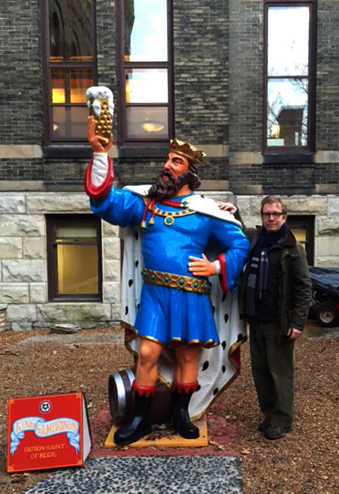
Yours truly posing with a statue of Good King Gambrinus
restored to his former glory and back in his old home at the former Pabst Brewery

Friday, April 20, 2012

Lonely and stupid here... you rang?

Two articles from The Atlantic were recently brought to my attention that deal with something I've been thinking about a lot lately; the role of innovation and technology on our lives.

Stephen Marche wrote an insightful article on social media titled: Is Facebook making us lonely? The article delves into the contemporary psyche, especially from the American standpoint. He touches on subjects that go beyond the scope of the title such as questioning what exactly makes us happy.

Here's a hint: trying to be happy doesn't make you happy.

As far as loneliness goes, we Americans the author believes, are a lonely lot by design. We value our independence and individualism over community. In other words, we choose to be lonely. It's not surprising then that Facebook, which allows us to connect with others without having any real contact with them, was born and bred in the good ol' USA.

But is there a causal effect between the social media and loneliness? On that subject, the author reluctantly seems to suggest no; you get out of Facebook what you bring to it.

I could have told him that.

The other article addresses how new computer technologies and the quest for artificial intelligence are affecting human intelligence. It was written by Nicholas Carr who wrote a book on the subject. His point in a nutshell is that our attention spans have been greatly compromised by the cacophony of information the new media bombard us with on a steady basis. See if you can prove him wrong by getting through his lengthy article provocatively titled: Is Google Making Us Stupid?

Carr's most salient point comes toward the end of the piece where he questions his own premise by noting that the inventions of writing and the printing press themselves were questioned by folks back in the day who worried about the loss of oral history and memory, the dissemination of information without appropriate instruction or background, and the spread of "sedition and debauchery." In other words, they understood that a little knowledge can be a dangerous thing.

Sound familiar? It turned out that the fears of the naysayers about the written word and printing press came true. It just so happened that the benefits from those earth shattering inventions outweighed the drawbacks.

The fact is, with every great invention created through the ages, something has been lost. Before the phonograph was invented, people entertained themselves by making their own music. Before television, people used their imagination to conjure images in their mind's eye of the characters they read about or listed to on the radio. Before the automobile, people got their exercise by walking. To escape the summer heat before air conditioning, people sat on their front stoops and talked to their neighbors. The list goes on and on...

This brings to mind the greatest invention story of all time. A very long time ago, farmers stored their grain in large earthenware pots. One day, some farmers forgot to cover the pot to protect their precious harvest from the elements. A rainstorm drenched the grain. Then the sun came out and heated the rainwater, slowly cooking the grain converting starch into sugar. After the water cooled in the evening, yeast spores suspended in the air landed in the mixture, voraciously consumed the sugars, and reproduced wildly. When the farmers discovered the uncovered pot sometime later, they assumed their harvest was ruined. That is, until one brave soul decided to try the soupy mess. It tasted peculiar, but the farmer soon discovered that drinking the concoction sure made him feel good. In fact, the more he drank, the better he felt. Soon the others tried it. You can imagine the party they had that night.

After the next morning's grogginess wore off, the farmers realized they had a good thing on their hands. The problem was, recreating it wasn't simple as they weren't around to witness the sequence of events that had to take place before their simple grain would become a magic elixir. Through experimentation by trial and error, they eventually came up with a successful batch. Many archeologists credit this as the dawn of the scientific method. Next they needed a way to remember how the heck they did it so they could repeat the process. Other than their memory, (which may have been altered by this time), there was no system to record the steps they took to create the potion.

So they had to invent one.

We know this to be true because the earliest examples of written language that archeologists have discovered are you guessed it, recipes for beer.

Now I needn't point out the obvious benefits of beer to society. As is the case with all great inventions, we lost a few things too; productivity, innocence, and countless weekends just to name a few. But the fact remains that beer's greatest contributions to society are written language, science and mathematics, (they had to keep track of all that precious brew you know).

Because of written language, we have books, and because of books we have libraries and the dissemination of knowledge. After Guttenburg's invention, knowledge was no longer the exclusive domain of a select few. Along with the rise in literacy came the fall of oligarchies, the dawn of the Enlightenment, and the rise of the arts and democracy.

Just as literature opened our minds to the ways of our world, science and mathematics gave us a greater understanding of the mechanisms of our world. The work of scientists and mathematicians opened the door for inventions that would work for the benefit, and sometimes to the detriment of society. Increasingly complicated problems required a new method to calculate mathematical equations that was quicker than the capability of the human mind. Again out of necessity, they had to invent one. They would call it the computer.

Eventually it was discovered that the computer could be used for things other than calculations, it could be used on words as well as numbers. Once that discovery was made, as with the invention of movable type some 500 years earlier, the computer forever revolutionized communication and the spread of knowledge. Soon the entire world became connected.

Then along came Google and Facebook and because of them, we all got lonely and stupid.

Just think, all that because of beer.

We beer lovers the world over realize that at some point, our preferred beverage would make us stupid and maybe a little bit lonely. Who knew it would take 5,000 years?

Thursday, October 27, 2011

Real Ale

My friend, the author and architectural historian Francis Morrone made note of my admitted short shrift of craft brewing in my last post about beer. In the following, he fills in a crucial precedent for the great beer revolution in the United States:

I think a crucial link you left out is that the U.S. microbrew and craft-brew revolution followed on Britain's Campaign for Real Ale, which began in the 1960s (though not made a formal consumer advocacy organization until the early '70s) when a number of Englishmen, most of them young, began to sound the alarm about declining British beer and the decline of the traditional pub. I am sure that when you were over there you noticed that many pubs announce themselves as "real ale pubs." That shows that they pass muster with CAMRA, which is today the U.K.'s single biggest consumer advocacy group. This is important to me both because I think there never would have been a similar movement in the U.S. but for the movement in the U.K., and also because one of the people who most influenced the real ale movement was my idol among architecture writers, Ian Nairn (who, alas, died from cirrhosis of the liver).

Tuesday, October 25, 2011

Reinheitsgebot

That word and everything it entails meant that at one time, all was well in the world, at least in Germany. It was the law stipulating that in order to produce something and call it beer, (yes I'm writing about beer again, just a warning), you could only use four ingredients, water, barley, hops and yeast. The law was repealed in the 1990s when Germany became part of the E.U. and the laws of all the member nations were consolidated. German beers sold domestically continue to adhere to the law. But it is now possible for German brewers to export something they call beer that is something well, just a little less than beer.

What's the world coming to?

A wise man once said:
As goes beer, so goes the world.

I don't remember who said it, maybe it was Abraham Lincoln. Anyway, in this topsy turvy economy with our manic-depressive stock market and the country on the verge of class warfare, the world of beer in many ways parallels the bigger picture.
After all, if you can't trust beer from a place that takes beer as seriously as Germany, what can you trust?

Yes friends, I'm saying that beer is a metaphor for life.


OK for those few of you who have continued reading after that last line, I offer my thanks for sticking with me.


The beer world is essentially divided in two camps, the macros and the micros. The macro breweries, Big Beer, represent the one percent of the population who control most of the wealth. As such they represent all that is evil with corporations, greed, capitalism, you name it. Their product is a watered down version of real beer, filled with adjunct ingredients like corn and rice that dilute the product, designed to increase the profit margin for the sole purposes of making the rich CEOs of the multi-national corporations who control them, even richer. Why do people drink their ghastly swill? Because the multi-nationals have brainwashed the unsuspecting public through their marketing campaigns, into believing that using their product will make them hipper, sexier, manlier, more attractive, more honest, and less pretentious than drinking the beer of the smaller, less visible, independent companies, the micro breweries who represent the other 99 percent, aka, the rest of us.

Instead of occupying Wall Street and Chicago, maybe today's protesters of corporate greed gone amok should be at the doorsteps of Anheuser-Busch in St. Louis and Miller in Milwaukee, both subsidiaries of the evil global corporations based in South Africa, or Europe or God only knows where. After all, Big Beer in all its incarnations, controls about 95 percent of the beer market in America, and one of its products, an appalling concoction known as "Bud Lite" has a 28 percent market share all to itself. The insatiable appetite of Big Beer will not rest until its opposition is thoroughly crushed, mangled, and wiped off the face of the map, or short of that, absorbed into Big Beer.

It's not like the old days when the hard working immigrant brewers who brought their recipes from the old country and founded thousands of small breweries in this country, all made wonderful beers and happily co-existed with each other in blissful utopia when the world was less cruel.

Well that's the story as told by the most strident beeristas, the real story isn't quite as salacious. It is true that brewing in America resembles the overall economy in its complexities, and its inscrutable system of hierarchies, ownerships and distribution. But the history of beer making in this country is also a fascinating tale of struggle, innovation, survival, and ultimately for the lucky ones, tremendous success and fortune.

Beer was brewed in the New World before the arrival of the Mayflower. But if you consider beer a genuine part of American culture, as anyone who watches TV commercials during sporting events does, the real dawn of the brewing industry in America came during the great influx of German immigration in the nineteenth century. The thirst of all those new arrivals needed to be quenched and one of the most valued professions among their ranks was that of brewer. Hundreds of breweries were founded in the cities with large Teutonic settlements such as New York, Chicago, Cincinnati, Baltimore, Detroit, St. Louis and of course, Milwaukee.

In America, the brewers did the best they could to replicate the beer they made back home, but found that the barley available to them on this side of the ocean resulted in a cloudy brew. They discovered that the addition of corn or rice (ingredients that would have been prohibited in Germany), provided the clarity their customers demanded. The beer those customers wanted was a type of beer known as lager, which was the prevalent, but certainly not the only style of beer found in Central Europe at the time. The descendants of those German brewers would create an entirely new style of beer known as American Pale Lager, which would become virtually the only style this country would produce for a very long time.

The names of a handful of those immigrant brewers are immortalized to this day on the bottles and cans of the products that represent the companies they founded. The names include Frederick Miller, Adolph Coor, Captain Fred Pabst, Joseph Schlitz, and Adolphus Busch. The fact that we still know those names and not the others, testifies to the fact that these men, all of whom came from humble backgrounds, were businessmen first, and brewers second. In each case, they bought their way into existing breweries, and ended up with success far beyond their wildest dreams.

Joseph Schlitz's brilliant marketing skills were helped along by tragedy, the Great Chicago Fire. Five local breweries were destroyed in the fire and almost as serious, the city's water system was contaminated. Relief came from Milwaukee in the form of hundreds of barrels of beer, courtesy of Herr Schlitz. That bit of altruism not only solidified the company's reputation around the country but also that of its hometown. In fact the slogan: "The beer that made Milwaukee famous" was inspired by Schlitz's act of generosity back in 1871. For his part, Schlitz gained a foothold in the lucrative Chicago market which enabled him to open up several saloons serving of course, exclusively Schlitz beer. You can see evidence of this today as the familiar logo of the Schlitz company, (the earth wrapped by a banner displaying the name of company), still graces the facades of many surviving buildings that once housed Schlitz owned saloons.


Beer plays an important part in Chicago's history. Back in 1855, the city fathers enacted a law banning the sale of alcohol on Sunday. Since it was the tradition of Germans to congregate in beer gardens on their one day of rest, the law was seen as an affront to that community. This resulted in the Lager Beer Riot on April 21st of that year. The ban was soon lifted. The labor movement that rocked the city in the 1870s and 80s was made up mostly of Germans and Bohemains, and the resentment towrd those folks and their drink of choice, fueled the fire of the temperance movement, as did the intense anti-German sentiment during WWI.

Well into the twentieth century, most beer was sold in saloons. If you wanted to enjoy your beer at home, you'd have to go to the local watering hole and fill up a vessel of one kind or other to bring home. Part of my family's lore is the story of how my great-grandfather Robert Houlihan became a teetotaler. One Sunday morning, Robert had a taste for a beer and asked his wife Margaret to head out to the tavern to fetch him some. Margaret wasn't in the mood for a Sunday morning jaunt to the
neighborhood tap so she did what any sensible parent would do, she sent her child. Apparently, Robert's reaction to the sight of his favorite daughter Marie, my grandmother, returning from the saloon struggling to carry home a bucket of beer, sent him into a tizzy. Such was the disgust from the sight that from that day forward my great grandfather vowed, not to fetch the beer himself, but to give up drink. He would become an ardent and vocal supporter of temperance and Prohibition. Fortunately his beliefs did not rub off on most of his progeny.

The "noble experiment" of Prohibition sent a tidal wave of change throughout the land, little of it having to do with the expressed purpose of eliminating the evils of drink.

A good number of breweries had the wherewithal to survive the thirteen years of Prohibition, mostly by selling legal near beer, malt extract or yeast products. What the consumers did with those products was apparently their own business, so long as they didn't make beer, wink wink.

One unintended consequence was that Prohibition created a whole new market for beer. Old time saloons were primarily the domain of men, whereas the illegal speakeasies of Prohibition were filled with men, women and even children. When the repeal of the 18th amendment came in 1933, the breweries, anxious to recoup their losses, were eager to expand their market well beyond the traditional Central European, male core. The heavily malted, intensely hopped beverage that Bohemians and Germans preferred, was shall we say an acquired taste, not necessarily popular among this new group. So the brewers adapted their recipes to create a beer that was less intense, easier to drink, and had a greatly reduced mouth feel and aftertaste. They did this by adding more corn or rice, depending on the location of the brewery. This was the beginning of the aforementioned American Pale Lager, which became so dominant in the American market.

Many in the beer world call
American Pale Lager an inferior product, but that's not really true. The lack of taste and distinction (at least compared to other styles), is certainly the chief characteristic of APL, but that's exactly the point. While making a boatload of money is certainly their goal as with any business, big brewers do not skimp on effort or the quality of their materials. In fact, the opposite is true for the most part. The breweries spend a great deal of money to procure ingredients of the highest quality and to maintain the highest standards of quality control in their facilities. A brewmaster's most important job at a commercial brewery, especially a big one, is not creativity or experimentation, but quality control, making sure his beer tastes exactly the same, one insipid sip after another. That's not an easy job in the notoriously fickle art of brewing.


When a brand of beer becomes inconsistent, trouble follows, as the makers of Schiltz found out not too long ago. Schlitz was the leading brewer in America for most of the twentieth century. In the 1970s, the company seeking to improve its profit margin, tried to cut corners by experimenting with new techniques that would shorten the aging process and enable them to use a higher percentage of corn, which is cheaper than barley. The change of recipe changed the product, and resulted in a beer than was inconsistent from batch to batch, causing loyal drinkers to switch brands in droves. In about ten years, the great Downtown Milwaukee brewery closed for good, and Schlitz was absorbed into the Pabst company. The Schlitz label exists today, still owned by the Pabst Company, and contract brewed by Miller, as a boutique brand, brewed using the old recipe. Better yes, but don't expect it to taste like Pilsner Urquell.

If innovation, creativity and experimentation are not a part of the brewmaster's job description, that is certainly not the case for the marketers of beer. Early beer ads testify to the beer companies' desire to convince non beer drinkers to drink beer. They typically describe the healthful attributes of beer as well as other benefits. The following is the copy of an ad from around 1900: *

There is no beverage more healthful than the right kind of beer. Barley malt and hops - a food and a tonic. Only 3 1/2 percent of alcohol - just right for digestion.


Rhine wine is 12 percent alcohol; champagne, 20 percent; whiskey, 40 percent.


There are no germs in pure beer, while the sweet drinks you give you children are full of them.


Pure beer is a tonic which all physicians favor. They prescribe it to the weak, the run-down, the convalescent. And they recommend it to well people who want to keep well.
Of course you have to drink the right beer:

But get the right beer, for some beer is not healthful. Schlitz is the pure beer, the clean beer, the filtered and sterilized beer. No bacilli in it - nothing but health.
And now for the coup de gras:

And Schlitz is the aged beer that never causes biliousness.
Of course not.

As the advertising world became more sophisticated, a product's image became the selling point for everything from soup to nuts. Beer was certainly no exception. For more or less the first two thirds of the twentieth century, beer ads typically made an effort to present the image of their product and its users as urbane and sophisticated, in marked contrast to the public image that beer was the drink of working class men. The Miller Company for example, famously advertised its signature product, Miller High Life as the "Champagne of Beers"

Here is a TV spot featuring the suave and debonair Ray Milland in character as private detective Roy Markham from around 1960. Note the non-discreet product placement during the closing credits of the program:


A few things happened to beer advertising in the sixties. TV commercials became more epic and cinematic. Gone were the days of on screen talent simply explaining the merits of a product as they did on radio. Imported beer started making real inroads in the American market and the bland, less expensive, American beers could no longer with a straight face claim to be more sophisticated than a beer from say Holland or Germany. So American beer companies reacted by turning to their old reliable consumers as you can see in this ad from 1971:


This commercial was made in the era when the slogans; "Miller Time" and "For all you do, this Bud's for you" were introduced. Their message was; after a hard day at work, sit back, relax, and pour yourself a cold one, you deserve it. The aggressive, over-the-top manly, men doing über-manly things campaign of Schlitz didn't go over as well as its creators had hoped, maybe because viewers found it hard to relate to say, tuna fishermen. But it was part of the trend that continues to this day to market American beer primarily to the working man.

In the seventies and the eighties, the marketers and brewmasters got together to create an entirely new style of brew, light beer. Influenced by the diet soft drink, light beer was probably intended to be marketed toward beer drinking women who wanted to watch their waste lines. The Chicago brand Meister Braü was the first to market the stuff but went nowhere with it. The Meister Braü label was purchased by Miller, who was at the time owned by cigarette giant Phillip Morris Company. "Meister Braü Lite" became "Lite Beer from Miller", and the target audience was changed to thirsty men. The new angle was that you could drink a whole lot of this stuff and get drunk (ok not in so many words), but not get bloated. They also claimed it tasted good which I guess is a matter of opinion. Miller produced several commercials showing some of the manliest of men, mostly sports stars who wouldn't be caught dead drinking diet beer, but were happy to drink two cans of beer that had the same effect of one normal beer. It was brilliant. Not only did the beer companies have a successful new product on their hands, but they could sell twice as much of it. Every major brand jumped on the light beer bandwagon and today about 45 percent of all the malt beverages sold in the U.S. is "Lite" beer of one brand or another.

At the same time, another revolution was taking place in the beer world. No one agrees exactly how or where it all began, but the micro/craft brewing movement brought a whole new world of beer to this country. The author and renowned beer authority Michael Jackson, categorized beers from around the world and identified dozens of different styles in his groundbreaking book; The World Guide to Beer, first published in 1977. Another author, Fred Eckhardt, elaborated on the various styles is his book; The Essentials of Beer Style. Small, independent breweries and brew pubs began creating brews in every conceivable style. In the meantime, home brewing became legal for the first time in the United States since Prohibition, and all over the country people read Charlie Papazian's book, The Complete Joy of Home Brewing, and learned how to make their own Oatmeal Stout, English Bitters, Belgian Ales, India Pale Ales, German Kölsches, Weißbiers and Bocks, barley wines, heck even American lagers if they chose to do so. The end result was that in America, people who never knew they liked beer because all they ever drank was the tasteless product of Big Beer, became connoisseurs. It was a great awakening. New breweries sprung up all over the States after a steady decline for decades. Today there are almost 1,800 breweries in this country, and all but about 100 of them are either micro-breweries or brewpubs.

Big Beer of course is taking notice, not that craft breweries are really a threat to them. Boston Brewing Company, the largest craft brewery in the United States, shipped 2,259,000 barrels of beer in 2010 and ranked as the eighth top brewing company in the country according to Newsweek Magazine. That's a lot of beer. But its market share is 1.1% compared to 47.9% for Anheuser-Busch InBev, and 28.9% for MillerCoors. Boston's market share is even less than one half that of Pabst Company which doesn't even brew its own beer. Still those numbers would put the Boston Brewing Company in the ranks of Big Beer, even though there is world of difference between its flagship product, Sam Adams Boston Lager, and your standard American Lager from those other companies.

This year it was announced that Chicago's own Goose Island Brewery was to become part of the Anheuser-Busch InBev portfolio. In other words (to mix a couple metaphors), they went over to the Dark Side by selling out to the Evil Empire. Of course no one has a clue how this will all play out over the next several years, but it's unlikely that the giant multi-national corporation is interested in the brewery simply to destroy it. Here is some evidence to that effect. I seriously doubt if Goose Island will be cranking out Bud and Bud Lite anytime soon.

The craft beer movement has separated beer drinkers into people who either drink beer because of the taste, or because of the label. Big Beer is still the big player in the industry and far more people drink their product than any other beer. I'll admit that there are lots of folks out there who drink American Pale Lager simply because they like the taste of it better than anything else. But I'm willing to bet that far more people drink Big Beer more because of the label.

Again, there's that ever fascinating subject, marketing, and its ability to elevate one product over another even though there is absolutely no difference between the two. Take Pabst Blue Ribbon, an old time brew that was once best known as the beer preferred by red necks. PBR has recently gained a new life as the hip beer of the indie rock set. How that happened was a combination of dumb luck and shear brilliance. In the mid-eighties, Pabst was a near moribund company whose future was in the hands of a hostile takeover. The new owner concentrated on selling all the real estate holdings of the company and all but eliminating the advertising budget. The label became essentially invisible for a decade, until young, anti-establishment types, "re-discovered" it
as a cheaper alternative to the familiar, more "commercial" brands like Miller and Bud that their fathers were drinking. Without any effort at all from the company, Pabst became big again, and while keeping away from main stream advertising, the new owners, the Metropoulos family have nudged the brand along by sponsoring alternative events such as concerts at indie rock venues, bike messenger contests and artists who work on Pabst related projects.

In the meantime, the good folks at Miller, in a sense bucking the trend themselves, began to emphasize their "macro-beer" image, featuring the High Life brand that we hadn't heard from for a while, though it never went away. A recent ad campaign has featured a likable Miller High Life deliveryman who actually takes his beer away from people whom he deems pretentious and therefore unworthy of "living the high life." This is a message obviously directed at the "everyman" but in a way has made MHL hipper than hip as a counter-counter culture product. In other words, drinkers of MHL reject the faux coolness of PBR and view its drinkers as poseurs. They drink what is in their opinion, a more honest, therefore hipper product.

The irony of all this is that Pabst Blue Ribbon is contract brewed by Miller. While the two are brewed using slightly different recipes, they are both made in the same brewery and are essentially the same beer. I'm guessing that if the workers at the Miller bottling plant accidentally switched the labels on a batch of PBR and a batch of MHL, nobody would notice.

These are pretty good times for beer lovers in America. For those of us who love beer for the taste, never before has there been more selection of styles of beer available to drink fresh, at a local brewpub, or to pick up at a retail establishment, even the local supermarket. For those drawn to the label, many of the old, forgotten brands will be coming back as a sort of niche for drinkers interested in nostalgia. Of course they'll all be brewed up at Miller's, but what's the difference, label lovers only care about the label after all.

For those folks who feel bilious about big business, there are still independent brewers out there without any corporate affiliation, you're job is to find them.

And if the idea of anyone at all profiting off of the making of beer sends you into a tizzy, you can always brew your own.

It is after all a free country. Let's drink to that, while we still can.


* reprinted from an advertisement for Schlitz Beer, c. 1900 as found in:
Breweries of Wisconsin, Jerry Apps, University of Wisconsin Press, 1992

Thursday, October 13, 2011

More beer!

Some stats on beer from Newsweek magazine combined with some scintillating commentary:

The most beer is consumed yearly per capita in which state?
New Hampshire - I would not have guessed that.

How about the least?
Utah - Not much of a surprise there. However New York State is number three, least that is.

Of the top ten beer companies in the U.S., I've only heard of five. On the other hand, the top two companies combined enjoy more than a 75% market share in the U.S., and I've definitely heard of those. One's based in St. Louis, the other in Milwaukee, but neither are owned by American companies anymore.

You need to enter your age in order to access the web sites of some of the beer companies. Is it illegal for anyone under 21 to read about beer? I wonder if anyone lies.

Pabst, a brand that almost disappeared not too long ago and a company almost continuously in transition, is number 5 with a 2.7 market share in the U.S.

Montana proportionately employs more brewers than any other state, 3.2 per 100,000. However less than 1,000,000 people live in Montana which means about 30 people work as brewers in Montana.

Beer was virtually tied with milk as the third most popular beverage in the United States in 2010 with a per capita yearly consumption of 20.7 gallons. Soft drinks come in at a staggering 44.7 gallons and bottled water at 28.3 gallons. Americans drank 18.5 gallons of coffee per person in 2010, 2.3 gallons of wine (a little surprising) and 1.5 gallons of the hard stuff. Despite the high number for soft drinks, we drank 16% less of it than we did ten years ago.

In terms of beer consumption around the world, the United States comes in at number 15, between Slovakia and Denmark. Now get this, of the top beer drinking countries of the world, the Czech Republic is number one and Ireland number two. So how could I not love beer? It's my heritage. Extending this, Germany is number four right behind Austria. My wife is mostly German, meaning my children have even more beer running through their veins.

Nazdravy, Sláinte and Prost to all.

Getting thirsty

All the talk of Prohibition has gotten me thinking about one of my favorite topics, beer. The world's greatest beverage and I go way back, you could say it flows along with my Czech and Irish blood. What's more, my surrogate grandfather was a German, and he enjoyed his bier at least as much as my father enjoyed his pivo. For many childhood years I spent my summer vacations up in Milwaukee with my grandparents, and with each trip inevitably came a brewery tour. One year it would be Schlitz, another Pabst, still another, Miller. These were not just factory tours, the breweries themselves were magnificent works of industrial architecture that played an extremely vital role in the history of Milwaukee. The companies. very conscious of public relations, put a great deal of effort into those tours which of course would end with a sampling of the product.

Since I was underage, the highlight of the tours for me was the brewhouse where gigantic copper kettles would boil thousands of gallons of wort, the sweet liquid that is derived from the malted barley which is the basic ingredient of beer. It is here where the hops are added, at the beginning to stabilize the brew, then at the end to contribute to the flavor and aroma of the beer.

The Pabst brewhouse was the most beautiful of the three, a nineteen century structure lined with steel, cooper and ceramic. Ceramic tiles also lined the magnificent kettles which resided in a room that featured a wonderful stained glass window featuring, what else, the history of beer.

But to me the most wonderful part of a brewhouse, was the smell of the boiling wort mixed with the spicy, herbal smell of hops. Folks either love or hate the smell of brewing beer but to me it brings back a particularly happy time of my life, and I love it.

I fell in love with the process of brewing beer, long before I learned to love drinking beer. The latter corrected itself soon enough, it was in Milwaukee in fact where I enjoyed my first legal beer as the drinking age in Wisconsin was 18 back in those days. It took me much longer to brew my own, it was during a brief period of bachelorhood in my mid-thirties when I finally had the time and inclination to pursue a life-long interest. As is usually the case with me, I plunged into my new hobby head first and for a few years, it was my main passion. Everyone who knew me back then knew not to bring up the subject of beer because it would begin a monologue which would last, well let's just say, longer than necessary.

Anyway, the bachelorhood and the brewing lasted concurrently for about five years. While I don't miss the bachelorhood part one bit, there are a few parts of brewing besides of course, the steady supply of beer, that I miss. Most home brewers brew with malt extract, a powder made from malted barley which you boil in water, add hops, then yeast after the mixture cools down. You could say it's a little like making instant beer.

That wasn't enough for me, no sir. I started with grain just like the real brewers, malted barley, ground it by hand, then mashed it by mixing it with water and cooking it at a very precise temperature. This is the process that extracts the good stuff from the malt into the water, and also chemically converts the starches from the grain into sugar, most of which will later be converted into alcohol. There is a fine line between success and failure in the mashing process, and it more than doubles the amount of time, but to me it was the essence of brewing my own beer, very much akin to processing my own film.

That was grunt work to be sure, the real fun came after the wort cooled down, and the yeast was added to the five gallon glass container that would be the home for the brew for the next few weeks or more. Usually, fermentation would begin the next morning, if not, anxious hours would be spent waiting to see if I would end up with real beer, or near beer. Fortunately for me, fermentation always took place. It was a joyful moment to discover that the hours of careful preparation and work were not for naught, when the brew would come alive as the yeast did its magic, feeding off the sugars I created in the mash, creating the byproduct of alcohol. Different batches fermented differently, but there was always a bubbling cauldron of activity as the yeast gleefully fed and fruitfully multiplied as it did its magic. Eventually most of the sugars would be converted, the yeast would go dormant, and it would be time for what now could be rightfully called beer, to age. Usually two or three weeks were enough, then it was time for bottling. That was the least fun part of the process. The bottles would have to be disinfected with bleach, then boiled, as were the caps. Each bottle was filled individually and capped. That process alone took at least four hours. Then came the anxious wait as the still active yeast in the beer would continue to do its work in the air tight environment with some freshly added wort to produce carbon dioxide, the all important carbonation.

After a few impatient days, the beer was ready to drink. How was it? Well some of it was pretty good if I do say so myself, although quite honestly not as good as the best commercial beers I've had. All of the batches were drinkable, better than many commercial beers, although to paraphrase a famous backhanded compliment, some may have had a taste that only a brewer could love.

But the satisfaction of brewing my own from scratch made even the lesser of my brews well worth the effort.

Eventually however the time and effort became too much, I just couldn't bring myself to bottle what could very well have been my best batch of beer, a Belgian ale. I sadly dumped all five gallons of the brew that had gone bad from sitting around too long, down the sink, and knew it was the end of my days as a brewer.

I became a father not long after that and even imagining going back to brewing now is something I can't even comprehend.

But it was fun while it lasted.

Now you know, don't get me started talking about beer!