Showing posts with label Washington monuments. Show all posts

Sunday, September 8, 2013

The Monumental City II


In my first installment on the monuments of Washington DC, I distinguished between sites that played a direct role in history versus the ones that are far removed in time and place from the subject they honor. Ford's Theater of course represents the former. It is a site preserved for eternity, just as it was that dreadful night when Abraham Lincoln was shot in his box seat above stage left.

An example of the latter would be the Jefferson Memorial, a building built so long after its intended subject, that even the land it sits upon did not exist in Thomas Jefferson's time. The monument was dedicated in 1943 on the 200th anniversary of Jefferson's birth. To get a more immediate glimpse into the life of the founding father and third president of the United States, you needn't go far. The main building of the Library of Congress, named for Thomas Jefferson, contains the largest collection of Jefferson documents anywhere. On public display you can view a reconstruction of his expansive library. Or you could go down to Charlottesville, Virginia and its environs. There you will find written upon his tombstone (which he designed), his epitaph (which he wrote), noting the accomplishments of which he felt the proudest:
Here was buried 
Thomas Jefferson
Author of the Declaration of American Independence
of the Statute of Virginia for religious freedom
Father of the University of Virginia 
Note the glaring omission.

Jefferson's monument in Washington makes up for that omission, as it sits directly across the National Mall from the White House, separated only by the Washington Monument, equidistant between the two. I don't believe there was ever a monument built in Washington DC that was not controversial for one thing or other and the Jefferson Memorial certainly is no exception. From the Japanese cherry trees that were sacrificed to make room for it, to its not so fashionable (for the time) classical revival architecture, to the out of context quotes on the walls intended to bring Jefferson in line with the administration in power when it was built, this monument never really got the respect, nor the visitors that the other big monuments in the city have enjoyed over the years. It doesn't help that it's a bit off the beaten path, you have to really want to go there to visit it. The one time I did make the trek to visit the great man in his marble mausoleum, frankly I was left a little cold, especially after visiting the Lincoln Memorial down the road apiece.

Fortunately you can appreciate it just as well if not more from a distance. An exquisite jewel box of a building, the Jefferson Monument perhaps is most famous for providing the backdrop in early April for the blossoming cherry trees that line the Tidal Basin. The building couldn't have a finer lineage. John Russell Pope, who built many of the neo-classical landmarks in Washington, designed it to resemble Jefferson's own Rotunda of the University of Virginia in Charlottesville, which itself was inspired by the Pantheon in Rome, for my money one of the greatest buildings ever built. Not having to protect its contents from the elements, the Jefferson Monument is completely open, prompting the viewer from a distance to line up the gargantuan statue of Jefferson by Rudulph Evans within the "sights" of two of the monument's 54 columns of the Ionic order, as I did in the photograph above.

The Jefferson monument is the first familiar building to greet visitors to the city when they arrive by the Metro from the National Airport as the train crosses the Potomac. It completes the quartet of landmark buildings, including  the US Capitol, the White House and the Lincoln Memorial, that radiate around the spindle of the Washington Monument with the National Mall as the east-west axis. It fits in so well with the rigid style and geometry of the city, it would be difficult to imagine Washington DC without it. Furthermore, despite its limited value as a place of historical significance, architecturally speaking, it's simply one of the most beautiful buildings in town.

As they say, if it didn't already exist, someone would have to invent it.

Until fairly recently, except for cherry blossom time, the Memorial was one of the only attractions in West Potomac Park, other than the lovely park itself that surrounds the Tidal Basin, an artificial body of water that serves to regulate the flow of the mighty Potomac. Since 1997, three monuments to great Americans have been unveiled around the Tidal Basin.

The "Stone of Hope"
The most recent of these is the Martin Luther King Jr. Memorial which was dedicated in October of 2011. As monuments go, this one is most in the spirit of Mount Rushmore, that is to say, a heroic image hewn out of a block of stone. I touched on it briefly in my first Washington monument post, and in another piece devoted to Dr. King here. But I hadn't actually set eyes on the monument until my most recent trip to Washington last week.

I must say, little surprised me seeing it in person, it pretty much looks just as it does in the pictures. Entering from the north, the visitor passes between two enormous stone monoliths, labeled "The Mountain(s) of Despair", toward a third rock labelled "The Stone of Hope." The names were inspired by a line from King's famous speech at the 1963 March on Washington: "...out of a mountain of despair, a stone of hope." Dr. King's likeness standing thirty feet high, is found on the Tidal Basin side of the Stone of Hope. He gazes to his right off into the distance toward the south, arms folded with a rolled up piece of paper in his left hand, perhaps the "I Have a Dream" speech. Extending in a semi-circle off each Mount of Despair are two granite walls into which are carved quotations from the civil rights leader. A stream of water separates the visitor from the wall.

A quote carved into the Stone of Hope originally read: "I was a drum major for justice, peace and righteousness." Like the quotes on the Jefferson Memorial, this one was taken out of context. Here is the original quote from Dr. King, spoken shortly before his assassination in 1968:
If you want to say that I was a drum major, say that I was a drum major for justice. Say that I was a drum major for peace. I was a drum major for righteousness. And all of the other shallow things will not matter.
Critics, including the poet Maya Angelou, claimed the abbreviated version misrepresented King making him look arrogant. Unlike the quotes misrepresenting Jefferson on his own memorial, the original inscription was sandblasted off the stone, which as you can see by the clear slab off Dr, King's left shoulder in these photographs, has been left blank, for now.

If most of the classic Washington DC monuments can trace their influence back to ancient Greece and Rome, the King Monument appears to go farther back, to ancient Egypt. Whether the effect is intentional or not, the two rear stones placed behind the head stone suggest lion haunches, making the whole ensemble when viewed at the proper angle, a little reminiscent of the Great Sphinx at Giza.

The King monument is certainly a powerful tribute to the slain civil rights leader. His image carved in stone by the artist Lei Yixin, has already attained iconic status, at least judging from the number of images of it found on tee shirts worn at the 2013 March on Washington. It is an appropriate heroic monument dedicated to one of the few truly heroic figures of our lifetime, well my lifetime at least.

But I've said it before and I'll say it again, no monument to Martin Luther King, no matter how stately or well executed, will ever be a more powerful and moving experience of the man than standing in his footsteps on the Lincoln Memorial a short walk away, on the spot where he delivered his great speech at the 1963 March On Washington. There, looking out toward the National Mall with the Washington Monument and the US Capitol off in the distance, in the center of the top step leading into our nation's greatest shrine are inscribed the words: "I Have a Dream." Quite often you will find a rose placed near this simple tribute to Dr. King.

No explanation is given, none is necessary.

The Franklin Delano Roosevelt Memorial, only a couple hundred yards to the west of the King monument, couldn't be more different. Instead of finding a heroic figure cut from a piece of rock, you are greeted by a fragile looking figure wearing a wrinkled suit, and sitting in a wheelchair. The sculpture by Robert Graham of the 32nd president at the entrance to his monument was not part of the original design. The centerpiece of the design is a massive statue of the seated president toward the back of the monument, (see the photograph below), his cape covering up what is presumably a wheelchair. FDR who contracted polio in 1921 and was left paralyzed, famously went to great lengths to keep his affliction from the public. This caused a great debate as to how to portray him in his memorial in a much different time. Even people with strong ties to disability issues disagreed about the proper way to portray FDR, some fearing that showing him in a wheelchair would imply he was a hero simply because of his disability. However the sentiments of those who felt it important to show the president as he actually was, won out, and the Graham statue was unveiled in 1991, four years after the monument opened. On the wall behind the statue are inscribed these words of Eleanor Roosevelt:
Franklin's illness gave him strength and courage he had not had before. He had to think out the fundamentals of living and learn the greatest of all lessons -- infinite patience and never-ending persistence.
The Roosevelt monument designed by Lawrence Halprin, sits on a sprawling seven acre site divided into four sections, each section representing one of the president's four terms in office. Water is a recurring theme in the monument. From a single drop representing the Great Depression to a torrent representing World War II, each section uses a water feature to symbolize the distinct nature of the term it represents. The symbolic arrangement of stones, along with quotes from FDR were also carefully thought out to bring home the point. Topping it all off, each section features works of art relating to the theme of each term, created by a number of artists:

  • George Segal contributed three free standing works to the memorial all dealing with the Depression: The Fireside Chat, The Rural Couple, and The Bread Line.
  • Leonard Baskin created a bas-relief of Roosevelt's funeral cortege.
  • The stone carvings of FDR's and Eleanor Roosevelt's words were executed by John Benson.
  • The above mentioned sculpture of a seated Roosevelt with the cape is the work of Neil Estern who also gave us the free standing sculpture of Eleanor Roosevelt, who deserves, and probably one day will get a monument of her own.
  • In addition to the statue of FDR in a wheelchair, Robert Graham also created a bas-relief of the president waving to the crowd during his first inaugural. Perhaps the most evocative work in the memorial, Graham's thirty foot long relief entitled Social Programs, is comprised of square panels subdivided into smaller squares each one depicting a different program. These panels are repeated in negative form on columns in the center of the section devoted to the Great Depression.  
The Bread Line, by George Segal

Social Programs, by Robert Graham

Roosevelt with his dog Fala, by Neil Estern, the original centerpiece
of the FDR Memorial

Given the choice between the two neighboring monuments, I'd have to say I prefer the FDR memorial to Dr. King's. The artwork in the FDR tribute is more diverse and compelling. Lawrence Halprin wisely chose to keep his creation in a park setting, leaving many of the established trees on the site, adding to its beauty, as well as shading the visitor from the brutal Washington summer sun. While it's a complex, some would say overly fussy tribute to its subject, the FDR monument doesn't command an overburdening feeling of reverence, as its somewhat bombastic neighbor to the east does. The sight of children playing in and around the rocks and waterfalls only adds to the experience as opposed to the King memorial where I saw a woman admonishing two parents whose young kids were splashing in the water, behaving like, well, like kids. And as I grow older, I have come to truly appreciate the addition of benches, where I can sit down and take it all in.

Besides the other, arguably superior monuments that already existed in Washington prior to the building of the Thomas Jefferson and Martin Luther King Memorials, there is another monument to Franklin Delano Roosevelt in the city, one that conformed exactly to his wishes. It is a simple marble slab measuring about four by six feet wide and three feet high that sits in front of the National Archives Building. Roosevelt told his friend, Associate Justice of the Supreme Court Felix Frankfurter, that he would like a monument to himself measuring no bigger than the size of his desk, and sitting in front of the National Archives building. In 1966, that's exactly what he got.

In my previous posts on the monuments of Washington including this one on a proposed memorial to Dwight D. Eisenhower, I've noted the trend since the success of the Vietnam Verterans Memorial, to build ever bigger, more complex monuments. One that has bucked the trend is the third recent monument built in West Potomac Park, the George Mason Memorial, dedicated to one of the lesser known founding fathers of this country. Situated near the monument to his fellow Virginian, Thomas Jefferson,the Mason monument also resides in a park setting. A simple reflecting pool sits before a pergola under which is a bench where a statue of the subject sits cross legged, inviting you the visitor to join him. Faye B. Harwell designed the site and Wendy M. Ross created the sculpture. Stone tablets inscribed with Mason's words sit on either side of the bench. It's an utterly charming monument in marked contrast to its rather pompous neighbors.

Unfortunately it's unlikely that the George Mason Memorial will set a trend for more modest, thoughtful Washington DC monuments, as the ones on the drawing board seem ever more ambitious. As long as the "they have theirs, now I want mine" element runs through Washington, we can expect bigger, more extravagant creations to be built in our nation's capital.

Judging from the latest monuments built in Washington, what the new monuments probably won't be, is more powerful, moving or edifying. Designers could take a cue from the successful monuments of the past, and from the poet Robert Browning whose poem, Andrea del Sarto, called the Faultless Painter, contains the axiom, later adopted by the architect Ludwig Mies van der Rohe: "less is more."

On my recent visit to Washington I had revelations of two of the monuments I wrote about in my previous posts that will stay with me for a long time. As I entered the portion of the National Mall in front of the Lincoln Memorial where the celebration of the 50th anniversary of the 1963 March on Washington was taking place, a gentleman who I'd say was in his mid to upper seventies walking beside me had a look of deep concentration on his face. Assuming he was trying to listen to the events taking place broadcast over the distant loudspeakers, I asked him if he could make out who was speaking at the time. Without breaking his glance ahead and slightly to his left, the man said to me: "No, I'm just staring in amazement at that monument over there, it looks like something Hitler would have built." He was looking at the National World War II Memorial, opened in 2002. Although I never made the connection, the man had a point. The pillars, triumphal arches, and water fountains of that monument seem to speak to the glory of war, and little about reflection and loss. Something similar could have indeed come out of the sketchbooks of Albert Speer, the official architect of the Third Reich.

Then after the event on the Mall, I had the rare opportunity to pass by the Vietnam Veterans Memorial while it was closed to the public, due to the festivities.


On a normal day, hundreds, sometimes thousands of people would be standing in front of the wall at any given moment, searching for the name of a loved one, or simply taking in the magnitude of the sea of names representing American soldiers who lost their lives during the Vietnam War. 

Without all the visitors, the interaction between the Frederick Hart sculpture The Three Soldiers, seen on the right of the photograph above, and Maya Lin's Wall on the left is even more striking. Once I thought the interaction of the visitors with the Wall was the only source of its power. But the other day with the monument empty, it took on a new dimension. Like Robert Graham's portrait of FDR in a wheelchair, the statue of the three soldiers was not part of the original design, but added after people objected to the fact that only the dead were commemorated in Lin's monument. 

I believe that as is the case with the wheelchair-bound FDR, the Hart sculpture has become an essential element of its monument, adding the necessary touch of humanity to the work. In the case of the Vietnam Memorial, seeing the three soldiers gazing into the void of the black wall cut into the earth, perhaps looking for the names of their fallen comrades, or even their own names on that wall, is a chilling, yet poignant experience. 

As with seeing the words "I Have a Dream" carved into the top step of the Lincoln Memorial, no explanation is given, none is necessary.

Monday, September 2, 2013

The March on Washington, 2013


National Mall, Washington, DC, Wednesday August 28, 2013


The year was 1965 or 1966 and I was about seven years old, playing at my friend's house while his parents were watching the news on TV. A report came on about a protest march led by Martin Luther King Jr. My friend's parents (both immigrants from Europe), called Dr. King a troublemaker and added something of this nature: "why doesn't that colored guy just mind his own business and let people live in peace?"

Back at home I recall parroting those sentiments to my parents another time Dr. King appeared on TV. I'm happy to report that both my mother and father (he also European by birth), in no uncertain terms repudiated my friend's parents' blatant bigotry, and assured me that Martin Luther King was indeed a very good man who was fighting a righteous battle on behalf of people that did not receive a fair shake in this country.

Those are my very first memories of Dr. King. Not long after that he would be dead and like President Kennedy before him, he would be elevated to the status of sainthood, at least in the minds of people my age who came to know both men more in death than in life. Not only that, his I Have a Dream speech came to be exalted into the realm of sacred American texts.


Last week as the 50th anniversary of that speech and the 1963 March on Washington for Jobs and Freedom approached, having no personal memories of the event, I asked my mother about her memories. She told me that she supported the march, yet like many people across the country, had apprehensions about the possibility of violence. She also recalled my grandmother who, while supporting the spirit and ideals of the march, objected to the means, especially the idea of Catholic priests and nuns marching. "It's just not their place" she said.

About two weeks ago it occurred to me that I would be in Washington DC at the same time as the golden anniversary of the march. Not only that, it turned out my work schedule allowed me to be present at the exact moment marking 50 years to the minute when Dr. King delivered his most famous speech. At that time, church bells would be rung throughout the country and President Obama would deliver a speech from the exact spot on the steps of the Lincoln Memorial where Dr. King stood, overlooking the National Mall. I couldn't pass up the opportunity to be present at such an important historical event. After all, while people at that march a half century ago certainly might have predicted a change coming in America, I doubt that few if any in their wildest dreams would have imagined that fifty years from the moment Dr. King got up to address the multitudes on that sweltering Washington afternoon, the first African American President of the United States would stand on that very spot to commemorate the event.


The 2013 march was surely one for its own time, not in any way (except for the location) intended to be a re-enactment of the original. Perhaps the biggest difference between the march fifty years ago and the one this past Wednesday was its focus. More than 200,000 persons, the overwhelming number of them black, gathered in 1963 to demand that the laws of this country apply equally to everyone; that the promises made in the Declaration of Independence and the US Constitution would be fulfilled.

In the words of Dr. King:
...one hundred years later (after the Emancipation Proclamation), the Negro still is not free. One hundred years later, the life of the Negro is still sadly crippled by the manacles of segregation and the chains of discrimination. One hundred years later, the Negro lives on a lonely island of poverty in the midst of a vast ocean of material prosperity. One hundred years later, the Negro is still languishing in the corners of American society and finds himself an exile in his own land. So we have come here today to dramatize a shameful condition.

Those words were not the exaggerations of a firebrand painting a desperate picture only to prove a point. On the contrary; if anything they grossly understated the situation at the time. As correctly pointed out by the Rev. Al Sharpton, the original march was not merely an event, it was "the middle of a struggle." So called "Jim Crow" segregation laws were still in place all over the South, imposing separate and anything but equal facilities for people of color. Poll taxes still existed preventing poor people, mostly black, from participating in the most basic civil liberty, the right to vote. When people spoke up about the injustice, police stepped in using any means they felt necessary to prevent American citizens from exercising their constitutional rights of freedom of assembly and speech.

Things weren't much better up north. Although there were no official segregation laws in place, restaurants, hotels and other institutions refused to serve black people. Rocks were thrown at Dr. King in Chicago when he marched through white neighborhoods demonstrating the lack of equal housing in this city. Dr. King said of his experience here:
I have seen many demonstrations in the South, but I have never seen anything so hostile and so hateful as I've seen here today.
So the trepidations of folks concerning trouble during the march were not unfounded. It took very hard work on both sides, the organizers of the March and the City of Washington and its police force, to make sure the 1963 demonstration would be peaceful.

Where there was a definite anti-establishment edge to the original March on Washington, (President Kennedy watched passively from the comfort of the White House a few blocks away), the organizers of last week's event had to drive establishment figures away with a stick. Two former presidents made the cut, Jimmy Carter and Bill Clinton joined Obama on the dais, along with the First Lady and President Kennedy's daughter Caroline. Ties to the original march included members of the King family and US Congressman John Lewis, the last surviving speaker at the 1963 March. And yes, Oprah Winfrey was there. It is a telling symbol of the changing landscape of America, that by far the richest, most main-stream establishment figure sitting up on the steps of the Lincoln Memorial that day was an African American woman.

Unlike 1963, practically every human rights cause under the sun was represented this year. This may have diluted the message but let's face it, times have changed in fifty years:


The following day in his column in the Washington Times called "Washington Sketch", Dana Millbank bemoaned the fact that "2013 didn't live up to 1963." In his column:
  • He expressed his feeling that the preponderance of causes at this year's rally watered down the original intent of the march. 
  • He noted President Obama's predicting his speech wouldn't be as good as his predecessor's fifty years ago, then went on to suggest the president fulfilled his prediction. 
  • He mentioned the hundreds of vendors, mostly African American, selling chintzy souvenirs many of them featuring the images of not only King and Obama, but also of Treyvon Martin. 
  • And he also noted that the slick production values, VIP seating sections, and many other features of this year's event, ran diametrically opposed to the grass roots nature of the original. 

Everything he said was true, but that was exactly the point of the event. Today while the issue of civil rights for people of color is still a burning one, it certainly is not the only one. While much work has yet to be done, significant progress has been made since 1963, as evidenced at this march from the independent entrepreneurs selling their wares all the way up to the gentleman sitting today in the Oval Office. Beyond freedom and justice for people of color, the March of 1963 empowered a tidal wave of movements dedicated to justice and freedom for all groups of people. 

No one was ever under the delusion that the 2013 model of the March on Washington would be a replay of the original, as it would be impossible to match the spirit and urgency of that much different time. On the contrary, this event was a celebration not only of the 1963 event, but of how far we have come in fifty years, without ever losing sight of how far we have yet to go. Many people believe that the 1963 March on Washington for Jobs and Freedom was the turning point in the civil rights movement; perhaps, (to paraphrase Winston Churchill), not the beginning of the end, but the end of the beginning of the struggle for equal rights in the United States.

To that end, it is certainly fitting that we celebrate the great event's fiftieth anniversary.

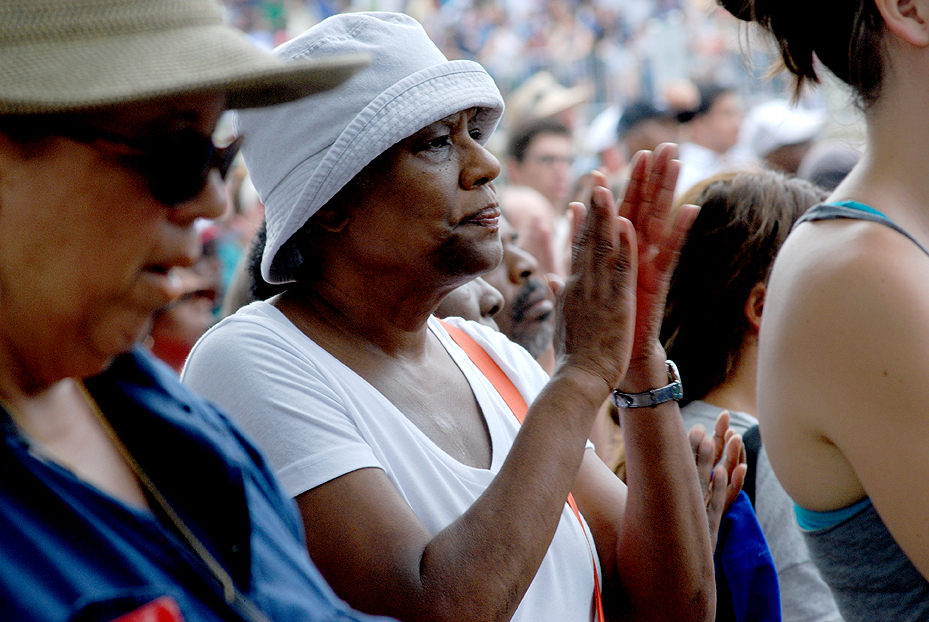
As a celebration I'd have to say this event was a rousing success. As you can see from the photographs, the group who gathered on the National Mall last Wednesday was made up of people of all shapes and sizes,  a diverse group of races, ethnicities, genders, ages, and sexual orientations, representing the depth and breadth of this country. 

Perhaps as Mr. Millbank wrote, there were "no speeches likely to live beyond a news cycle or two." But that hardly matters. In the end, more than the group of dignitaries gathered on the steps of the Lincoln Memorial, the lasting image of the 2013 March will be the crowd of Americans who spontaneously assembled together in our nation's most hallowed spot, to share Dr. King's dream that the promise put forth by the fathers of our great nation might one day be fulfilled. When all the words spoken on that platform will long have been forgotten, the spirit of that day will remain...


... and what a magnificent day it was.


Saturday, June 30, 2012

How do we like Ike? Let me count the ways...

Yet another controversy is brewing over a proposed monument in Washington D.C. Last year there was the tumult over the Martin Luther King Memorial when it opened on the southwestern edge of the National Mall. The gargantuan likeness in stone of the civil rights leader was not the work of an American sculptor, but outsourced to China, much to the chagrin of detractors who, correctly I believe, felt that the commission should have gone to someone slightly more local.

The Franklin Delano Roosevelt monument a few steps away caused a stir when advocates supporting the rights of the disabled, objected to the focal point of the monument, a statue of the 32nd president whose cape partially obscurs the wheel chair in which he is sitting. The problem was solved by adding a second statue where FDR's wheelchair was in the open for all to see.

Before that, the World War II Memorial just west of the Washington Monument was roundly criticized for its location, blocking the previously unobstructed view between the Lincoln Memorial and the Washington Monuments. The mother of all monumental battles took place in the 1980s when a controversial design by an undergraduate architecture student at Yale won the competition for the Vietnam Veterans Memorial. You can read about those two monuments (and others) here.

The truth is, none of the monuments in our nation's capital were built without controversy including the two most famous, those dedicated to Abraham Lincoln and George Washington respectively. So it should come as no surprise that the latest projected monument, the Dwight D. Eisenhower Memorial, would also stir up a fuss. What is surprising is the fact that the most vociferous critics of the planned memorial, are none other than the family of the general and president.

A closed competition was held with 44 entries being solicited by the Eisenhower Memorial Commission. The Commission selected the entry of Frank Gehry, arguably this country's most prominent architect. As has been the current trend in monument design since the Korean War Memorial in the 1990s, Gehry's monument is expansive and didactic; the design covers many aspects of the life of Eisenhower, going all the way back to his boyhood in Kansas.  A statue of the young Ike seated on a plank was to be the centerpiece of the memorial. Eisenhower's family felt the man who was at the helm of the command of Allied Forces during World War II and the 34th President of the United States would better be served remembered in those capacities, rather than as a barefoot farm boy in Kansas. The architect agreed to shift the focus of his monument to the adult Ike. Other changes have been requested and for his part, Gehry has been uncharacteristically amenable to the changes in the design.

Nonetheless, the good feeling from the architect has done little to dissuade detractors who oppose the current design for many reasons. There is you may have guessed, a blog devoted to the subject. It's title: "The Truth About the Eisenhower Memorial" leaves little to the imagination as to where the sympathies of its authors lie.

From that site, here are two letters from the Eisenhower family that enumerate their objections to Gehry's design.

General Dwight D. Eisenhower

Here's a post criticizing the memorial on philosophical and design grounds from Howard Blackson, a design and urban affairs specialist who is a contributor to the PlaceShakers blog.

On the flip side of the coin, here is a New York Times OpEd piece written by Witold Rybczynski who serves on the United States Commission of Fine Arts (one of the bodies that approved Gehry's design). Rybczynski makes a valid point that the monument will suffer if too many voices have their say about the final design. I agree wholeheartedly. One need only go a few blocks away from the site of the proposed monument to view the mess that is the WWII Memorial to see the effects of compromise, the inevitable result of "too many cooks in the kitchen." When it comes to a public memorial, perhaps we'd all be better off with a benevolent art czar/dictator hand picking an artist who is granted carte blanche in the design and execution of the project. The WWII Memorial proved that design by committee is rarely successful.

But I have a far more radical idea. Why not just can the whole idea?

Don't get me wrong, I think Dwight Eisenhower is among the most important Americans of the Twentieth Century. If anyone deserves a monument in the District of Columbia, (anyone who doesn't already have one that is), it is he. No my problem isn't with the subject, it's with the monuments. Something unsettling happened after the creation of the Vietnam Memorial in the 1980s. That particular monument evoked a public response that was remarkable. Since then there has been an explosion of proposals for monuments on the National Mall, each one attempting to replicate the scope, power and impact of "The Wall". So far all of them have failed to come close.

Part of the problem is that designers of the new monuments failed to take a cue from successful monuments of the past, namely that less is more. What evokes Washington D.C. and the memories of their subjects more than the utter simplicity of the Washington Monument or the Lincoln Memorial?

The power of the Vietnam Veterans Memorial also lies in its simplicity. Stone slabs cut into the ground bear the names of the 58,000 fallen American servicemen and women. Its straightforward design inspires visitors, loved ones and strangers alike, to leave personal mementoes at the foot of the Wall, and take rubbings of the inscribed names. Most of the visitors today to The Wall have no direct connection at all, many of them are school groups on their ritual tour of Washington. They may be going through the motions but many can't help being moved, the vast ocean of names of the dead is too overwhelming. I have little doubt that the Vietnam Memorial, like its neighbor the Lincoln Memorial, will continue to evoke great passion long after the generation that inspired it is long gone.

It's a fallacy to believe that the impact of the Wall can ever be duplicated given the unique nature of the War in Vietnam. That hasn't stopped the deluge of proposals for new memorials, all conceived with the conceit: "if such and such a group can have a monument to their cause, why can't we?"  Every successive design has engaged in a battle of one upmanship, each one trying to be more inclusive, more educational, more moving, than the one that came before.

In that regard, Gehry's proposal for the Eisenhower Memorial takes the cake. In addition to the statue of Ike the barefoot farm boy on a plank, Gehry's design includes massive, eighty foot columns which support "tapestries" of woven steel which would depict leafless trees inspired by those found in the Kansas landscape. Gehry sees himself first and foremost as an artist, and in that role he feels it absolutely necessary to create something new and visionary, something that reflects the society in which we live. I'm not entirely sure what his feeling is about Dwight Eisenhower, but he's left us with plenty of comments about himself and his work, including this:
Life is chaotic, dangerous, and surprising. Buildings should reflect that.
I'm sure that when and if Gehry's design is built, it will be a knock your socks off kind of experience. It would also occupy enough space to contain the Washington and Jefferson Monuments as well as the Lincoln Memorial put together, with room to spare. Impressive as all that sounds, I'm still not so sure how enlightening it will be about its subject. Also, my guess is that "chaotic, dangerous and surprising" are not exactly the attributes the Eisenhower family had in mind when they set about lobbying for a monument to their ancestor. Perhaps they had the strange notion that the monument was intended to honor the general, not the architect.

This all reminds me an old children's book my wife dug up called "Millions of Cats." The story goes something like this:

A little old man and woman lived together in a nice old cottage, but they were very lonely. One day the man set out to get a cat for his wife to help keep her company. He found a field filled with cats of all shapes and sizes, but couldn't decide which one to take home as each cat was prettier than the one that came before it. So he took them all. When the man came home with literally millions of cats following him, his wife said: "How are we ever going to find room for all these cats?" The man scratched his head and told his wife she was right. He went out to tell the cats about his dilemma and asked them to decide amongst themselves who was the prettiest. Well cats being cats, they quarreled, each one claiming to be the prettiest of all. The argument got ugly and the man decided he'd best go inside and let the felines sort it out. The noise of the cat fight was deafening but eventually it stopped. The man and woman were shocked to see that all the cats had vanished except for a scrawny little one that was cowering in the bushes. "What happened?" said the old man to the emaciated kitty. "Well... " said the little cat, "all the other cats kept fighting and fighting over which one was the prettiest and eventually they just ate each other up." "And how come you didn't get eaten up?" said the old man. "Oh I'm just a homely little cat, when you asked who was the prettiest, I didn't say anything. So nobody bothered about me." And the little old man and woman took the cat into their home, fed, took care of and loved him, and eventually he became the prettiest of all the millions of cats.

So what's the moral of the story?

Just listen to the Eisenhower family and build the General a nice old fashioned statue on top of a pedestal, and everyone will live happly ever after.