
It should surprise no one that Washington DC is a city filled to the brim with monuments. Any government city is bound to contain reflections of its nation's past and Washington is certainly no exception, it is the repository of our nation's collective consciousness.
Washington is a remarkable place to visit, especially for anyone wishing to know what the United States is all about. Every child in this country I believe should visit the city at some point during his or her school career.
There are the great attractions to be sure, the White House, the Capitol, and Supreme Court Buildings, The National Archives, one of the best collections of museums in the world, the zoo, the arboretum, etc. But the real draw for me, like
Berlin, is the emotional impact of history being spilled out from every nook and cranny of an incredible city.
Monuments come in all shapes and sizes, but essentially they either commemorate their subjects from a great distance of time and space, or they play an integral role in whatever story they have to tell. As our nation's capital for the past 211 years, Washington DC has its share of stories to tell.
To me the most compelling story to be found there is its role during the time of the greatest anguish in this country's history, the Civil War.
By 1790 there were already disputes between the North and the South, both wanted to claim the nation's capital for their own. New Yorker Alexander Hamilton and Virginian Thomas Jefferson, bitter political rivals, came to a compromise, over dinner nonetheless. The federal government would take on the Revolutionary War debts of the northern states in exchange for moving the capital south, to somewhere along the banks of the Potomac. George Washington chose the site for his namesake city, a piece of land at the confluence of the Potomac and Anacostia rivers between the already developed towns of Georgetown, Maryland and Alexandria, Virginia.
After the South seceded from the Union in 1861, Washington found itself in hostile territory. The Confederate Army never made it to the Union capital proper, but they came mighty close, so close in fact that some Civil War battlefields are today only a short Metro ride from Downtown Washington. The Commonwealth of Virginia, (whose capital city Richmond was also the capital of the Confederacy), is an easy walk across the river.

Arlington Memorial Bridge, the work of the firm McKim Mead and White, opened in 1932. It connects Washington DC to its Northern Virginia suburbs and is crossed by tens of thousands of commuters every day. One can only guess how many of them are aware of the significance of that bridge, a great symbol of healing. It connects the North and the South and two icons of each, the Lincoln Memorial, and Arlington House, once the home of Robert E. Lee. His home and property were confiscated by the Union Army and turned into a military burial ground in 1864 just to spite the great Confederate general. Today, Arlington National Cemetery is hallowed ground, our nation's most important monument to the men and women who gave their lives in the service their country, some 300,000 of them lie within its confines.
One looking for a living monument to the Civil War needn't go further than the U.S. Capitol Building.
Here is a photograph of it during the first inauguration of Abraham Lincoln in 1861. In addition to its duties as the home of two of the three branches of government at the time, the Capitol was pressed into service as a military hospital during the war. Washington was a much sought after prize for the Confederates and the defense of it was of the utmost importance to the Union. All construction was halted on the Capitol Building with the exception of the work on the dome, whose completion was seen by President Lincoln as a symbol of hope for the people of Washington, despite its tragic situation. The dome was completed when the
Statue of Freedom was hoisted into place, crowning the dome on December 2, 1863.

Ironically, many of those who built the Capitol Building, including one of the chief artisans of the Statue of Freedom, were slaves.
Phillip Reid presided over the final stages of the casting of the 20 foot high statue. He did not become a free man until November of 1864, when the State of Maryland in which he resided approved their new constitution which abolished slavery. (As a border state that sided with the Union, Maryland was not subject to the 1862 Emancipation Proclamation which only applied to the Confederate States.)
With the dome complete and the war nearing its end, on March 4, 1865, President Lincoln delivered perhaps his greatest speech, his
Second Inaugural Address, from the Capitol steps. One month later, Lee surrendered to Grant at Appomattox. In six weeks the president would be dead, shot about a mile away at Ford's Theater. His body lay in state in the Rotunda under the great dome until it was carried down those same steps to begin its long journey home to Illinois.
Three miles away, at the other end of the
National Mall, stands the most recognizable and poignant memorial to the Civil War, and so much more.

So ingrained in our national consciousness, it's easy to forget that the
Lincoln Memorial wasn't built until 1922, generations after the death of the 16th president. That would place Henry Bacon's temple to Abraham Lincoln within the realm of monuments well removed in time from their subjects. Yet the Lincoln Memorial has been at the center of so many important public events in our nation's history that it has taken on a life of its own as a significant historical site in its own right, and along with the stretch of the National Mall in front of it, the country's most profound monument to freedom.
In the year 1939, and in the most pig-headed fashion, the Daughters of the American Revolution refused to allow the renowned American contralto
Marion Anderson, because of her race, to perform in recital in their Constitution Hall. As a response, with the help of Eleanor Roosevelt (who resigned from the DAR in protest), a concert was arranged for Easter Sunday of that year in a much larger venue, the National Mall. The steps of the Lincoln Memorial would serve as the stage with the magnificent Daniel Chester French likeness of the president as the backdrop. “In this great auditorium under the sky, all of us are free" were the words of Secretary of the Interior Harold Ickes when he introduced Miss Anderson.
In 1963, an even greater event was held on exactly the same spot:
A plaque commemorating one of the greatest speeches of American history can be found on the top step of the Memorial.
As I write this, in a little over one week, a new monument will be unveiled in Washington.
The Martin Luther King Jr. National Memorial promises to be a massive, jaw dropping commemoration of this great American leader, placed not very far from the Lincoln Memorial.
Here is the official web site which includes a virtual tour. Quite something isn't it?
Perhaps it's because I can actually remember Dr. King that I simply can't imagine a more spine tingling experience than standing in his footsteps on the stairs in front of Abraham Lincoln and gazing out at that great expanse as he did nearly fifty years ago. Without that personal connection, I suppose that future generations who only know him as a distant historical figure will have a closer connection to the new memorial.
The King Memorial is only the latest in what has been a building boom for monuments in Washington in recent years. Of the soon to be
ten National Memorials in the District of Columbia, half of them, including the King Monument, were built since 1982. This current trend began with the
Vietnam Veterans Memorial.

After the deplorable reaction from their countrymen to servicemen and women upon their return home from the unpopular Vietnam War, a memorial was proposed to honor them on the National Mall, steps away from the Lincoln Memorial. A competition was held to select the design of the monument.
Maya Lin was then an undergraduate student of architecture at Yale who entered a class assignment, (which incidentally earned her a B), into the competition and gained instant notoriety when she was selected the winner. Her design was conceptual and minimal, two highly reflective polished black stone walls bearing the inscribed names of 58,175 American dead. The slabs were dug into the earth, as if a giant wound. Her creation which became known simply as
The Wall, was a departure from the heroic designs of Washington's existing assortment of monuments. This was to be a statement about war, not merely a monument to those who participated.
There was immediate criticism of the design, much of it bombast from politicians who objected to the unconventional nature of proposed monument. In the midst of the feeding frenzy, there were some valid concerns. Some veterans felt that the monument only paid tribute to the dead, not to those who returned. Others objected to the fact that an American flag was not a part of the design. The debate about whether or not to build The Wall dragged on for several months.

In the end, Lin's design was built with minor concessions. The third place winner in the competition, an established Washington area sculptor by the name of Frederick Hart, was commissioned to create a representational sculpture to be added to the Memorial. His piece added faces to the overwhelming sea of names. Titled,
The Three Soldiers, Hart's work
was created with Lin's creation in mind, the soldiers gaze in the direction of the Wall, perhaps looking for their own names on the monument. Hart took great pains to place his statue at a respectful distance from Lin's work, in no way does it detract from the Wall.
Still, Lin objected and displayed no small amount of arrogance when she refused to attend the dedication of Hart's work, apparently forgetting that the memorial was meant to be a monument to the veterans and not to her.

Despite the objections, Lin's work proved to be an unqualified success and has gained iconic stature. As was the case with the Lincoln Memorial, the monument was revered not simply for its design, but for the way that visitors have interacted with it. From the start, friends, relatives and comrades of the dead sought out the names and left mementos in honor of their loved ones. I've seen everything from a pack of cigarettes to a purple heart medal left at the base of the Wall. At the end of every day, park rangers collect the items and deposit them in the National Park Service Museum and Resource Center. The daily maintenance ritual also includes cleaning the polished surface of the monument as the hand prints of visitors reaching up to touch the names of the soldiers, poignantly mark their grief and devotion.
A third sculpture has since been added to the ensemble honoring women, specifically the nurses who served in Vietnam. Regardless, it is the Wall that everybody associates with the Memorial,
The Three Soliders and
The Women's Memorial sculptures, despite their relative merits, are merely bit players.
For better or worse, the Wall has become the standard by which monuments are judged, and it inspired a title wave of plans for the creation of new memorials on the National Mall.
 The Korean War Veterans Memorial
 opened in 1995 and in many ways mirrors the Vietnam Memorial just across the Reflecting Pool to the north. It too contains a reflective wall. Instead of names, this wall contains images of the faces of people who participated in the war, sandblasted into the surface. The Pool of Remembrance at the center of the monument, is a somber black reflecting pool lined with granite blocks inscribed with statistics; the number of American and United Nations forces dead (54,246, and 628,833 respectively), captured (7,140 and 92,970) and missing in action (8,177 and 470,267). The dominant feature of this monument, scattered on evergreen shrubs between the wall and a walkway are 19 larger than life sculptures representing a squadron of troops on patrol.

Perhaps because of the lack of personal connection given by names on the wall, or possibly because the event it commemorates is farther removed from us in time, the Korean War memorial doesn't evoke the same kind of emotional response as its neighbor to the north, But it is a reflective and quite beautiful tribute to those who served in what has become a truly forgotten war.
Were it not for the creation of these two stirring war memorials, it's unlikely that anyone would have come up with the idea of a World War II monument for the National Mall. After all, the veterans of that war were never treated with open hostility, nor have they and the epic struggle in which they participated, ever been forgotten. Besides, a heroic and
supremely iconic memorial already exists right across the river in Arlington. OK so technically it's a monument dedicated to the Marine Corps, but the event depicted in the sculpture, taken from an image by AP photographer Joe Rosenthal, is so emblematic of World War II, that hardly a soul looking at the Iwo Jima Memorial would not immediately associate it with the veterans of that war, regardless of their branch of service.

The seeds of the
National World War II Memorial were sewn not long after the dedication of the Korean War Memorial. The sentiment was essentially this: "the Korea and Vietnam vets got their monuments, why don't the WWII vets have theirs?" It was a no-brainer to go ahead with a project that would seem to be something no one could possibly quarrel with. Being Washington however, nothing is simple and there were detractors. The biggest complaint was the choice of location on the axis of the National Mall, right in the shadow of the Washington Monument. By contrast, the two previous war memorials were placed discreetly to the sides of the Mall and are not visible until you are right on top of them. The placement of anything on the site proposed for the WWII monument would obscure the previously unobstructed view between the Washington and Lincoln Monuments and the reflecting pool (at this writing currently being rebuilt), that spans almost that entire distance. That view was an integral part of the March on Washington and Dr. King's speech in 1963. Since then, the western section of the Mall has become sacrosanct to the members of the Civil Rights movement and anyone who values freedom of speech and the right to dissent. Any construction altering that space would be seen as a desecration.
Since the supporters of the monument were steadfast in their selection of that specific prominent site despite the objections, as a result they ended up with a monument that was destined to be constrained by severe design limitations. The monument that we now have has been well received by veterans and their families, much less so from critics. A visitor at the dedication responding to the critics of the monument made an astute comment, he said: "As long as it's a memorial, it could be a hole in the ground with a plaque on it and it wouldn't matter, it's in the heart."
With that I agree.
That after all is exactly what the Vietnam Wall is, but before it was built it was excoriated by veterans groups who said its lack of monumentality showed them disrespect. It's unlikely that the even more conservative WWII vets would have accepted an unobtrusive plaque in a hole in the ground to commemorate their war.

What they got was much worse. What they got was a compromise, a design that was hampered because of its site by so many restrictions that it has been rendered insignificant. The choice of architectural style is a throwback to a time when in Washington if you were going to build anything, you could use any style you liked as long as it was neo-Classical. Contextualism there is so rampant that two of my favorite buildings in town, the Richardsonian-Romanesque Old Post Office building and the neo-Renaissance Pension Fund Building (now the home of the National Building Museum), were threatened many times with demolition simply because they didn't fit in. Fortunately the community lightened up and those two buildings are now landmarks. That's not to say that neo-Classicism ever went away or that it is bad thing in itself. Think of the Lincoln Memorial. But the WWII Memorial is a monument to our role in the the greatest tragedy the world has ever known, and in the end it was designed to merely "fit in" so as to please as many and offend as few people as possible, which is political correctness at its worst.
The veterans of World War II deserved better. Six years after the Memorial opened, on any given day you may see a few of them at the monument, reliving memories of the past. Or you may see a handful of folks, reading the inscriptions on the walls from the familiar quotes of politicians of the day, or even fewer gazing at the small relief sculptures that depict in a nutshell, the war from an American perspective. You might even find one or two paying homage to the dead by the bronze stars, each one representing 100 lives lost.

What you're more likely to see are bus loads of school kids on field trips disembarking at yet another stop on their tour of the capital, to find a wading pool that you can't wade in, and tempting ramps that you can't skateboard down. You wouldn't know you couldn't do any of this were it not for the signs posted everywhere telling you not to. There are lots of good vantages to have your picture taken however, and any time day of night you'll see folks standing by the pool, primping and posing for their souvenir picture, taken against either the Washington Monument to the east or the Lincoln Monument to the west.
Granted, the task of designing a memorial to commemorate an event as enormous and heartbreaking as World War II, of creating something that all who were personally involved in the event as well as everyone else would approve, and building it in the middle of an already emotionally charged national treasure, had to be, well pardon the pun, monumental.

The way I see it, a successful monument needs to be a few things. It needs to be a place for contemplation, it needs to revere its subject and respect its visitors. There should be at least a modicum of beauty to the place. And while I certainly don't expect a memorial to be first and foremost an educational experience, I do believe that it should at the very least, inspire.
The World War II Memorial fails on all counts in my opinion. The design is stiff and passionless, it misses the point in so many ways. The monument is divided state by state, yet WWII probably brought the nation together more than any other. There is no invitation to connect with it, you can look at a distance, but you mustn't touch. Worst of all, it only pays lip service to those who lost their lives, the 100 dead per star system is more like a demographic map than a tribute. The monument was not built for the ages, its purpose seems to be that it exists, nothing else. It's almost as if a bureaucrat said to the vets: "Well you wanted a memorial, now here it is."
We recently lost the last American veteran of World War I and it won't be very long before all those who participated in World War II will be gone. All who will be left will be those kids who couldn't wade in the fountain or skateboard down those ramps. That is what they will remember of World War II.
In his actions and speeches, Martin Luther King did nothing but confirm the values expressed in the Declaration of Independence and the rights guaranteed by our constitution, those that we Americans claim to espouse. The March on Washington which featured his unforgettable speech forever marked the National Mall as the place where Americans go to openly speak their mind, whether it conforms to government policy or not, without fear of official retribution. As such that place embodies the core values of what this nation supposedly holds dearest, liberty and justice for all. For that reason alone all Americans whatever their political bent should view that particular patch of ground as our nation's most profound monument to freedom and democracy.
Which brings to mind an almost sacrilegious question: "Would it be better to have no memorial at all than one that is ill conceived and poorly designed?"
It may come as a surprise that there is no National Memorial in Washington, DC to the deadliest war in American history, the Civil War. Yet as we've seen, all of Washington and its environs is a monument to that war.
Perhaps the question was best answered by the columnist George Will several years ago. In essence he said in defense of NOT building the WWII memorial, that all Americans should go to Washington, DC, look around at the National Mall and all the other symbols of our democracy, then remember that none of it would be there today without the unselfish acts and sacrifice of the veterans of World War II.
Memorial or not, that is their real monument.


 Back at home I recall parroting those sentiments to my parents another time Dr. King appeared on TV. I'm happy to report that both my mother and father (he also European by birth), in no uncertain terms repudiated my friend's parents' blatant bigotry, and assured me that Martin Luther King was indeed a very good man who was fighting a righteous battle on behalf of people that did not receive a fair shake in this country.

 Those words were not the exaggerations of a firebrand painting a desperate picture only to prove a point. On the contrary; if anything they grossly understated the situation at the time. As correctly pointed out by the Rev. Al Sharpton, the original march was not merely an event, it was "the middle of a struggle." So called "Jim Crow" segregation laws were still in place all over the South, imposing separate and anything but equal facilities for people of color. Poll taxes still existed preventing poor people, mostly black, from participating in the most basic civil liberty, the right to vote. When people spoke up about the injustice, police stepped in using any means they felt necessary to prevent American citizens from exercising their constitutional rights of freedom of assembly and speech.


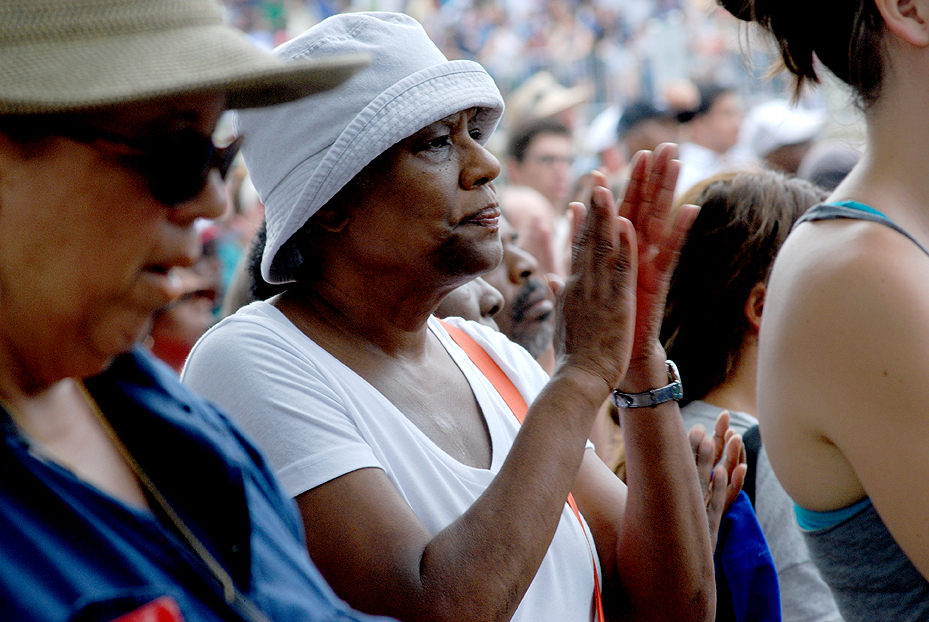
 Everything he said was true, but that was exactly the point of the event. Today while the issue of civil rights for people of color is still a burning one, it certainly is not the only one. While much work has yet to be done, significant progress has been made since 1963, as evidenced at this march from the independent entrepreneurs selling their wares all the way up to the gentleman sitting today in the Oval Office. Beyond freedom and justice for people of color, the March of 1963 empowered a tidal wave of movements dedicated to justice and freedom for all groups of people.


 ,
,
