Friday, May 31, 2013

A bad day for the medium

Yesterday, Thursday May 30, 2013, one of Chicago's two remaining daily newspapers, the Sun Times laid off its entire staff of photographers. In a press release, Sun Times management said:
Our audiences are consistently seeking more video content with their news. We have made great progress in meeting this demand and are focused on bolstering our reporting capabilities with video and other multimedia elements. The Chicago Sun-Times continues to evolve with our digitally savvy customers, and as a result, we have had to restructure the way we manage multimedia, including photography, across the network.
Approximately thirty full and part time staffers, including a number of Pulitzer Prize winners will lose their jobs effective immediately. It's not as if still photographs will stop appearing in the paper and on the web. According to Michelle Maynard, a blogger at Forbes, The Sun Times
plans to get by with freelance photographers, and rely on reporters to snap photographs with smart phones.
In other words, the paper is going to do photography on the cheap. Hypothetically turning the situation around 180 degrees , Chicago Tribune staff photographer Scott Strazzante wrote yesterday in his blog:
This is a horrible thought, but, just once, I want a writer fired because the boss decided the photographer could write his own stories to go with his images.
That would be unlikely to happen because photographers are a highly undervalued group; after all, anybody can take a picture right?

The idea that you could make an image with a machine rather than by hand, has made photography a controversial medium since its first appearance on the scene in 1839. The medium's verisimilitude in depicting a subject led the French academic painter Paul Delaroche upon viewing his first Daguerreotype to comment: "From today, painting is dead." Of course painting did not die, but it did change radically since the invention of photography. The two mediums since that time have borrowed heavily from each other. Despite the fact that the earliest photographers considered themselves artists in their own right, not simply failed painters, few in the art academies, or the general public considered photography an art.

It only got worse in 1888 when George Eastman patented his idea of a box camera that came loaded with a roll of film (roll film was also his idea). "You press the button, we do the rest" was the slogan for the Eastman Kodak camera that took away all the "hard work" of photography. Once you shot the film, you'd send the whole bundle, camera and all back to Kodak who sent back processed prints along with another camera loaded with a fresh roll of film. In the fifty years of photography before Eastman, practitioners of the medium were limited to professionals and highly dedicated amateurs who needed to master the complex process of coating plates, processing them into negatives, and printing out the final output, before they could even consider creating the image.

From Eastman on, a chimpanzee could make a photograph.

But could a chimpanzee make a good photograph, let alone a cohesive body of work? Well you know what they say, given enough chimps pecking away on typewriters you'll eventually end up with Shakespeare.

Just like the typing monkey theory, the idea that everybody could become accomplished photographers is a myth.

Fortunately the notion that the validity of a work of art should be judged primarily on its technical difficulty has been almost universally rejected. Otherwise, ridiculously difficult skills like engraving would be considered the greatest of the arts.

Still, ever since I first became serious about photography, more years ago than I care to remember, I've been put into the position of having to answer the question: "If it takes skill to be a photographer, well then, what makes a good photograph?" Truth be told, I've never been able to answer that question adequately;  photography in all its manifestations, is far too complex to pigeon hole, even if only to distinguish the good from the bad. Some photographers put as much work into a single image as would the most traditional academic painter. Other photographers shoot pictures "from the hip", images that seem as if the photographer is not even looking through the viewfinder. One photograph could be great because of its rendition of tones, for example a sumptuous platinum print with an incredibly long tonal range, or a gelatin silver print with a dramatic transition from the deepest blacks to the whitest whites. A photograph could be simply about composition like an abstract painting. Most often however, people associate photographs with the subjects they portray. The subject of the photograph could be profound or it could be banal. A photographer might organize what's before the camera carefully around the frame, or could allow the action in front of the camera to occur spontaneously. Or the action could appear spontaneous but in reality be planned down to the nth degree as in this photograph. Photographs could be about topics, or they cold be about ideas.

Is a photograph a mirror into the photographer's soul or is it a window to the outside world? Does a photograph tell the truth and if so, does it really matter? Questions like these have been pondered for the 174 years of photography's existence by thinkers from Charles Baudelaire to Susan Sontag.

One thing is certain, no one who takes art seriously today questions that photography is indeed an art form, worthy of being included in the circle of the other fine arts such as painting and sculpture.

Yet unlike painting and sculpture, photography exists in realms that are far removed from the fine arts. There are cameras everywhere and hardly an event regardless of how trivial goes by without being documented on film or more likely in this day and age, electronically. No one knows for certain how many photographs are created in one year but a reasonable guess is in the neighborhood of 350 billion. The world's largest archive of photographs today is Facebook which in less than ten years has accumulated 140 billion images and counting, 10,000 times larger than the photographic archive in the Library of Congress. By contrast, the collection of photographs in the Department of Photography of the Art Institute of Chicago where I work, a collection that spans the entire history of the medium, is pushing about 20,000 objects.

There is no question that the impact of photography made by non-photographers is far greater now than ever before. The inclusion of cameras on electronic devices meant primarily for other purposes has put image making devices in the hands of people living in all corners of the globe. Any news organization would be insane not to include images gathered from all sources including non-photographers, even non-human ones, this one for example.

But it's truly a great loss that the Sun Times, and I'm guessing more papers to follow, will be foregoing experienced, professional photographers who have dedicated their lives to the art and craft of telling stories through pictures. What will go next God only knows, professional writers perhaps?

I understand the economics of the business, but at what point does a newspaper stop being a newspaper and become just another blog? Regrettably it seems the powers that be at the Sun Times don't understand the nature of the medium of photography, and the power of a well seen image. Nor do they understand that video is not an extension of still photography, the two media serve two entirely different purposes.

Oh and for the record, owning a smart phone doesn't make you any more of a photographer than owning a musical instrument makes you a musician. Of course we now have audio software that can cover up a multitude of sins, so trained musicians are probably a thing of the past as well.

A sad, sad state of affairs indeed.

Monday, May 27, 2013

The DIA


The Train is a remarkable John Frankenheimer film made in 1964 based upon a true story recounted in the book, Le front de l'art by Rose Valland. The story takes place during World War II and it centers around works of art pilfered from the Jeu de Paume Museum in Paris by German occupation forces who intended to send the works home to the Fatherland. Museum officials seeking to stop the larceny, enlisted the help of the French Resistance who in the end, manage to stop the train containing its precious cargo before it reached the German border, but not without appalling loss of human life. The chilling tracking shot toward the end of the movie shows unharmed crates bearing the labels, "Roualt", "Matisse", "Renoir", "Braque", "Dufy", "Degas", "Lautrec" and "Cezanne", scattered among the corpses of the people who died during the process of keeping the priceless objects in France.

This begs the question, what value can you place upon a work of art? That very question is being raised as we speak, in the Motor City.

The Detroit Institute of Arts is among a handful of this nation's most important art museums. Its collection includes the work of the usual suspects found in major Western institutions of its kind: Old Masters such as Dürer, Velazquez, Rubens and Rembrandt; Impressionists, pre, during and post, Courbet, Monet, Cezanne, and Van Gogh; Expressionists, Beckmann, Kirchner, and Kokochka, you get the idea. The DIA also has in its holdings important works from great artists who are not found everywhere such as Van Eyck and Pieter Brueghel the Elder. While the museum is especially known for its fine collection of American art, its collection is encyclopedic.

In the thirties, Edsel Ford commissioned the Mexican muralist Diego Rivera, to create a cycle of frescos inspired by the city, for the museum's central court. Rivera's work, like his Rockefeller Center frescos in New York City was highly controversial at the time it was created because it openly espoused his Marxist ideals. But the capitalist Edsel, son of Henry Ford, was unmoved by the protests and defended Rivera's work titled Detroit Industry. During the anti-communist McCarthy era twenty years later, the museum put up a sign remarkable in its candor that said the following:
Rivera's politics and his publicity seeking are detestable. But let's get the record straight on what he did here. He came from Mexico to Detroit, thought our mass production industries and our technology wonderful and very exciting, painted them as one of the great achievements of the twentieth century. This came after the debunking twenties when our artists and writers found nothing worthwhile in America and worst of all in America was the Middle West. Rivera saw and painted the significance of Detroit as a world city. If we are proud of this city's achievements, we should be proud of these paintings and not lose our heads over what Rivera is doing in Mexico today. 

Today, Rivera'a work at the DIA is one of Detroit's great cultural landmarks.

The Detroit Institute of Arts is a municipally owned museum and given the current state of the city in which it resides, its financial straights should not come as much of a surprise. Recently the museum was forced to impose draconian cuts including gallery closures and layoffs of highly regarded, veteran museum professionals. If you thought things couldn't get any worse for the DIA, now come reports that the emergency manager of Detroit's finances is suggesting that parts of the museum's collection might be sold in order to help pay off the city's massive debt. Here is the story found in the Detroit Free Press.

I can see how to the uninitiated, this might seem like a good idea; selling off a few dozen paintings worth tens, even hundreds of millions of dollars apiece, could go a long way toward settling the city's multi-billion dollar debt. The museum's vaults contain about 60,000 objects, and twenty or thirty would be a mere drop in the bucket. One may ask: what's more important, keeping a city solvent, enabling it to pay essential employees such as police, firefighters, and teachers on time, or a handful of paintings down at the museum?

Now before you say to yourself: "beware, the Philistines are at the door", there are a few things to consider. A few years ago at the museum in which I work, (a comparable institution to the DIA), we faced our own financial crisis, albeit one not anywhere close to the scope of Detroit's. Yet the ax was about to fall on a good number of people who put in many years of faithful service and everyone was on edge to put it mildly. At a museum-wide meeting, someone raised the hypothetical question of selling works of art to help fund the museum's operating budget. For a moment, some considered this a tempting idea. Most of us would have gladly chosen to keep our jobs over a Monet or two.

Selling objects in a collection, known in the museum world as deaccessioning, is not an uncommon practice. Much as a gardener might thin out a garden, museums occasionally sell work to thin out bits and pieces that may be overrepresented in the collection or do not fit in with the mission of the institution. However a museum's bylaws generally stipulate that an object in the collection may only be deaccessioned if the proceeds from such a sale would go toward the accession of an object of equal or greater value to the museum. Proceeds going toward any other purpose is strictly forbidden and is in fact, unethical. As the lion's share of any museum's collection is acquired through donation, either of works themselves or the funds to purchase them, a museum that sells a part of its collection for any purpose other than bolstering the collection, even to a modest degree, violates the covenant forged with its donors. Any museum choosing this path would lose all credibility with future donors and the museum community at large.

Again, one might say while this may be true, desperate times call for desperate actions. In the words of a spokesman for Kevyn Orr, Detroit's emergency administrator, a museum's collection
is an asset of the city to a certain degree. We’ve got a responsibility under the act to rationalize that asset, to make sure we understand what’s it’s worth.
We have to look at everything on the table... as much as it would pain us to do it, and it does, I’m a great lover of art and so is Kevyn, (yet) we’ve got a responsibility to rationalize all the assets of the city and find out what the worth is and what the city holds.
It was added that the city's creditors may even force the issue of selling works of art along with other municipally owned assets. Chicago did just that when they sold former municipal holdings such as the Chicago Skyway and the control of its parking meters in order to raise revenue.

Of course the comparison of selling off a city's cultural treasures to selling roadways and parking meters is ludicrous. Even at the most basic level, it's obvious that the toll roads and parking meters in question are still with us, happily taking our hard earned money. Selling a work of art in a public institution on the other hand, would inevitably mean that the work would no longer be available to the public, as no other public institution could possibly afford to purchase the most valuable objects in the DIA's collection at current market value.

Museum professionals all across the country are responding with understandable concern about the situation in Detroit. Thomas P. Campbell, the director of the Metropolitan Museum of Art in New York City notes the outrage of the Detroit art community as well as
the millions of people who admire the Detroit Institute of Arts and the entire cultural community who rightly believe that art is a permanent, rather than a liquid, community asset.
Some may view the opinion of a museum director with a certain amount of disdain; they see it as the view of privilege handed down from an ivory tower.

So what is the value of a work of art in a museum?

The director of the DIA, Graham W. J. Beal, has an interesting and unexpected answer:
As far as we’re concerned... as objects held in the public trust, they actually don’t have a value. 
Simply put, a collection of art held by a public institution belongs to all of us. It is an asset to a community only insofar as it constitutes an essential part of the heart and soul of the community. A person can sell parts of his body for money, blood plasma or a kidney perhaps, but eventually he will run out of body parts. You cannot sell your heart or any other vital organ without dying. Your heart has absolutely no value to you as anything other than exactly what and where it is. What the Met is to New York, and the Art Institute is to Chicago, the DIA and its incredible collection is to its city. It is a vital part of what makes Detroit, Detroit. By selling it off bit by bit, the money managers may as well be saying: "let's give up on the idea of Detroit altogether; just pay off its debts, plow it under, and move everybody to some other place that works better."

Getting back to the movie mentioned at the top of this post, after the train carrying the art is forced to stop and the German troops riding aboard it scatter, killing innocent passengers as they depart, the officer who ordered the operation confronts the French Resistance leader who stopped him. The Frenchman Labiche (played by Burt Lancaster), from the beginning was indifferent to the works of art he was saving, his actions were driven purely out of principal. The officer (played by Paul Scofield) says this to Lebiche:
Here's your prize, Labiche. Some of the greatest paintings in the world. Does it please you, Labiche? You feel a sense of excitement at just being near them? A painting means as much to you as a string of pearls to an ape. You won by sheer luck. You stopped me without knowing what you were doing or why. You are nothing, Labiche. A lump of flesh. 
The paintings are mine. They always will be. Beauty belongs to the man who can appreciate it. They will always belong to me, or a man like me. Now, this minute, you couldn't tell me why you did what you did.
There are many folks who like the character Labiche, view art as an elitist enterprise. They feel that art is for a select few and not them, therefore they have no time or need for it. Unfortunately that view is enforced by not a select few in the art community who feel just as the German officer does, that art belongs only to a small, rarified group, namely themselves.

Hopefully the current conversation about the fate of the collection at the Detroit Institute of Arts will engage the entire community, not only the few of us directly involved in the arts. After all, people here in Chicago, even those who never set foot in the place feel justly proud of the Art Institute and the city's other cultural institutions, just as the people of Detroit are proud of theirs. Like Labiche, they may not know exactly why, but they understand the importance of those institutions just the same.

Art whether it be painting, sculpture, literature, music, photography, architecture, or whatever, tells the story of our culture, of our past, present and future. It is for and about us. The wishes of the benefactors who saw to it that their collections of art should ultimately belong to us, regardless of their motives, should be honored and respected. Once it belongs to us, like the air we breathe and the water we drink, no one should ever be able to legitimately say that culture belongs to exclusively to them.

In that vein, anyone who cares a lick about art, about the free exchange of ideas and culture, about Detroit, or about any city for that matter, should stand adamant in opposition to this dangerous precedent. The possible selling off of the collection at the Detroit Institute of Arts is tantamount to the wholesale selling off of the city of Detroit.

That would be a tragedy.

Friday, May 10, 2013

A beautiful day for a ball game...


Well actually it was cold and the wind was gusting from the north, chilling us, me especially to the bone. You can tell from the sparse crowd at Wrigley Field that conditions weren't perfect the other day. They said the attendance was over 32,000 but I'd guess half of those were no shows, that is unless 16,000 fans spent the game under the stands in the concourse area.

And yet it's special any time you get to experience Wrigley Field. There is nothing like it anymore, anywhere -- well OK, except maybe the old ballpark in Boston. Today Fenway Park and Wrigley are celebrated for their intimacy, for their beauty, and their history. Back in the fifties, you could have said the same for virtually every ballpark, Forbes Field in Pittsburgh, Ebbets Field in Brooklyn, Shibe Park in Philadelphia, Tiger Stadium in Detroit, Sportsman's Park in St. Louis, Yankee Stadium in the Bronx, Griffiths Stadium in Washington, Crosley Field in Cincinnati, Comiskey Park here in Chicago -- in all twelve major league ballparks (both St. Louis and Philadelphia had two teams that played in the same park), and many more minor league ones that shared features with Wrigley and Fenway, some even surpassing them. Forbes was more beautiful, Ebbets and Tiger Stadium more intimate, and it would be hard to match the compendium of baseball history made at Yankee Stadium.

One by one all those palaces of baseball disappeared; only Fenway and Wrigley survive. Plans surfaced several years ago to build a new Fenway across the street from the old one, keeping some of the signature features like the Green Monster and the idiosyncratic dimensions, while introducing 21st century comforts into the joint. But it turned out that old Fenway was as important in the hearts and minds of New Englanders as Wrigley is to Chicagoans, perhaps more so. The plans were scrapped and old Fenway was fixed up and updated, heck they even put up a Jumbotron scoreboard in left field.

Now it's Wrigley Field's turn and things are heating up. The current owners of the Cubs have agreed to raise 300 million dollars of private capital to renovate the 99 year old park. In return they want more night games, more parking, and are asking the city to roll back landmark ordinances that would prevent them from making changes such as, you guessed it, installing a Jumbotron in left field. If they don't get these things, the owners say, they may have to find another place to play ball.

I used to believe that the two entities, Wrigley Field and the Cubs were inseparable, you simply could not have one without the other. I believed the groundswell of public sentiment for the place would be like a title wave, that no owner of the club with half a brain would dare suggest moving the team elsewhere. But I was wrong. From an unscientific survey based upon listening to others in person, and through the media, I'd say sentiment among Cubs fans for keeping the team at Wrigley is maybe 50-50 at best. Besides the obvious lack of modern conveniences, for many fans, Wrigley Field represents 99 years of failure for the team. The last time the Cubs won a World Series was in 1908, when they played at the West Side Grounds, which stood on the current site the College of Medicine of the University of Illinois at Chicago. Not that there weren't great years for the team in Wrigley Field on the north side; the Cubs were perennial contenders in the teens, and between 1929 and 1938, they won the National League Pennant four times like clockwork, every third year. The last time the Cubs won the National League pennant was in 1945; they've been wandering around the desert ever since, 28 years longer than the Israelites under Moses.

Many die hard Cubs fans would have no problem exchanging the Friendly Confines for a championship. Some go so far as to blame the team's one hundred years of ineptitude on the ballpark, others on a curse. But it's not difficult to rationally explain the Cubs' lack of success on the field since 1945.

Wrigley Field was not built for the Cubs but for the Chicago Whales of the short lived Federal League. The park built in 1914 was originally known as Weeghman Field, named after one of the founders of the breakaway league and the owner of the Whales, Charles Weeghman. When the league folded in 1916, Weeghman formed a consortium of investors who bought the Cubs for $500,000. Upon buying the team, he moved them into his new north side park. One of Weeghman's investors was chewing gum magnate William Wrigley Jr. who bought controlling interest in the club in 1918. The park would be known as Cubs Park until 1926 when it officially became Wrigley Field. William died in 1932 and left the team in the hands of his son, Phillip Knight Wrigley.

P.K. Wrigley as his Wikipedia biography states, presided over the "family hobby", the Cubs, until his death in 1977. Where other baseball owners developed money making, game-changing innovations, P.K. preferred to do things his own way. Wrigley the Younger was particularly fond of his namesake ballpark. Unlike every other baseball owner, he steadfastly refused to allow advertising inside the park. The outfield ivy, the bleacher section, and the famous hand operated scoreboard were installed under P.K.'s tenure (all carried out by the way by Bill Veeck under Wrigley's employ). Lights, particularly the standards that supported them were particularly offensive to P.K.; he thought they detracted from the beauty of Wrigley Field. As far as developing major league talent through minor league affiliate teams, the practice known as the "farm system", Wrigley believed that minor league organizations had the right to develop their own talent, free from the influence of major league "masters". Charming and noble as his intransigence may have been, Wrigley's refusal to change with the times worked to the detriment of his team. Some trace the demise the beloved also-ran 1969 Cubs to their erratic schedule, having to play all their home games during the day while most road games were played at night. Others site the lack of depth on the team that forced the starters to play virtually every game that season.

There was one innovation that P.K. Wrigley embraced as far as baseball was concerned. Despite the presumption that televising home games was akin to "giving away the product", Wrigley alone among his peers was steadfast in bringing every Cubs game into people's homes. It could be argued that TV was at least partly responsible for the decrease in attendance at Major League ballparks in the fifties and early sixties. With the combination of night baseball and TV, people stayed home to watch rather than go to the ballpark, especially during work nights. Of course the Cubs playing only in daylight, didn't have that problem. That's why the overwhelming number of fans at Cubs games during my childhood in the sixties and seventies were children and out of work adults. Manager Lee Elia pointed that out in his famous rant (warning, not for the fainthearted). That was back when a couple dollars could get you into the ballpark on the day of the game no less. Kids paid even less.

In the sixties and early seventies, other teams, especially in the National League left their old parks in favor of spiffy new downtown digs built for them by their cities. P.K. was unfazed; for him, it was Wrigley Field that drew the fans, especially when the product on the field could not.

Things began to drastically change for the Cubs in 1978, one year after P.K. Wrigley's death, when WGN, the Chicago television station that broadcast the Cubs went national, and viewers all over the country could pick up Cub games on cable. The team now had fans coast to coast, drawn by the lovable losers who played in that strange, lovely old ivy-covered ballpark on the north side of Chicago.

Harry Caray as pitchman for a beer and
a new lifestyle on the north side of Chicago.
The Wrigley Era officially ended in 1981 when the family sold the Cubs to the Tribune Company, the parent company of both their eponymous newspaper and WGN, (the call letters standing for "World's Greatest Newspaper"). That year, the TV voice of the team for a generation or two, the avuncular Jack Brickhouse retired. Brickhouse's lullaby style of broadcasting, long a staple in Cubs nation, was replaced in the booth by his diametric opposite, Harry Caray. Caray's voice was Big Ben, compared to Brickhouse's dinner bell, a fog horn opposed to a finger snap. Caray was already well known across the States, and was a perfect fit for the team that was now nation-wide. While Brickhouse spent much of his on-air time reading his mail, often silently to himself, Caray was forever engaging his listeners, having fun with them and himself, and especially the team. An inveterate lover of life, as well as baseball, he called it like he saw it, unlike his predecessor who would never make a disparaging remark about the home team, much to the pleasure of his boss, P.K. Wrigley. Caray's demeanor filtered down to the fans in the stands who became a rambunctious, beer guzzling lot, just like Harry, and just like fans of the White Sox, Caray's previous employer. The copy in the ad at the right became more than a catchy advertising slogan. Every year, tickets became harder to come by and every year, the streets around the ballpark became packed with more revelers in a drunken stupor, before, during and after the games. Even though the team had some on-field success in the eighties with two playoff appearances, one in 1984, the other in 1989, the Tribune Company received the same rap as the Wrigley family, they just didn't seem to care about putting a good team on the field as long as they put fans in the stands, and reaped the huge revenue that was now available though TV broadcasting.

The Lakeview neighborhood where Wrigley Field resides, went from being a sleepy residential community, to Partytown, USA, Rush Street north, the bar-hopping area now known as "Wrigleyville." If Caray's joining the Cubs was a catalyst for the change, the coup de gras took place on the evening of August 8, 1988, when the last vestige of day-only baseball fell by the wayside; it was the evening the lights were finally turned on in the old ballpark.

Night baseball had been a long time coming, the neighbors who resisted it must have felt at least a little vindicated when after a few innings, the skies opened up and the first night game at Wrigley Field was rained out. If the baseball gods were displeased, it would be only for one evening. Night baseball became a reality in Wrigleyville.

Wrigley Field was not always held in the highest esteem in the baseball world. The term "Friendly Confines" that is used to describe the place, was coined by the most beloved Cub of all, Ernie Banks. He spent his entire career and the years since espousing the glories of his team and its ballpark. But even Mr. Cub was less than impressed the first time he set foot in the joint. On a recent local radio program, Banks admitted his first impression of Wrigley Field after coming to Chicago from the premier team of the old Negro Leagues, the Kansas City Monarchs, was less than spectacular. He compared the experience to the old Peggy Lee song: "Is That All There Is?" Clearly it grew on him over time as it does for most.

Because the Cubs went so long without playing home games after dark, that first night game was a milestone, an event that drew tremendous national attention to the ballpark. Beautiful as she is at daytime, the old girl is a sight to see as the waning rays of the sun bathe the scoreboard, the ivy, and the buildings to the east in golden light. As day fades into night, the effect is magical, an emerald gem in a sea of indigo sprinkled with flickering lights. I'd say the night they turned on the lights for the first time, Wrigley Field ceased being a dumpy old ballpark and became a national icon.

Four years later, Camden Yards opened in Baltimore. It would be the first of many so called "retro" ballparks, new ballparks built to look like old ballparks, that is, built specifically to look like Wrigley Field and Fenway Park. Today it would be inconceivable to build a major league ballpark that doesn't have eccentric dimensions like Fenway, and a spectacular view of the city, like Wrigley.

Photograph by Anthony Rodriguez
While the fan base and the atmosphere have been drastically altered, physically, Wrigley Field hasn't changed much since I was a kid. Other than the expanded bleacher section and a few discretely placed advertisements, the view of the ballpark above (made by my friend last week), if not the neighborhood behind it, looks exactly as it did fifty years ago. Some of that will change if the Ricketts Family, the owners of the Cubs renovate the ballpark. A huge electronic scoreboard will be built that would obscure view of the building with the blue roof beyond left field, and there will be more ads. From a purist's perspective, Wrigley Field is fine just as it is. But simply put, the ballpark was not built to last one hundred years. Just like the Wells Street Bridge that was recently rebuilt truss by truss, section by section, serious work needs to be done on the old lady at Clark and Addison. Things have gotten so bad, if you look up you can see nets retaining the concrete that supports the upper deck, preventing it from crumbling and falling on the heads of the people below.

Revenue generated from the new bells and whistles will help pay for the restoration. Not everyone mind you is in favor of the restoration, each has his or her own reason. Ironically, the folks who one would think, have the most to lose if the Cubs were to pull up stakes, seem to be the most vociferous in their objections. I've written in this space about the owners of the buildings across the street from the ballpark who object to the team's putting anything up that would block the free view of the field from their rooftop bleacher seats which they sell for a very steep price. It is they, and the alderman they have in their pocket who are at the moment the major roadblocks for the project to move forward.

My hunch is that by hook or by crook, the project will go ahead with or without everyone being on board. As we've seen in the past, the Mayor of Chicago generally gets what he wants in the end and this particular mayor, a Cubs fan, wants it to happen. The talk about building a stadium in the suburbs that would recreate the feeling one gets at Wrigley, is just plain silly. As you can see from Tony Rodriguez's photograph above, you would have to recreate the entire north side of Chicago and throw in the lake to boot to accomplish that. I laughed when I heard the proposal to put a new ballpark in Rosemont, a suburb near the airport, imagining the already ridiculous traffic conditions being exacerbated by the addition of 30,000 or so more cars  in the middle of rush hour carrying fans going to a weekday game with a 7PM start. Then there's the spectacular view of the airport, the Allstate Arena and the Target parking lot. It would make for a dazzling poster.

No, Chicago is not going to let go of the Cubs and probably not Wrigley Field either. The team and the ballpark are significant engines in this city's economy. In addition to the plans for the ballpark, there are additional plans to build a hotel and other amenities outside the park for visitors. It's a deal too good to pass up for the city, especially if it doesn't have to foot the bill, and here I'll say it again, that's something unheard of these days.

Not only is the Ricketts family willing to put their money where their mouth is to keep Wrigley Field around for another 50 or 100 years, they seem equally committed to the success of the team. They have hired a proven management team that finally gets the idea of the importance of developing a farm system, and recognizes the fact that building a winning team does not happen overnight. In my mind, it's a pretty good time to be a Cubs fan, sometimes in fact, I wish I were one, (I am an avowed Cubs liker).

Everyone who like me appreciates the tradition of the Cubs in Wrigley Field has one man to thank for the likelihood of several more years of that tradition. Had old Phil Wrigley not followed the beat of his own drummer back in the thirties, Wrigley Field would not have its most distinctive features, the ivy, the bleachers and the scoreboard. Had he followed the crowd back in the forties and fifties by not taking advantage of the new medium of television and forging the relationship with WGN, the team may never have reaped the benefits of national exposure years later. Had he put lights in the park, there would not have been the transformation (with truly beautiful light standards by the way), and the celebration that went along with it in 1988. Had P.K. Wrigley been in lockstep with his peers in the sixties and seventies, he would have threatened to leave town unless the city built him a new multi-purpose, astroturf clad "cookie cutter" stadium downtown. Of course it's possible that stadium might have had at least a few World Series flags flying in the outfield, but that is merely conjecture.

Yes it's a good time to be a Cubs fan because despite their current record, the organization seems hellbent on having a championship caliber team in a few years. And they seem to be equally committed to keeping the team in Wrigley Field by bringing the park up to current safety standards while throwing in some bells and whistles that please the fans and bring in revenue to pay for it all.

In other words, almost everybody wins. For those of us, yes I'm including myself, who say nothing should change, that Wrigley Field is a historic landmark and it should remain just as it was back when we were kids, please remember this: two dollar admission, ladies days, no ads in the park, day only baseball, and many other perks we took for granted in the good old days, simply are not sustainable today. For those of us who long for the way things used to be, I have three simple words:

The Rosemont Cubs.

Wednesday, May 1, 2013

From the morning commute...

Of all the commuting alternatives at my disposal, this week I have one fewer because of the reconstruction of the Wells Street Bridge over the Chicago River. As you can see in the photograph made yesterday, it's a double level bascule bridge with a roadway at the lower level and elevated tracks above. I didn't know what to expect when I came upon the scene after taking a detour on my way to work from the train station, but I certainly did not expect to see the new (north) section of the bridge, visible at the right, already in place. The rust colored bridge section sitting on the barge at the left, is what remains of the original 91 year old bridge. The raised section in the background was installed a couple of months ago.

Remarkably, the process of removing the old section and replacing the new one takes just over one week, from the end of Friday rush hour to the beginning of Monday rush hour the following week.

There has been some moaning and griping by commuters but when you consider the enormity of the task, those complaints are unfounded.

Glad to see that Chicago is still "the city that works"...at least in this case.

Tuesday, April 30, 2013

There goes the view

In her once legendary, now all but forgotten dismissal of Chicago in the New York Times, Rachel Shteir managed to find three things she actually liked about the city:
The beauty of Lake Michigan. A former rail yard has become Millennium Park. Thanks to global warming, the winters have softened.
Well I can't argue about the lakefront, but I do have a hard time rooting for global warming for many reasons, not the least of which is that around here, the last two winters have not provided us with a steady frost enabling my son and me to play outdoor hockey. And I may represent a party of one, but I actually liked the rail yard that was covered up (not replaced) by Millennium Park.

Illinois Central tracks as seen from the Art Institute
Today the presence of the railroad is still felt south of Millennium Park as its tracks continue to bisect Grant Park, Chicago's front yard. There is no longer the massive freight yard that once extended all the way north to the river, that's all been replaced by underground parking and other development. Today the tracks that remain in the Loop exclusively serve the Metra and South Shore commuter railroads.

There have been many calls to cover up the tracks, burying them beneath the park and the Art Institute of Chicago. The AIC plans to build more gallery space over them in the future, as the air rights over the tracks are the only free space the museum has available. As for the rest of Grant Park, well it might happen someday, but now it would be prohibitively expensive to cover up the remaining tracks from Jackson Street to Roosevelt Road.

And that's just fine by me. That railroad right of way, if not the actual tracks that sit about fifty feet behind me as I write this, has been around longer than just about anything extant in Chicago. It was the railroads that made Chicago the transportation hub of the nation, and consequently the booming city it would become. Those particular tracks, once the domain of the Illinois Central, and now owned by the Canadian National Railway, extend south to Memphis and New Orleans. Louis Armstrong came to Chicago aboard a train upon those tracks as did millions of other African Americans during the Great Migration, looking for a better life up north. Those who stayed, headed to the south side and Bronzeville, the one part of the city available to people of color in those days, and built a great community.

The Illinois Central tracks which to the casual observer appear to lie in an underground trench, were originally built upon trestles in the lake. The ground beneath them as well as all the ground east of Michigan Avenue is landfill, remnants of the First City destroyed by the Great Chicago Fire. The retaining walls that line the railroad trench we see today in this, the Second City, are made of Joliet limestone, the same material from which the Water Tower and many other buildings of its vintage were built. That stone was quarried in the vicinity of and transported up the Illinois/Michigan Canal, the original link between the Chicago River, and by extension the Great Lakes, to the Mississippi River. That link, and the dreams of building it, is the entire reason why Chicago exists in the first place.

So those railroad tracks represent much more than transportation conduits, they are a part of the living history of the city, the region, and even the country. If I were king, (which probably would not be a very good idea), I'd decree they remain just as they are, forever.

To me, a city is more than great architecture, museums, concert halls, sculptures and monuments. Cities are more than postcard vistas or the images of shiny happy people that you see in the visitor center. A city reads like a novel. Every brick, pane of glass, every bridge, water tank, smoke stack, every factory, greasy spoon, every home from balloon frame cottage to palatial mansion, every inch of the city holds a piece of that story. Who would want to read a novel that had no tension, no conflicts to resolve, (or not resolve), a novel where all the characters were forever content and nothing ever happened, a perpetual Lawrence Welk Show?

Great cities are like great novels. The stories they tell are not always pretty, they're often filled with pain and the struggle to survive against all odds. There are stories of desperation, of unfulfilled hopes and dreams, of unspeakable tragedy. On the other hand, there are times of triumph and joy; of great plans, some little, some not, conceived and occasionally carried out. Some people will be tested beyond their limits, responding with dignity, selflessness, and charity they never thought possible of themselves, just like we saw in Boston this month.

There lies the poetry of the city.

Lincoln Tower as seen from Garland Court, 2010
But mostly the story of the city is told in prose. It's the story of people going about their daily lives, getting up, feeding the kids, going to work, to school, to play, to church, to the tavern. Most of the story centers around the banality of life that takes place all around us, fixing up the house, mowing the lawn, shooting the breeze with the neighbors, the things we take for granted. In my career as a photographer, that part of the story interested me the most, as it continues to this day.

Those of you who have followed this blog no doubt have noticed posts that describe my commute to and from work. Unlike others who see commuting as wasted time, I enjoy that part of my life, two hours a day that belong to me alone. Each commute is a story within a story, no two are ever quite the same.

I have a several options to get to work, I can either come into the city through the front or the back door. From the front side I ride my bike along the lake; it's about as beautiful a trip as one can imagine, 'nuff said. As you can imagine, it's usually more interesting to come in through the back door. When I want to arrive that way, I can either take the elevated (the L as we call it), which runs through residential neighborhoods above the alleys of the north side, or I can take the commuter train that takes me along the old Chicago and Northwestern RR right of way through the guts of the city, past industrial sites, some thriving, some moribund. That train deposits me at the other end of the Loop from work meaning I get to walk about three quarters of a mile through one of my favorite places on earth. I've often said, hardly a day goes by when I don't discover something new about the city. But the old stuff thrills me too, especially some of the amazing vistas through the streets of the Loop.

Garland Court, April, 2013
On my walk from the train I pass several iconic Chicago views, first down the canyons of LaSalle Street which terminate with the magnificent Art Deco Board of Trade Building. Next comes the view up and down Dearborn Avenue with its collection of architectural gems, and State Street, punctuated on the south with the bombastic facade of the Harold Washington Library and to the north, the vertical marquee of the theater proudly bearing its name and the name of its city, Chicago. Perhaps my favorite street in the Loop is Wabash Avenue covered by the L structure, and above that, a wonderfully eclectic collection of nineteenth and early twentieth century facades. That view has remained virtually unchanged for a century until the recent addition of Trump Tower north of the river. The contrast of the new and the old makes the view up Wabash not unlike of the view up the Yellow Brick Road toward the Emerald City of Oz. Lastly the walled-in city opens up as you hit Michigan Avenue, kept forever open (for the most part) thanks to the efforts of A. Montgomery Ward who wanted to keep his view of the lake from his office in the tower he built at Six North Michigan.

But my favorite view of the city, until just a few weeks ago that is, was up an alley. North of Madison Street, the alley is known as Garland Court. It is lined with the buildings that front on Michigan and Wabash Avenues, but you'd never know it. Instead of a few feet to the east where men and women in their Gucci loafers and Balenciaga sandals stride up and down the avenue, on Garland, Sears work boots are de rigueur. On the "Court" you won't see taxicabs depositing people in front of expensive restaurants, but trucks hauling dumpsters and restaurant staff sneaking away for a quick cigarette break. Rather than ornate limestone and terra cotta facades, gothic tracery and Louis Sullivan ornament, the backs of these buildings are sheathed in common brick and support exhaust fans, air ducts, smokestacks, HVAC units and fire escapes. One would be hard pressed to identify these well known buildings from their backsides.

Downtown Chicago is filled with such alleys. My friend Bob Thall published a book of photographs on that very subject. As these alleys all lead to a commercial street, the views of them are punctuated by a building front, providing a dramatic visual contrast: the dark, sinister alley framing the facade of a glorious building. It's the perfect illustration for the complexity of the city, and I believe our city is all the more glorious because of these views.

Anyway, the alley in question terminates at Randolph Street and the Italianate facade of an 1870s post-Chicago Fire structure. Beyond that was a layered texture of buildings at varying heights, (another one of my favorite visual themes of the city). Topping off the view was the glorious Lincoln (originally Mather) Tower, the eccentric 1928 Herbert Hugh Riddle building at 75 East Wacker Drive. Its design was influenced by Chicago's zoning ordinance of the time which stated that a building could be any height so long as the surface area of the top floor did not exceed 25 percent of that of the ground floor. The "set-back" ordinance, similar to New York City's, resulted in the construction of some of the most iconic American skyscrapers of the twentieth century. There is another aspect of many of these towers such as the Chrysler and Empire State Buildings in New York, Terminal Tower in Cleveland, and Lincoln Tower. Since forests of trees have been sacrificed dedcicated to writings on the subject, I'll leave it at that, other than to say that their thrusting, vertical erection, er... construction, may evoke something other than pure architectural form, if you catch my drift.

Alas, that view is disappearing for as we speak, a new building is being constructed at 73 East Lake Street. The future luxury rental apartment building will top off at 42 stories. It's probably half the way there now and as you can see from the photograph made last week, it has already covered up the buildings immediately to its north and is about to eclipse the view of Lincoln Tower. I bet the views from that building, especially to the north and to the south will be fantastic. Lucky those folks who will live there.

Still, I'm not happy about this turn of events. The view up Garland Court will still be interesting, but never the same. The wannabe king in me would have prevented this new building going up from the get go. But the wheels of progress keep on turning and change is inevitable.

After all, that's life in the big city.

Tuesday, April 23, 2013

Open season

Trust me, I haven't been seeking out articles that slam Chicago, they're just everywhere to be found these days, even where you least expect them.

Like everybody else, I've been pouring over accounts of the multiple tragedies in Boston last week, beginning with the two bombs set off at the Boston Marathon. I just came across an article by David Gergen titled: Boston Never Surrenders. In it, the author listing some of the hardships suffered in The Hub over more or less the last three centuries, says this:
In the late 1980s, gang violence and murder were rampant; by 1990, Boston felt like Chicago today as it had the highest number of killings in its history, many among the young.
The spike of murders that Chicago has been experiencing in the last couple of years, has indeed gotten us unwelcome worldwide attention. That attention peaked, hopefully, after the murder of a teenage girl, Hadiya Pendleton, who had participated in the inauguration ceremonies of the president just a few weeks earlier, and was killed not far from the Obama family house in the neighborhood of Kenwood.

There is simply no obfuscating tragedies like this one, they have sadly become a fact of life in many parts of Chicago. This is not a new phenomenon, the murder rate in Chicago today is in fact far less than it was in the eighties. Without question, one murder is one too many, and to waste a human life, no matter how young or old, rich or poor, significant or seemingly insignificant, is horrible and unacceptable.

However, it's not simply a Chicago problem. These tragedies are happening all over the country, as they have ever since human beings inhabited the world. There are many causes for violence in our time: the breakup of the family, the ready availability of guns, excessive violence in the mass media, poverty, loss of hope, faith, and values of decency in our society, the list goes on and on. Chicago becoming the symbolic, if not the actual murder capital this country, while somewhat unfair and unfortunate, is understandable. Given readers' short attention spans and the professional laziness that is rampant among many journalists looking for an easy, glib hook to their stories, we can expect this dubious distinction to hang over our heads until we become famous for something else. Where's Michael Jordan when we need him?

Two of my recent posts featured a trend in journalism, something I consider to be a prime example of journalistic sloth: the internet top ten list. As you may recall, one of these lists, courtesy of the folks at Forbes Magazine,  rated Chicago the fourth most miserable city in the country, just behind Detroit, Flint, MI, and Rockford, IL. Another from HuffPost Travel, lists Chicago as the seventh most overrated place to visit in the ENTIRE WORLD.

The latter list cites the lack of Chicago to live up to the boosterism that is so common among its advocates. Again I have to admit that we in this city are guilty of being hucksters to the extreme. As I said in the earlier post, depending upon how you look at it, bluster is either our greatest fault or our greatest charm.

Someone who decidedly finds no charm in our bluster is Rachel Shteir whose article, ostensibly a review of three recent books on Chicago, made the cover of this Sunday's New York Times Weekly Book Review. Shteir uses the books as a launching pad into a diatribe; the article is a no holds barred trashing of this city. Shteir opens her piece with this:
“Poor Chicago,” a friend of mine recently said. Given the number of urban apocalypses here, I couldn’t tell which problem she was referring to.
Then she reads off a litany of a widely divergent set of problems such as the Cubs' record, bad weather, Ritchie Daley's parking meter fiasco, the drop in population, the high murder rate, the high sales tax, the high foreclosure rate, the high segregation rate, the state's pension crisis, the Tribune's bankruptcy, and of course Hadiya Pendleton.  The tag line about the tragically symbolic Ms. Pendleton was redundant since our high murder rate was already mentioned, but how could she resist mentioning the teen?

Shteir goes on to say calling Chicago "'poor' seems kind."

You can spin statistics to tell any story you like and Ms. Shteir does seem hellbent to paint as bleak a picture of Chicago as possible. There's nothing wrong with her laundry list, it simply paints an incomplete picture, by a long shot. Except for the Cubs of course, Chicago is not alone in suffering any of these ills. To balance the Shteir list of misery, I could compose my own list of inspiring things about Chicago, but what would be the point? Cities exist as complex organisms, you take the good with the bad; if you tackle one problem you invariably create another one. It's true for example that Boston and New York City's murder rates have gone way down in the last few decades. It's also true that in the same period of time, those two cities have virtually priced themselves out of the market for poor and even some middle class people. Poverty as we know is at the heart of much discontent in our society, and that discontent sometimes leads to crime. Boston and New York did not all of a sudden create magnificent opportunities for the poor, they just became too expensive; poor people in those cities were forced to move to the fringes, out of sight and out of mind. If you look at Chicago's declining population that Shteir mentions, you'll find that a good number of the people that left town, were also poor. While this may be a band-aid solution to the crime problem for a community, it's certainly not a good one.

Shtier also mentions Chicago's high segregation rate. I'm not an expert on how data regarding segregation rates in cities are gathered, but I assume they're made by measuring populations, community by community. Chicago certainly has many community tracts where the population of one race or other is over ninety percent. My own community, Rogers Park by contrast, is probably one of the most integrated in the United States. About as many black people live in Chicago as white people. Chicago also has a large Latin American population, one of the few cities in the country represented by significant numbers of people from all the regions of Latin America instead of just one or two. Chicago in fact has significant numbers of people from all over the world, my guess is that only New York City is more ethnically diverse in the US.

Pardon me for showing a little swagger in defending my city, apparently it does nothing to help. In Shteil's words:
...the bloviating roars on, as if hot air could prevent Chicago from turning into Detroit.
Those are fighting words to be sure, not just in the hearts and minds of Chicagoans, but especially in those of Detroiters. For if we in Chicago don't appreciate being the symbol of murder and mayhem in this country, imagine how our brothers and sisters in Detroit feel about their city being labelled the symbol of all that can possibly go wrong in an urban area, as I can only assume Shteil intended it to be. I have no idea what she knows about Detroit, I wouldn't be surprised if she's never been there. While she's lived in Chicago for the past thirteen years, she apparently hasn't visited much of this city either. Here's what she writes about her alma mater, the University of Chicago:
I have often wondered if geographical isolation — the campus is seven miles away from downtown, connected by a highway that circumvents the poor neighborhoods in between — breeds myopia even more devastating than that in the rest of the city. Did Milton Friedman ever see the burned-out projects as he sped along Lake Shore Drive?
Why does she call the University of Chicago "geographically isolated?" No, it's not surrounded by an industrial region or in the middle of a corn field; it's smack dab in the middle of the city. Northwestern University is twice as far from downtown and nobody, presumably not even Rachel Shteir would call it isolated. You take the same Lake Shore Drive most of the way up to NU from downtown as you do to go down to the Uof C on the south side. The difference is that Northwestern is surrounded by the affluent, tree lined, lily white (at least the area around the university) suburb of Evanston, while the University of Chicago is surrounded by urban neighborhoods whose population is predominantly African American. In those neighborhoods, home to hundreds of thousands of people, some poor, some rich, some in between, you will find some of the most beautiful parks and residential blocks in the city of Chicago. The "burned out projects" she speaks of were indeed once clearly visible as she sped by them on Lake Shore Drive, but anybody taking the time to explore the city between the University and the Loop would realize those projects (now  demolished) in no way represented that part of the city. I can't speak for Milton Friedman, but clearly Rachel Shteir never bothered to take the time to discover those neighborhoods for herself. You can draw your own conclusions as to why.

If there is in fact myopia in the world view of the University of Chicago, then Rachel Shteir would be the standard bearer for it. Shteir's piece evokes the memory of A. J. Liebling and his 1950s New Yorker essays on Chicago grouped together in book form as Chicago, The Second City:
Before anyone accuses me of being some latter-day A. J. Liebling,... let me say there are some good things about living here. The beauty of Lake Michigan. A former rail yard has become Millennium Park. Thanks to global warming, the winters have softened.
She's right, she's no Liebling. His pieces lambasting the city are filled with cheeky humor, combined with at least a superficial understanding of the city. At times he nails Chicago to a tee:
People you meet at a party (in Chicago) devote a great deal more time than people elsewhere to talking about good government, but they usually wind up the evening boasting about the high quality of the crooks they have met.   
and again:
Walking through a cocktail lounge and into another dining room in the Sherman, known as the Well of the Sea, I was handed a bill of fare proposing "Bahama Conch Chowder with Barbados Rum, said to be a favorite soup of Ernest Hemingway, believed by the natives of the Bahama Islands to promote virility and longevity" and "Scallops in Season: Called St. James Shells in England. Says Elliot Paul, 'Cleverest and most tasty of Mollusks.' " The Sherman menu writer is in the great tradition of a Chicago restaurateur named Dario Toffenetti, who opened a New York suecursale, where, in season, he sells "Autumnal Pumpkin Pie in an Avalanche of Whipped Cream.
Now there's some New York parochialism and arrogance at its finest. By contrast, the writing of Rachel Shteir, (who lived in New York before moving to Chicago), is simply mean and vindictive. Compared to Ms. Shteir's rantings about Chicago, Liebling's book reads like a love letter to this town.

Which brings up the question of why anyone who hates a place so much, would choose to live there for thirteen years. Perhaps it comes from a burning desire to write negative, scurrilous works. In that vein, Chicago appears to be a muse, providing her much inspiration. She has published three books, one called:  The Steal: A Cultural History of Shoplifting. The other two books are about strippers. I haven't read any of them so I'll give her the benefit of doubt that she refuses to give the city of Chicago, that is, withholding comment on something which I know virtually nothing about.

To illustrate my point, Shteir once wrote an essay for an internet magazine called Tablet. It was written during the last Chicago mayoral election. Here's a sample:
Chicago might be rough and tumble, but where Jews are concerned the most racially and ethnically segregated city in the nation prefers repressed politesse, a country-club attitude more pre-Civil Rights than post-racial. Whenever I complain about this to New Yorkers I get bewildered stares and shrugs. They’re too concerned with Palestine to bother with what’s going on in a flyover zone.
Bullshit like that merits no comment, it stands on its own. It shouldn't come as a surprise to anyone that the Tablet article those insightful comments came from was titled: Out of the Loop: Rahm Emanuel won’t be Chicago’s next mayor, because the city won’t elect a Jew.

Well she was dead on about that one.

Her last sentence in the Times piece reads:

So Chicago is not Detroit, not yet. But the city is trapped by its location, its past, and what philosophers would have called its facticity — its limitations, given the circumstances. Boosterism has been perfected here because the reality is too painful to look at. Poor Chicago, indeed.

Stuck in the "flyover zone" for thirteen years, readers of the New York Times should really be saying this: "poor Rachel Shteir." I think we Chicagoans all owe her a debt of gratitude for pointing out our foibles, that is, fooling ourselves into believing that we live in a special place. In her honor, I'd like to propose a fund in her behalf, to purchase a one way ticket to get her out of this hellhole of a city, to someplace, anyplace where she could be happy.

You can put me down for one hundred dollars.

CODA

Chicago Sun Times writer Neil Steinberg whose book, You Were Never in Chicago which was lambasted by Ms. Shteir, had this to say about being panned in the New York Times.

Rachel Shteir, hounded by local media after her article, granted one interview, to Chicago Marazine. Here it is.

Thomas Dyja whose book The Third Coast actually received some faint praise from Shteir, was interviewed this afternoon on the local Chicago Public Radio station WBEZ. He was less than thrilled about the article implying that Ms. Shteir really didn't understand what he was getting at in his book. He agreed to a point, as I do, that excessive boosterism, especially without any insight, is tiresome at best, harmful at worst. But he added, why on earth should people not be proud of the place in which they live.

Monday, April 15, 2013

42

Before the March on Washington, before the integration of the University of Mississippi, before the Freedom Ride through the South, and the sit-in at a lunch counter in Greensboro, NC, before the Montgomery Bus Boycott, before Brown v. the Board of Education, and Executive Order 9981 which officially integrated public schools and the armed forces respectively -- before every great moment in the struggle for civil rights in the United States that anyone alive can remember, there was Jackie Robinson.

One does not usually hear Robinson's name spoken in the same breath with the likes of Thurgood Marshall, Medgar Evars, James Meredith, Rosa Parks, Malcolm X, Martin Luther King, and scores of other individuals who fought tirelessly and often gave up their freedom and even their lives for the cause of civil rights in this country. After all, Jackie Robinson was only a ballplayer and much of his legacy is wrapped around a game. But back in the day, baseball wasn't different from any other institution in the United States in regards to race, it was simply more public, and the integration of the game brought the issue of racial injustice in this country to the forefront. Because of that, Jackie Robinson's trailblazing career marks the beginning of the modern American civil rights movement.


Jackie Robinson
April 15th, is the anniversary of Robinson's debut with the Brooklyn Dodgers in 1947 which officially broke the Major Leagues' color barrier. It will be celebrated all over the big leagues as Jackie Robinson Day, the day where every Major League baseball player will wear on his back the number 42, a number that has officially been retired on every big league team, Jackie Robinson's number.

It is right and just that we celebrate Robinson this way. However, lost in all the attention we give to one man, are others who broke into the big leagues at the same time, who suffered exactly the same indignities and hardships, but got none of the accolades.

Most of the credit for integrating baseball has been given to Branch Rickey, the president and general manager of the Brooklyn Dodgers. Rickey understood the lucrative potential of attracting the untapped reservoir of the African American community to his ballpark and began his pursuit of a black player for his team in 1945. However Bill Veeck, the most innovative of baseball owners, proposed integrating baseball back in 1943. Veeck's proposal was rejected by then Commissioner of Major League Baseball, Judge Kenesaw Mountain Landis.

While Bill Veeck was serving in the Marine Corps in the South Pacific during WWII, (where he lost a leg), back home Landis died and was replaced by former Kentucky governor Happy Chandler. Chandler was amenable to the idea of integrating baseball and it was with his support that Rickey succeeded in putting Jackie Robinson in his opening day lineup for the Dodgers on April 15, 1947, making him the first black major leaguer in over fifty years. Once the door was opened, if just by a crack, Bill Veeck who by then owned the Cleveland Indians, like Rickey knew he had to proceed cautiously. Not only would he need a stellar player, but someone who combined intelligence with an even temperament, courage, and enormous strength of character. In other words he needed someone who like Robinson, not only understood the significance of the position he would be thrust into, but also had the intestinal fortitude to withstand the abuse that would inevitably come his way. If that player failed the test, the cause would be set back twenty years.

Larry Doby
Veeck found his man in Larry Doby. Doby spent his childhood in Montclaire, NJ. Growing up there he didn't experience the same kind of up-front bigotry that many of his fellow Negro League players did. That all would change while he served in the Navy during WWII. From basic training on Doby was "stunned and embarrassed" by being segregated from the white inductees, some of whom were friends he played ball with as a kid. It was unfortunately a lesson that would prepare him for his future life in the major leagues.

After the War, the former all-state athlete in multiple sports returned to his position at second base with the Newark Eagles of the Negro Leagues where he got Veeck's attention. Unlike Rickey who prepared Jackie Robinson (and the baseball world), for integrated baseball by playing Robinson in the minors for one year, Doby played in a double-header for the Newark Eagles on the Fourth of July of 1947, and the next day found himself in an Indians uniform in Chicago playing against the White Sox.

Another difference: Veeck bought Doby's contract from Effa Manley, the owner of the Eagles, in marked contrast to Branch Rickey who reasoned that since there was no reserve clause in the Negro Leagues, he had no obligation to compensate in any way the Kansas City Monarchs, Robinson's former team.

Even though he had been in the majors only three months, Jackie Robinson took it upon himself to mentor Doby, teaching him the ropes of coping in a world where both men would be stars on the field, yet treated like dirt everywhere else. Another mentor was Veeck whom Doby viewed as a second father. Where Robinson was forced to play with teammates who did not accept him for his race, Veeck traded the Indians players who refused to shake Doby's hand when he was introduced to them. Other than that, Doby suffered exactly the same indignities as Robinson. Despite being the second African American ballplayer in the majors, it must be remembered that playing in a different league, Doby just like Robinson, was the first player of color to appear in ballparks with fans that had never seen black and white ballplayers together on the same field. Just like Jackie Robinson, Doby was taunted on and off the field by fans and other players, he wasn't able to stay at the same hotels as his teammates, he received death threats. Yet Doby never received the credit nor the adulation that Robinson did, especially later in life.

Doby like Robinson knew his responsibility as a pioneer was to keep quiet despite the indignities. Unlike Robinson who after a few years was allowed to (and did) let loose a bit, Doby continued to keep all his frustrations to himself. As a result many of his teammates considered him aloof and sullen. One can only imagine what must have been going on inside of him.

Larry Doby had a very respectable major league career. In thirteen complete seasons in the majors, he complied a .283 batting average, hit 253 home runs, and 970 RBI. Twice he led the league in home runs and in one year, 1952, he led the league in runs scored, home runs, slugging percentage and yes, also strikeouts. Other notables for Doby: he became the first black player in the majors to win a World Series title as the Indians became world champs in 1948. In 1949, Doby joined Robinson, Roy Campanella and Don Newcombe (both players also from the Brooklyn Dodgers) as the first African American players chosen to play in a Major League All-Star Game. In 1978 Bill Veeck hired Doby to manage the Chicago White Sox, making him the second black manager to be hired, behind Frank Robinson. Doby was inducted into the Baseball Hall of Fame in 1998.

Home Run Brown
Doby and Robinson were not the only black players who broke into the major leagues in 1947. Hank Thompson and Willard "Home Run" Brown were both signed by the St. Louis Browns that year. Unlike the Dodgers and Indians, two very successful clubs in cities that supported at least tacitly the idea of blacks and whites playing baseball together, the Browns were a terrible team in a city that was shall we say less than progressive on the subject of race. Some of the players on St. Louis's other team, the Cardinals, tried to organize a walkout rather than play against the Dodgers and Jackie Robinson. Thompson and Brown were not signed, in the words of Brown's general manager Bill DeWitt: "because they are Negros, but because we hope they can put more power in a club that has been last in the American League club batting most of the season." Unfortunately neither the city nor the ball club were as colorblind, and neither accepted them. Toward the end of the season, both players spent most of their time on the bench. In a game against Detroit, Brown was sent up to pinch hit. He had sat for so long he didn't even have his own bat to use, so he borrowed one from the team's one slugger, Jeff Heath. Brown swung at a Hal Newhouser pitch and sent it deep into center field of old Sportsmans Park, hitting the fence some 428 feet away. Brown was one of the fastest men in baseball at the time and when the dust settled, he had circled the bases for an inside the park home run. It would be the first home run hit by a black player in the American League. For his efforts, Brown returned to the dugout and was greeted with silence by his teammates, no one even looked his way. Heath picked up his bat that Brown used and smashed it against the wall. Both Brown and Thompson were cut from the Browns at the end of the year.

Dan Bankhead
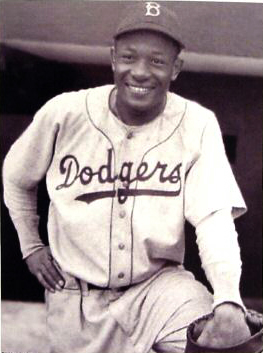
The first black pitcher in the Major Leagues was Dan Bankhead who became Jackie Robinson's teammate on the Dodgers. His debut was on August 26, 1947 where he hit a home run in his first at bat. It would however be his only big league home run, for as great a pitcher as he was in the Negro Leagues, he had less success in the majors. No one is entirely sure why but it has been speculated that having grown up in the deep south, he was terrified at the prospect of hitting a white batter with a pitch and the consequences it would bring upon himself and others. As anyone who knows baseball can tell you, it's impossible to be an effective pitcher while fearing to pitch inside to a batter. Years later, Bankhead's son recalled his father telling him that he once had a no-hitter going deep into the game. He then intentionally tossed up a lollipop to the batter who obliged him with a base hit. "It wasn't time yet for a black man to throw a no-hitter" he told his son. Like Home Run Brown, Dan Bankhead's Major League career was short lived.

The old Negro Leagues began to fold shortly after 1947. Still it took a long time for the Majors to fully integrate. In the fifties, for black players who were not of superstar caliber like Willie Mays, Ernie Banks or Henry Aaron, options were drying up. The Yankees would not sign a black player until Elston Howard joined the team in 1955. The Phillies and the Tigers would wait a couple more years. It would take twelve full years after Jackie Robinson played his first game in Brooklyn before every team in the Major Leagues signed their first African American player. That happened when the immortal Pumpsie Green joined the Red Sox in 1959. Talk about a slow train coming.

In regards to Larry Doby, the sports writer Scoop Jackson said the following about the tradition of  every big league ballplayer wearing Jackie Robinson's number 42 jersey on the anniversary of his breaking into the big leagues:
Second place finishers in America are suckers. And so are those who make the story of history less simple than it needs to be. This happens sometimes in America. Those who don't come first or don't do things a certain way get lost. They disappear. 
In an age of historical amnesia where fewer and fewer of us consider history important, an era where many ballplayers, including African American ones barely know about Jackie Robinson, what he did for the game and what he did for them, fewer still know the names Larry Doby, Home Run Brown, Dan Bankhead and countless others.

That's a damned shame.