A copy of the book
Remembering Marshall Field's just came into my possession. It's from the ubiquitous
Images of America series, published by Arcadia Publishing and written by Leslie Goddard. Like all the books in this series, there's no body of text to speak of; words illustrate the photographs, not the other way around. That aside, the photographs are terrific, and even though most of them were taken before I was born (hard to believe), they made my life flash before my eyes.
Nostalgia is a double edged sword; handled correctly it can help us reflect upon our lives, remembering especially the happy times of our past and keeping alive the people and places that made us who we are. On the other hand, if we fall under it's grip, nostalgia can stick us into the past and not let us out. Sometimes the more past we accumulate, the more we want to stay there.
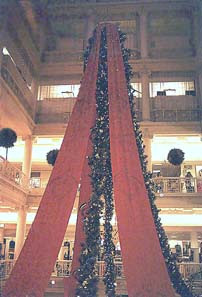 |
| Field's at Christmastime, c. 1977 |
I wrote that last paragraph much for my own benefit as I don't want to believe the past is actually a better place to be than the present. But looking at the pictures in this book make it really difficult.
In case you don't know,
Marshall Field's was a department store whose flagship occupied an entire city block right in the heart of Chicago bounded by State Street on the west, Randolph and Washington Streets on the north and south, and Wabash Avenue on the east. Business was so successful that the company built an annex building to the south to house a store devoted exclusively to men. That men's store alone by today's standards would be considered enormous but back in the day, it paled in comparison to the big store across the street. Even though State Street at one time was the home to at least a dozen big department stores all of them with Chicago roots, Field's was the grandaddy of them all. It alone captured the heart and minds of visitors to this city, as such it was an indelible symbol of Chicago. Marshall Field's was to Chicago what
Higby's was to Cleveland,
Dayton's was to Minneapolis,
Wanamaker's was to Philadelphia,
Filene's was to Boston, and
Macy's was to New York - only much more so.
Those names are only memories now, save for Macy's, which today exists in name alone. The economics of the retail business have changed drastically over the past century, and department stores, at least the great downtown ones, are dinosaurs struggling to survive in the days of strip malls, big box stores and the internet. The few that survive are either very high end stores like Nieman-Marcus and Bloomingdales, or have been absorbed (like Field's) by huge corporations of which there are about three in this country. But even these are struggling big time and in a way it's a small miracle that there are any department stores left. Reluctantly I say that Marshall Fields as a mere shadow of its former self as a Macy's store, is better than having nothing at all.
The other day my mother, wife, children and I found ourselves inside the great State Street store formerly known as Field's, (most life-long Chicagoans still refuse to call the place by the "M" name). My mom reminded me of our days together when I was a child, and Saturdays meant going to the Loop, lunching at any one of the number of eateries all gone now, and ending up at Marshall Field's. If I had a nickel for every hour I spent accompanying her while she did her Saturday stopping, I'd be a rich man today. But my reward would always be a trip to the fourth floor where they had the toy store. It's hard to imagine these days how magnificent that place once was. Half of the entire fourth floor, that is, one half of an entire city block, was devoted exclusively to toys. It was not a toy warehouse like a Toys 'R Us, but a place that was put together with as much creativity and care as the rest of the store which was dedicated to adults. The book has several photographs of that very special place from my childhood, but it also has something even more special. There is a reproduction of a little block print found perhaps in an early catalog (the book doesn't say), which spells out what could be the mission statement of the store's toy department, founded in 1912. It reads:
Toys do for children what literature and art do for their elders-supply the mind with images and develop breadth and activity of thought.
Imagine finding that written at your local WalMart or Target. You certainly won't find it at Macy's/Field's stores anymore which (with the exception of a brief, failed appearance of FAO Schwartz), stopped selling toys on a large scale decades ago.
If Marshall Field's put that much effort into the selling of toys back then, imagine what the rest of the store was like. Old Marshall Field himself coined the motto of his establishment when he told his staff to: "give the lady what she wants." My mother who considers herself an expert on such things, talks about the old store's commitment of service to their customers. "Service keeps getting worse and worse these days" she says, but I always remember her complaining about how the service used to be better; in fact I recall her saying that forty years ago.
Yes, life was always better in the good old days, they even felt that way back in the good old days. Looking at all the wonderful pictures of the Marshall Field's store of bygone days with a critical eye, one begins to notice a few unsettling things. In very few of the pictures, and none of them made before the seventies will you find a person of color, not the customers, nor the staff. With its Gilded Age opulence and style, Marshall Field's reflected its time; it was a place exclusively for upper middle class white people, or in our case, people who strove to become that.
Realistically of course, the good old days weren't all that good. Two World Wars, a Great Depression, the lack of equal rights not only for minorities but for women, were facts of the past we wouldn't particularly choose to re-live. Not to mention polio, smallpox, TB, and other horrible diseases that had yet to be eradicated, and scores of other facts of life that we no longer have to deal with. Even during the "golden years" of my childhood, the Vietnam War, race riots, the disintegration of American cities and the crumbling of other worthwhile institutions, are all things few of us want to revisit.
That's the thing about the past, it's certainly a nice place to visit, but none of us should want to live there. That's not to say we can't learn from the past, especially from the things they did better back then. I have a cousin who comes from the marketing world. When I expressed my objection about the parent company of Macy's converting Marshall Field's into another Macy's, he assured me it was a prudent business decision. It's important he said, that they shore up their corporate image, including replacing the traditional Field's green with Macy's red. It was all a matter of looking at the big picture he said.
I'm not convinced. These are things stockholders like to hear. While they may be pleased, I'm not sure the customers are. For years Marshall Field's took measures to insure their success by nurturing their customer base by providing the best possible service. The care they extended even to the toy section was not frivolous, they were catering to their future customers. It worked well for generations, and it worked for me. Until the store became a Macy's, I was a regular customer of Marshall Field's. Today I can't say I no longer set foot in the place, I go there mostly these days to use the bathroom. But I can't for the life of me remember the last time I actually bought something at Macy's.
I don't think I'm alone.


 ,
,